
A video image exposure adjustment method
An adjustment method and video image technology, applied in the field of image processing, to achieve the effect of keeping the saturation consistent
- Summary
- Abstract
- Description
- Claims
- Application Information
AI Technical Summary
Problems solved by technology
Method used
Image



Examples
Embodiment 1
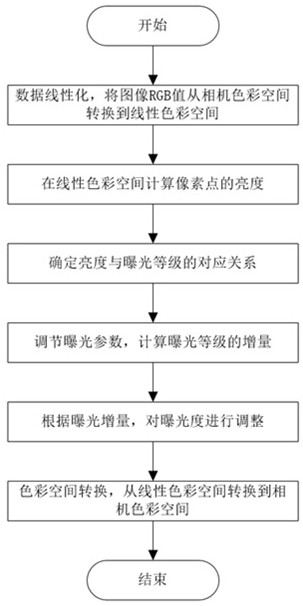
[0062] Embodiment 1: as figure 1 As shown, this embodiment provides a video image exposure adjustment method, including steps:
[0063] S1, according to the color space category of the material, linearize the data of the RGB channel of the material, and convert the data into linear;
[0064] S2, in the linear color space, calculate the brightness value of the pixel;
[0065] S3, calculating the exposure level corresponding to the brightness value of the pixel;
[0066] S4, calculating an exposure increment according to the exposure adjustment parameter and the exposure level;
[0067] S5, adjusting the exposure of the pixel according to the increment of the exposure;
[0068] S6, performing Gamma calculation on the data after the exposure adjustment, and converting the data from the linear color space to the camera color space.
Embodiment 2
[0069] Embodiment 2: On the basis of Embodiment 1, in step S1, include sub-steps:
[0070] S11, determine the camera color space used when shooting the material, and determine the category of the camera's photoelectric transfer function OETF;
[0071] S12, using The function linearizes the RGB channel data of the material, and converts the RGB data into a linear color space. The conversion formula is as follows:
[0072]
[0073] In the formula, Represents the inverse function of the photoelectric conversion function of the camera; Indicates the value on the RGB channel of the material; Represents the value of the RGB channel converted to the linear color space after linearization.
Embodiment 3
[0074] Embodiment 3: On the basis of Embodiment 1, in step S2, calculating the pixel brightness includes adopting the following brightness calculation formula:
[0075]
[0076] In the formula, Represents the brightness value of a pixel in a linear color space; , , Respectively represent the values on the R, G, and B channels of the pixel points converted to the values in the linear color space; , , Respectively represent the weight coefficients of the R, G, and B channels.
PUM
 Login to View More
 Abstract
Description
Claims
Application Information
 Login to View More