Household appliance comfort simulation natural wind test device and test method

A technology of household appliances and testing methods, which is applied in the direction of measuring devices, testing of machine/structural components, instruments, etc., can solve the problems of no unified testing method, no ventilation and simulation of natural wind for the comfort of electrical appliances, etc. Good social needs, the effect of meeting social needs

CN114199603APending Publication Date: 2022-03-18CHEARI BEIJING CERTIFICATION & TESTING
0 Cites 0 Cited by

Patent Information

Authority / Receiving Office
CN · China
Patent Type
Applications(China)
Current Assignee / Owner
Publication Date
2022-03-18

Smart Images

  • Figure 1
    Figure 1
  • Figure 2
    Figure 2
  • Figure 3
    Figure 3
Patent Text Reader

Abstract

The invention discloses a household electrical appliance comfort simulation natural wind test device and a test method. Whether the air outlet of a tested sample reaches the comfort simulation natural wind effect can be assessed. The natural wind simulation test method for the comfort of the household appliance comprises the following steps: firstly, acquiring a wind speed-time curve of the air outlet of the household appliance (such as an air conditioner, an electric fan, an air purifier, a ventilator, a fresh air system, a warm air blower and the like), and then analyzing and calculating the curve to obtain a power spectral density index and a phase diagram width-to-length ratio of the curve; and whether the outlet wind achieves the natural wind effect or not is checked through the power spectrum density index and the phase diagram width-to-length ratio. According to the household appliance comfort simulation natural wind test method, the use comfort of a tested sample is evaluated by checking items such as vertical air temperature difference, blowing feeling index, predicted average thermal feeling index, predicted unsatisfaction rate, temperature uniformity and equivalent temperature of a thermal dummy in multiple laboratories, so that the industry development is guided, the product variety is reasonably developed, and the product quality is improved. And the social requirements can be better met.
Need to check novelty before this filing date? Find Prior Art

Description

technical field

[0001] The invention relates to the technical field of electric appliance testing, in particular to a test device and a test method for simulating natural wind comfort of household appliances. Background technique

[0002] As the saying goes, the more natural, the more vivid, and the wind is no exception. The wind blown by traditional electric fans is very blunt, which makes people feel uncomfortable, but everyone will feel comfortable with the gusts of wind blown by nature. The problem is that the natural wind is different from the wind blown by electric fans, which makes many people choose air conditioners instead of fans.

[0003] At present, most of the air-supply household appliances such as air conditioners, fans, fresh air fans, and heaters used in indoor environments are mechanical air supply modes that only have directional, swinging air supply, and wind speed selection changes. Its air outlet or fan position Fixed, the cross-sectional area of ​​th...

Examples

Embodiment Construction

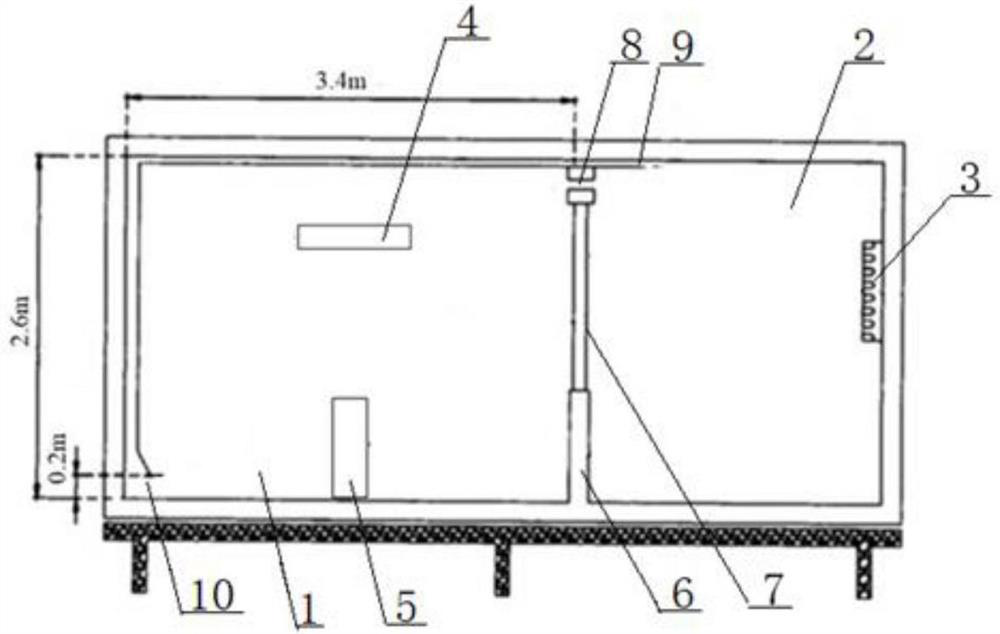
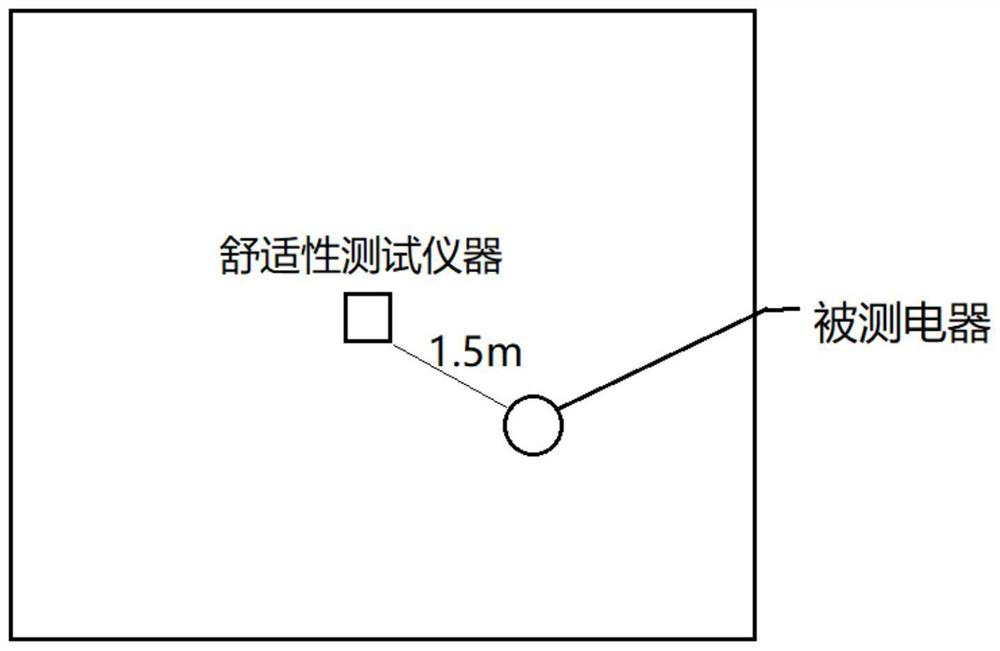
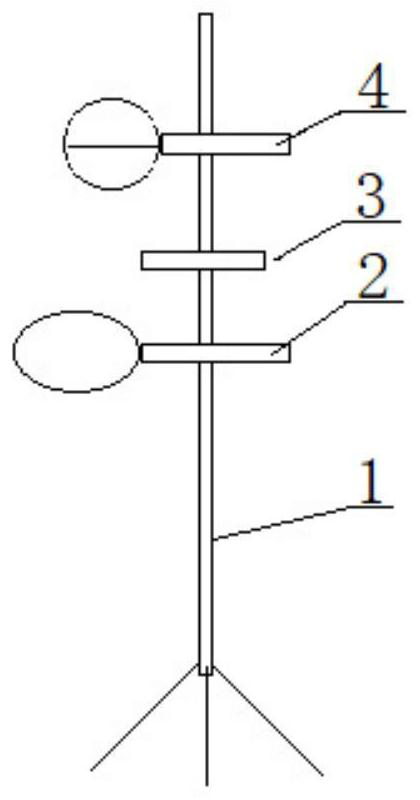
[0131] Household appliance comfort simulation natural wind testing device provided by the invention, such as Figure 1-7 shown, including:

[0132] 1) Climate laboratory (including outer chamber and inner chamber), 2) Test computer, 3) Temperature uniformity acquisition device (including temperature acquisition sensor, data collector GM10-1), 4) Comfort testing device (including universal anemometer, blackbody mean radiant temperature sensor, and air humidity transmitter).

[0133] climatic laboratories such as figure 1 As shown, it is composed of an inner chamber simulating the temperature of the inner room and an outer chamber simulating the outdoor temperature, and the temperature required by the inner chamber is generated by changing the temperature of the outer chamber. The laboratory is 4m long, 4m wide, 2.4m high, and 40m in volume 3 . There is a wall at least 3m x 1.5m on the outer wall, with a thermal conductivity not greater than 3W / (m 2 K) glass windows, the he...