[0009]A primary object of the invention is to prevent these disadvantages for metering units of the construction type as described in WO 2013 / 186175 A1 and to enable a simply and cost-effectively realizable adjustability of the rotating metering disks to different grain sizes and / or grain contours. In particular, the metering units should be customizable and convertible to different grain types, grain sizes, and / or grain contours at a reduced logistic effort and such that the respectively best possible separation quality can be obtained when sowing different grain types, grain sizes, and / or grain contours. Thereby, it is also intended to maintain the attainable release precision and / or the grain spacing in a volumetric grain conveyance to such an extent that the grain metering approximates or ideally reaches a single grain metering with regard to its separation quality, while at the same time a high grain volume flow should be enabled, and this preferably with a structure that continues to be simple and not very prone to failure and with a simple mode of operation, as is characteristic of volumetrically metering seed-drill machines.
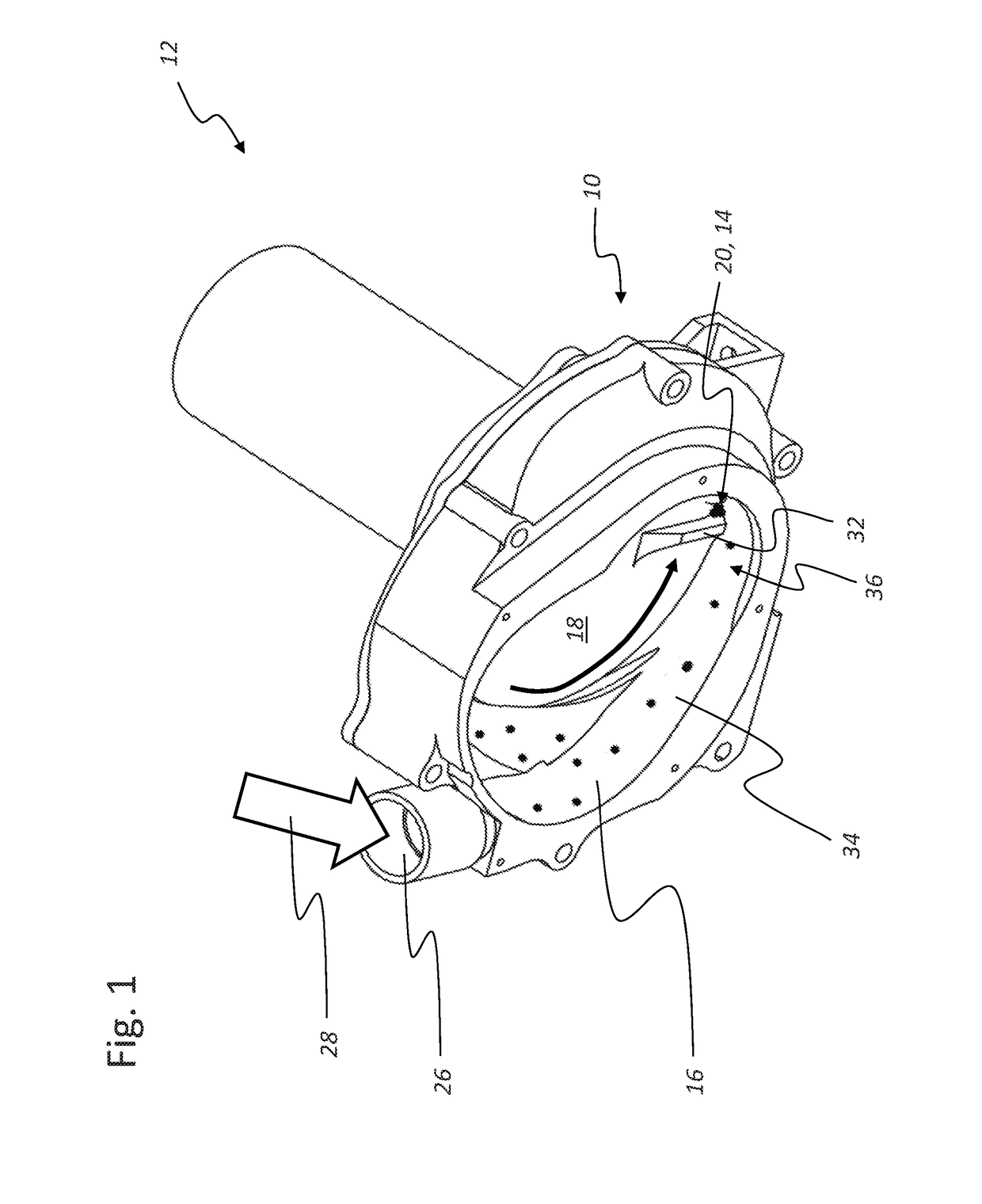
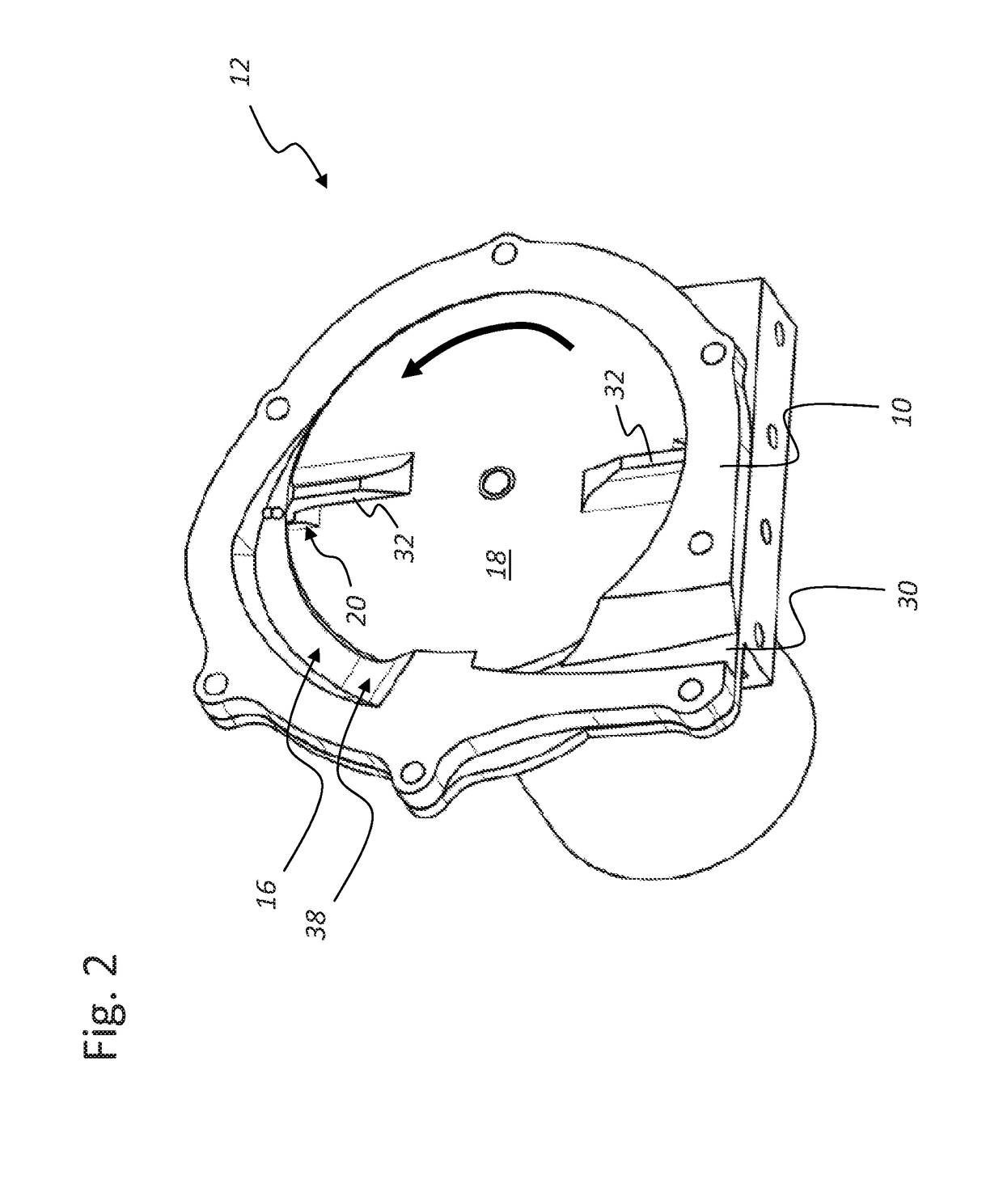
[0011]The metering unit itself, in which the conveyor disk according to the invention rotates, can be, in particular, a unit of the construction type as is described in WO 2013 / 186175 A1. For such metering units, the invention supplies a simple and cost-effective adjustment to different grain sizes and / or grain contours. In this manner, the correspondingly equipped metering unit can, in particular, be customized and converted for different grain types, grain sizes, and / or grain contours at a highly reduced logistic effort without having to respectively replace the complete conveyor disks. The replaceable inserts in the conveyor disk, which remains mounted, can ensure the respectively best possible separation quality when sowing different grain types, grain sizes, and / or grain contours. In this way it is additionally possible to maintain the respectively realizable release precision and / or the grain distances to be realized in a volumetric grain conveyance to such an extent that the grain metering thereby approximates or ideally reaches a single grain metering with regard to its separation quality, while a high grain volume flow is enabled at the same time. At the same time, metering units are thus provided that are structured in a simple manner and that are hardly prone to failure.
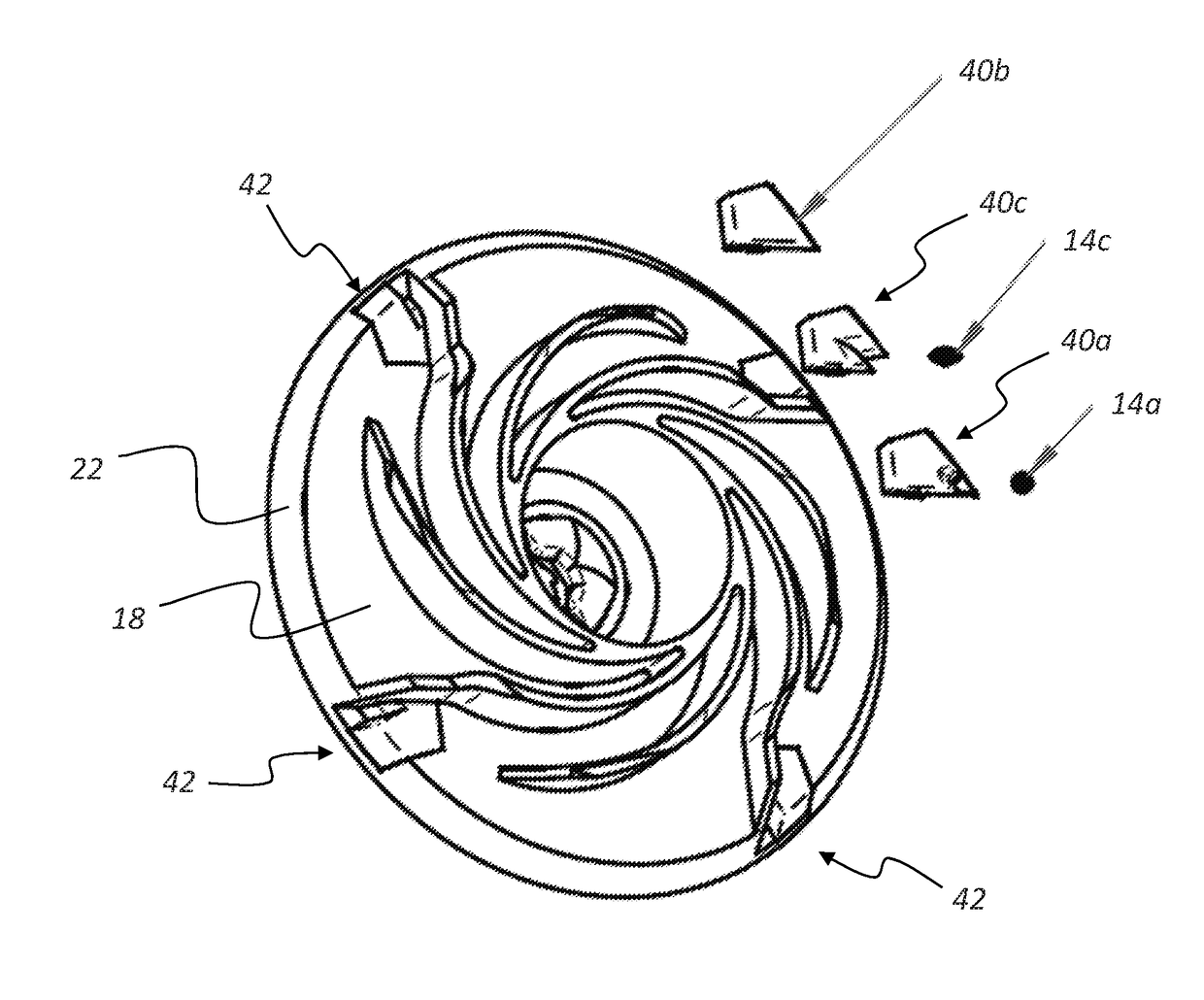
[0014]In this manner, a universal structure for the metering member or the metering unit is accomplished with a replaceable component, which makes it possible to flexibly respond and adjust to different seed types and sowing quantities. The replaceable inserts can thus be adjusted to the respective seed type with regard to their contours and sizes. The inserts additionally allow reacting to varying quantitative requirements.
[0016]Each of the snap-in receivers can have an approximately rectangular or trapezoidal contour for the approximately flush reception of one insert element respectively in the conveyor disk. It can also be provided that each of the snap-in receivers has guide elements for the respective insert element that is lockable therein, with the guide elements having an insertion direction and a removal direction that is directed approximately radial or approximately axially parallel in relation to the conveyor disk. The plug connections thus created for the toollessly detachable and lockable insert elements additionally secure their precise positioning and prevent incorrect fitting.
[0017]In addition, at least one of the insert elements can preferably be formed by two or more insert elements being distributed over the periphery of the conveyor disk as a cover element without a shoulder or recess and fitting flush with the conveyor disk contour. In this manner, the number of recesses provided at the periphery of the conveyor disk can be reduced according to requirements. Not only different sizes and / or different contours of the recesses are thus possible, but it is also possible to employ so-called blind pockets. Employing so-called blind pockets can be particularly useful if a reduction of the grain throughput is desired, which however cannot be realized by a corresponding reduction of the conveyor disk's rotational speed because the conveyor disk should not rotate too slow, for instance, in order to not affect the separation quality. In this manner, the disk's rotational speed can be maintained in a beneficial range, which is necessary for an optimum conveying quality and separation quality of the conveyor disk interacting with the inner cover surface.


 Login to View More
  Login to View More