Outlet add-on module

a technology of add-on modules and outlets, which is applied in the direction of power distribution line transmission, connection contact member materials, coupling device connections, etc., can solve the problems of inadequacies, inability to adapt to the needs of existing buildings, and inability to install new wiring infrastructure, etc., to achieve the effect of easy and simple upgrading of outlets

US20050180561A1Inactive Publication Date: 2005-08-18CONVERSANT INTPROP MANAGEMENT INC
99 Cites 108 Cited by

Patent Information

Authority / Receiving Office
US · United States
Patent Type
Applications(United States)
Current Assignee / Owner
Publication Date
2005-08-18
Estimated Expiration
Not applicable · inactive patent

Smart Images

  • Figure 1
    Figure 1
  • Figure 2
    Figure 2
  • Figure 3
    Figure 3
Patent Text Reader

Abstract

A method and an apparatus for upgrading an existing service outlet (e.g. LAN, telephone, power or CATV outlet) in a house by adding functionality thereto. The functionality is added by an add-on module, connected electrically and secured mechanically to the existing outlet. Several attachment devices are exampled, including surface attachment, side clamping, snap locking, strap securing and fastening screws. The add-on module may include a service connector for retaining the basic existing outlet function. The module may be attached in a permanent way or by using a detachable solution.
Need to check novelty before this filing date? Find Prior Art

Description

FIELD OF THE INVENTION

[0001] The present invention relates to the field of wiring using outlets, and, more specifically, to an add-on module for adding functionality to such outlets. BACKGROUND OF THE INVENTION

[0002] Outlets

[0003] The term “outlet” herein denotes an electromechanical device, which facilitates easy, rapid connection and disconnection of external devices to and from wiring installed within a building. An outlet commonly has a fixed connection to the wiring, and permits the easy connection of external devices as desired, commonly by means of an integrated connector in a faceplate. The outlet is normally mechanically attached to, or mounted in, a wall or similar surface. Non-limiting examples of common outlets include: telephone outlets for connecting telephones and related devices; CATV outlets for connecting television sets, VCR's, and the like; outlets used as part of LAN wiring (a.k.a. structured wiring) and electrical outlets for connecting power to electrical a...

Examples

Embodiment Construction

[0109] The principles and operation of a network according to the present invention may be understood with reference to the drawings and the accompanying description. The drawings and descriptions are conceptual only. In actual practice, a single component can implement one or more functions; alternatively, each function can be implemented by a plurality of components and circuits. In the drawings and descriptions, identical reference numerals indicate those components that are common to different embodiments or configurations.

[0110] Module.

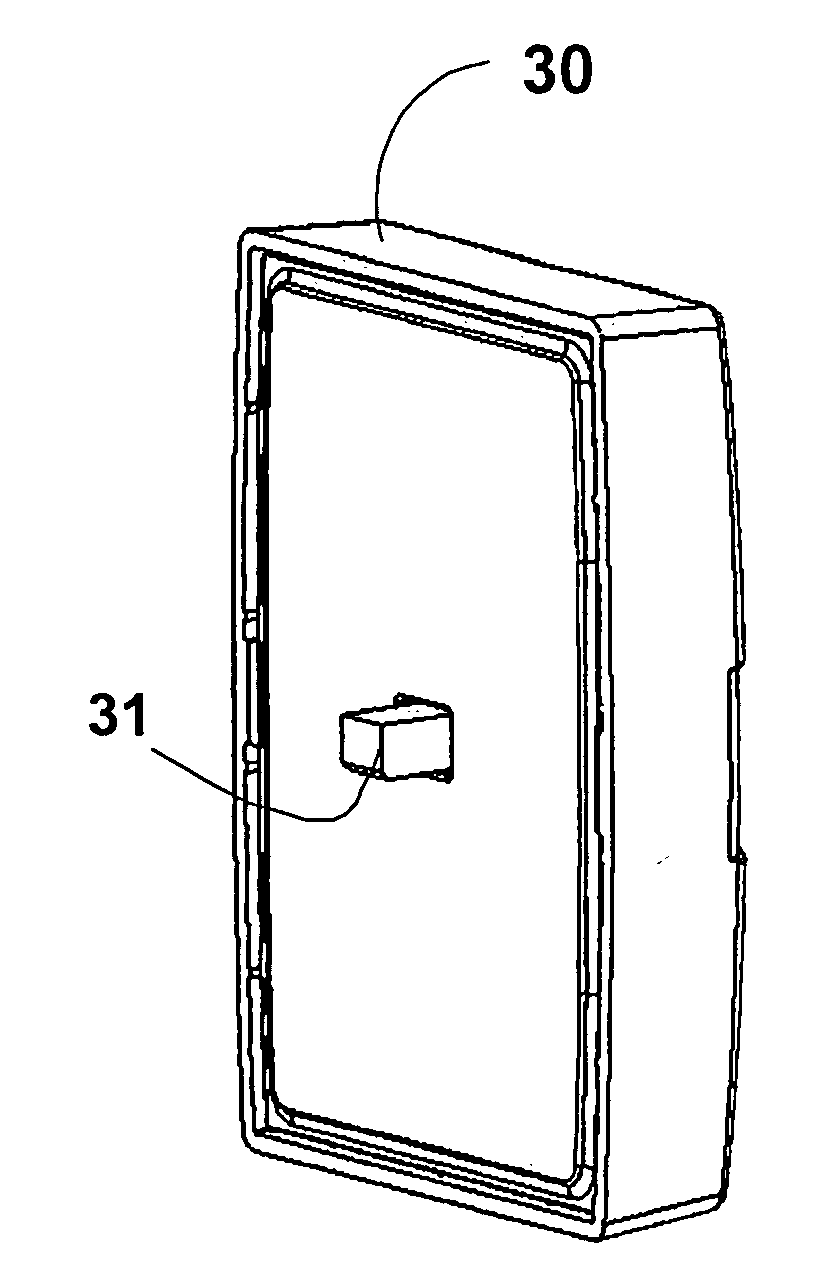
[0111] The present invention relates to a module that both connects electrically to an existing outlet and is also mechanically attached thereto. For the sake of simplicity, the invention will be herein first described with respect to a module for use in conjunction with a telephone outlet, in order to provide the electrical connection thereto. Front and rear views of a basic exemplary telephone module 30 are respectively shown in FIG. 3b and 3...