
Message delivery and playback
a message and playback technology, applied in the field of message delivery and playback, can solve the problems of large computing resources and the inapplicability of the advertisement model to voip communications, and achieve the effect of reducing the number of messages and playingback
- Summary
- Abstract
- Description
- Claims
- Application Information
AI Technical Summary
Benefits of technology
Problems solved by technology
Method used
Image

Examples
example 1
Exemplary Messages
[0016] In any of the examples herein, messages refer to information delivered to users by end-user communication devices. For example, a message can be an advertising message (e.g., a message advertising the products and / or services of a business or organization). A message can also be an announcement, alert, notification, or another type of non-advertising message.
[0017] Messages can be of a variety of types or formats. For example, messages can be text messages (e.g., static or scrolling text messages), audio messages (e.g., comprising spoken words and / or music), video messages, or a combination.
[0018] Messages can be organized by category. For example, advertising messages relating to insurance products or services can be arranged in categories such as: automobile insurance, homeowners insurance, life insurance, and the like.
example 2
Exemplary End-User Communication Device
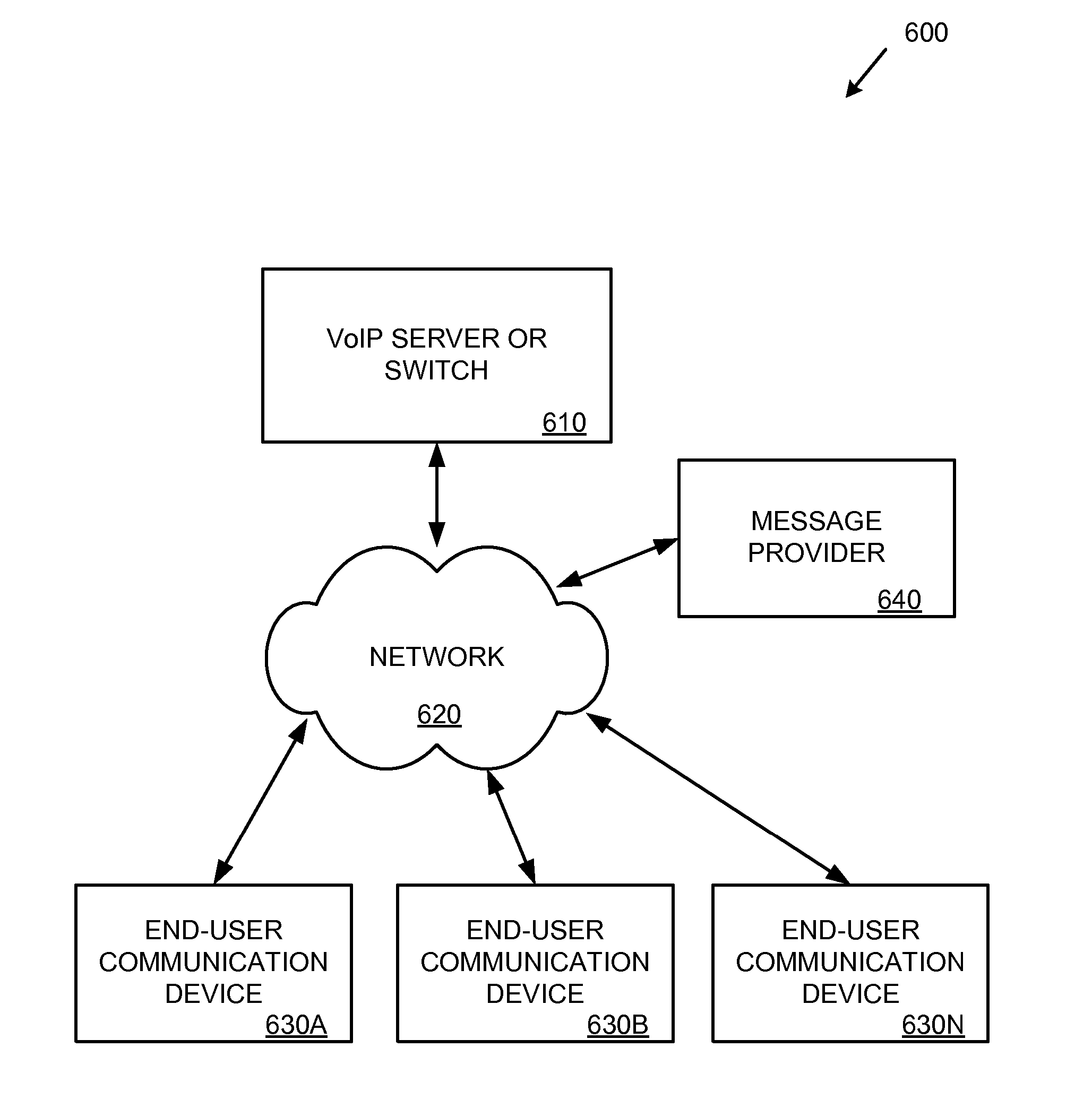
[0019] In any of the examples herein, an end-user communication device can be a communication device used for placing calls and playing back messages. For example, an end-user communication device can be a phone, such as a cell phone, mobile phone, smart phone, PDA phone, or the like. The end-user communication device can also be a Voice over Internet Protocol (VoIP) device. For example, the end-user communication device can be a computing device, such as a desktop computer, laptop computer, tablet computer, or PDA, with software enabling the computing device to make VoIP calls over the Internet.
[0020] In a specific implementation, the end-user communication devices include Internet Protocol (IP) connectivity for receiving messages and sending information (e.g., an IP-enabled end-user communication device). For example, IP connectivity can be provided over an IP computing network (e.g., the Internet) or over other types of communication netwo...
example 3
Exemplary Profile
[0024] In any of the examples herein, a profile can store information related to a user of an end-user communication device. For example, a user can sign up for a communication service (e.g., mobile phone service or VoIP service). Upon signing up, or at a later time, the user can enter profile information (e.g., stored by the communication service provider). Profile information can comprise contact information (e.g., name, phone number, address, email address, etc.), specific categories of messages (e.g., advertising messages) that are of interest to the user (e.g., banking services, financial services, travel, music, sports, etc.), billing information, service preferences, and other types of profile information.
[0025] Profile information can also be entered or edited by a communication service provider. For example, the communication service provider can receive indications of user interest in messages. The interest can be recorded in the user's profile (e.g., th...
PUM
 Login to View More
 Abstract
Description
Claims
Application Information
 Login to View More