Transfer belt for electrophotography and image forming apparatus equipped therewith

Active Publication Date: 2009-01-15
KONICA MINOLTA BUSINESS TECH INC
View PDF12 Cites 2 Cited by
  • Summary
  • Abstract
  • Description
  • Claims
  • Application Information

AI Technical Summary

Benefits of technology

[0010]The objects can be achieved by a transfer belt for electrophotography, which is made from at least a

Problems solved by technology

However, the PPS resin is not necessarily superior in the dispersing property of carbon, resulting in a problem in that upon extrusion-molding, the dispersed state of carbon fluctuates to cause nonuniformity in the conductive property.
When the resistivity fluctuates in the circumferential direction in the transfer belt, hollow defects and scattering occur.

Method used

the structure of the environmentally friendly knitted fabric provided by the present invention; figure 2 Flow chart of the yarn wrapping machine for environmentally friendly knitted fabrics and storage devices; image 3 Is the parameter map of the yarn covering machine
View more

Image

Smart Image Click on the blue labels to locate them in the text.
Viewing Examples
Smart Image
  • Transfer belt for electrophotography and image forming apparatus equipped therewith
  • Transfer belt for electrophotography and image forming apparatus equipped therewith
  • Transfer belt for electrophotography and image forming apparatus equipped therewith

Examples

Experimental program
Comparison scheme
Effect test

example 1

[0087]A mixture of PPS (polyphenylene sulfide: Torelina E2180, made by Toray Industries, Inc.) (86 kg), 6-nylon (made by Toray Industries, Inc.) (3 kg), acidic carbon (made by Degussa GmbH) (10 kg) and acetylene black (made by Denki Kagaku Kogyo Kabushiki Kaisha) (3 kg) was melt-kneaded by a twin-screw extrusion-kneader at 280° C., and the kneaded matter was then left to be cooled off, and pulverized to obtain a resin composition a1 (preliminary melt-kneading process). The resin composition a1 thus obtained was measured on Tg. As a result of the thermal analysis of this resin composition a1, virtually the same graph as that of FIG. 3 was obtained, and Tgs were observed with respect to 6-nylon and PPS respectively. Then, the resin composition a1 was melt-kneaded at 290° C. with the number of screw revolutions of 160 rpm by using a twin-screw extrusion-kneader to which a metal mold die having a slit with a gap distance of 0.9 mm was attached, and after having been extruded through the...

example 2

[0088]A mixture of PPS (polyphenylene sulfide: Torelina E2180, made by Toray Industries, Inc.) (84 kg), 6-nylon (made by Toray Industries, Inc.) (6 kg) and acidic carbon (made by Degussa GmbH) (10 kg) was melt-kneaded by a twin-screw extrusion-kneader at 280° C., and the kneaded matter was then left to be cooled off, and pulverized to obtain a resin composition b1 (preliminary melt-kneading process). The resin composition b1 thus obtained was measured on Tg. As a result of the thermal analysis of this resin composition b1, virtually the same graph as that of FIG. 3 was obtained, and Tgs were observed with respect to 6-nylon and PPS respectively. Then, the resin composition b1 was melt-kneaded at 290° C. with the number of screw revolutions of 160 rpm by using a twin-screw extrusion-kneader to which a metal mold die having a slit with a gap distance of 0.9 mm was attached, and after having been extruded through the slit, the kneaded matter was immersed in water of 24° C. to be quickl...

example 3

[0089]A mixture of PPS (polyphenylene sulfide: Torelina E2180, made by Toray Industries, Inc.) (84 kg), MXD6 (made by Mitsubishi Gas Chemical Co., Inc.) (6 kg) and acidic carbon (made by Degussa GmbH) (10 kg) was melt-kneaded by a twin-screw extrusion-kneader at 290° C. with the number of screw revolutions of 350 rpm, and the kneaded matter was then immersed in water of 24° C. to be quickly cooled, and pulverized so that a resin composition c1 was obtained (first pelt-kneading process). When the resin composition c1 thus obtained was measured on Tg, virtually the same graph as that of FIG. 1 was obtained, and only one Tg was observed at 87° C. The resin composition c1 was extrusion-molded at 300° C. by using a molding machine to which an annular metal mold die was attached so that an intermediate transfer belt (thickness: 105 μm) having a seamless annular shape was obtained (molding process). This intermediate transfer belt was evaluated on the above-mentioned items. Tg of the inter...

the structure of the environmentally friendly knitted fabric provided by the present invention; figure 2 Flow chart of the yarn wrapping machine for environmentally friendly knitted fabrics and storage devices; image 3 Is the parameter map of the yarn covering machine
Login to View More

PUM

No PUM Login to View More

Abstract

A transfer belt for electrophotography comprisesat least a polyphenylene sulfide resin and a conductive agent, preferably further a nylon resin,wherein a deviation in surface resistivity is 1 or less; and an image-forming apparatus comprises a latent-image supporting member, anda transfer member that supports a toner image transferred thereon from the latent-image supporting member and transfer the supported toner image onto an image-receiving material, comprising at least a polyphenylene sulfide resin and a conductive agent, and having a deviation in surface resistivity of 1 or less.

Description

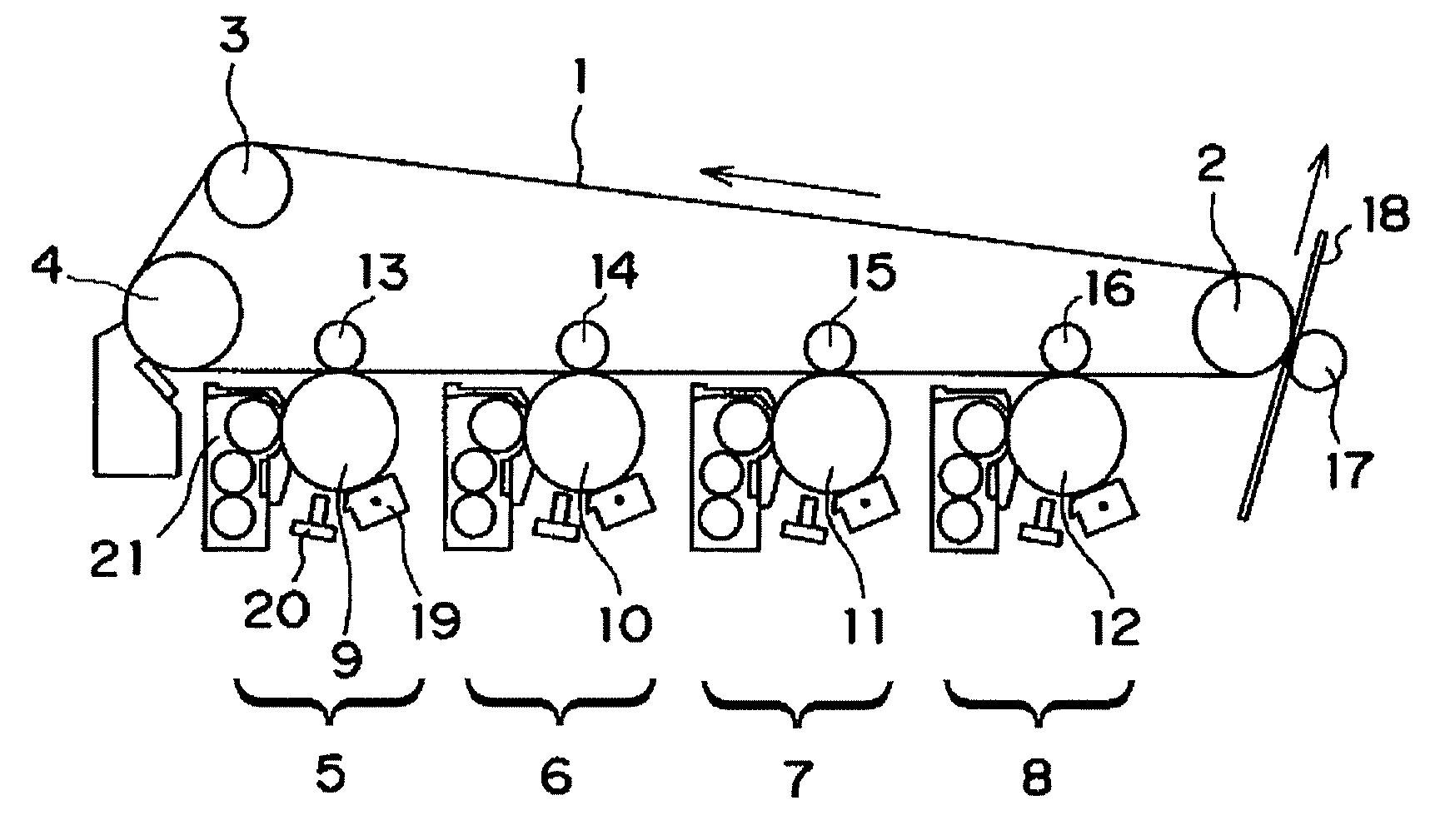
[0001]This application is based on application(s) No. 2007-180690 filed in Japan, the contents of which are hereby incorporated by reference.BACKGROUND OF THE INVENTION[0002]1. Field of the Invention[0003]The present invention relates to a transfer belt for electrophotography and an image-forming apparatus.[0004]2. Description of the Related Art[0005]In an image-forming apparatus in which an electrophotographic system is adopted, an intermediate transfer belt and a direct transfer belt, used for transferring a toner image, are adopted. A conductive agent such as carbon is blended in such a transfer belt and the conductive property of the transfer belt is set within a semiconductor area.[0006]It has been known that a polyphenylene sulfide resin (hereinafter, referred to simply as a “PPS resin”), which has superior characteristics as an engineering plastic material, from the viewpoints of heat resistance, flame resistance and rigidity, is preferably used as a resin forming the transfe...

Claims

the structure of the environmentally friendly knitted fabric provided by the present invention; figure 2 Flow chart of the yarn wrapping machine for environmentally friendly knitted fabrics and storage devices; image 3 Is the parameter map of the yarn covering machine
Login to View More

Application Information

Patent Timeline
no application Login to View More
IPC IPC(8): G03G15/20
CPCG03G7/0013G03G7/004G03G15/162G03G15/161G03G7/0046
InventorKURACHI, YASUO
OwnerKONICA MINOLTA BUSINESS TECH INC