Supercharge Your Innovation With Domain-Expert AI Agents!

Hematopoietic cell culture nutrient supplement

a hematopoietic cell and nutrient supplement technology, applied in the field of hematopoietic cell culture nutrient supplement, can solve the problems of toxic to cells, disadvantageous use of serum in the culture of hematopoietic cells, and inability to define the components contained in animal sera in the cell culture system, so as to increase or enhance increase or enhance the effect of the shelf life of the medium

Inactive Publication Date: 2010-11-25
LIFE TECH CORP
View PDF30 Cites 1 Cited by
  • Summary
  • Abstract
  • Description
  • Claims
  • Application Information

AI Technical Summary

Benefits of technology

[0019]The present invention also specifically provides a serum-free, eukaryotic cell culture medium supplement comprising or obtained by combining one or more ingredients selected from the group consisting of N-acetyl-L cysteine, human serum albumin, Human Ex-Cyte®, ethanolamine HCl, human zinc insulin, human iron saturated transferrin, Se4+, hydrocortisone, D,L-tocopherol acetate, and 2-mercaptoethanol, wherein the ingredients are present in an amount which, when the supplement is added to a basal cell culture medium, supports the expansion of CD34+ hematopoietic cells and cells and cells of myeloid lineage, in serum-free culture.
[0021]The present invention also provides a method of making a serum-free, eukaryotic cell culture medium supplement, the method comprising admixing water, N-acetyl-L cysteine, human serum albumin, Human Ex-Cyte®, ethanolamine HCl, human zinc insulin, human iron saturated transferrin, a Se4+ salt, hydrocortisone, D,L-tocopherol acetate, and 2-mercaptoethanol, wherein each ingredient is present in an amount which, when added to a basal medium, supports the expansion of CD34+ hematopoietic cells and cells of myeloid lineage, in serum-free culture.
[0038]The invention also relates to increasing or enhancing shelf-life of a eukaryotic cell culture medium (preferably a serum-free medium) comprising mixing the medium with a sufficient amount of an antioxidant (preferably N-acetyl-L-cysteine or a derivative thereof) to increase or enhance the shelf-life of the medium.

Problems solved by technology

To date, however, a common requirement, and major disadvantage, of cell culture systems has been the requirement for undefined components contained in animal sera (e.g., fetal bovine serum or horse serum) or in “conditioned cell culture media” for optimal growth.
The use of serum in the culture of hematopoietic cells is disadvantageous for several reasons.
Some lots of serum have been found to be toxic to cells.
Moreover, serum may be contaminated with infectious agents such as mycoplasma, bacteriophage, and viruses.
Finally, because serum is an undefined and variable component of a medium to which serum is added, the use of serum prevents the true definition and elucidation of the nutritional and hormonal requirements of the cultured cells.
However, the pre-screening process is time-consuming and subject to interpretation.
Even after a satisfactory lot is identified, storage of large quantities of pre-screened lots of serum at −20° C. and below is problematic.
Further, a major problem associated with previously available serum-free media is short shelf-life.

Method used

the structure of the environmentally friendly knitted fabric provided by the present invention; figure 2 Flow chart of the yarn wrapping machine for environmentally friendly knitted fabrics and storage devices; image 3 Is the parameter map of the yarn covering machine
View more

Image

Smart Image Click on the blue labels to locate them in the text.
Viewing Examples
Smart Image
  • Hematopoietic cell culture nutrient supplement
  • Hematopoietic cell culture nutrient supplement
  • Hematopoietic cell culture nutrient supplement

Examples

Experimental program
Comparison scheme
Effect test

example 1

Experimental Methods

[0125]In the examples that follow, unless otherwise indicated, the methods of obtaining bone marrow cells, selecting CD34+ cells, assaying cell proliferation, and flow cytometry assays were performed as described in this Example.

Bone Marrow Cells

[0126]Bone marrow was obtained from a population of screened normal donors (courtesy of Roswell Park Cancer Institute). Marrow was aspirated from the posterior iliac crest and placed into sterile heparinized tubes. In the laboratory, approximately 25 mL of heparinized bone marrow was diluted with an equal volume of Hank's Balanced Salt Solution (without calcium or magnesium) (Life Technologies, Gaithersburg, Md.) and carefully layered over Nycoprep™ 1.077 (Life Technologies) in 50 mL tubes. Samples were then centrifuged at 800×g for 30 minutes at room temperature. After centrifugation, the band of bone marrow mononuclear cells (BMMC) at the interface was removed by pipetting. Cells were washed once with Hank's Balanced Sa...

example 2

Proliferation of CD34+-Selected Cells Under Serum-Free Culture Conditions

[0133]In order to study the ability of CD34+ cells to expand and differentiate under various culture conditions, CD34+ cells were selected from normal donor bone marrow. Initially, 1.3% of the total bone marrow cells were CD34+ (Table 4), in agreement with reported values (Cinin, C. I. et al., J. Immunol. 133:157 (1984)). The selection process enriched CD34+ cells to 64% from 1% in freshly aspirated normal bone marrow cells.

[0134]The absence of serum allows the study of the effect of early-acting or late-acting hematopoietic growth factors on cell expansion. Various combinations of human recombinant cytokines were examined for their ability to support proliferation (Table 5). Using StemPro-34™ SFM, it was possible to stimulate variable degrees of cell proliferation, in the absence of the confounding effects of serum, by altering the combinations of growth factors employed.

[0135]In preliminary studies, stem cell...

example 3

Kinetics of CD34+ Cell Expansion

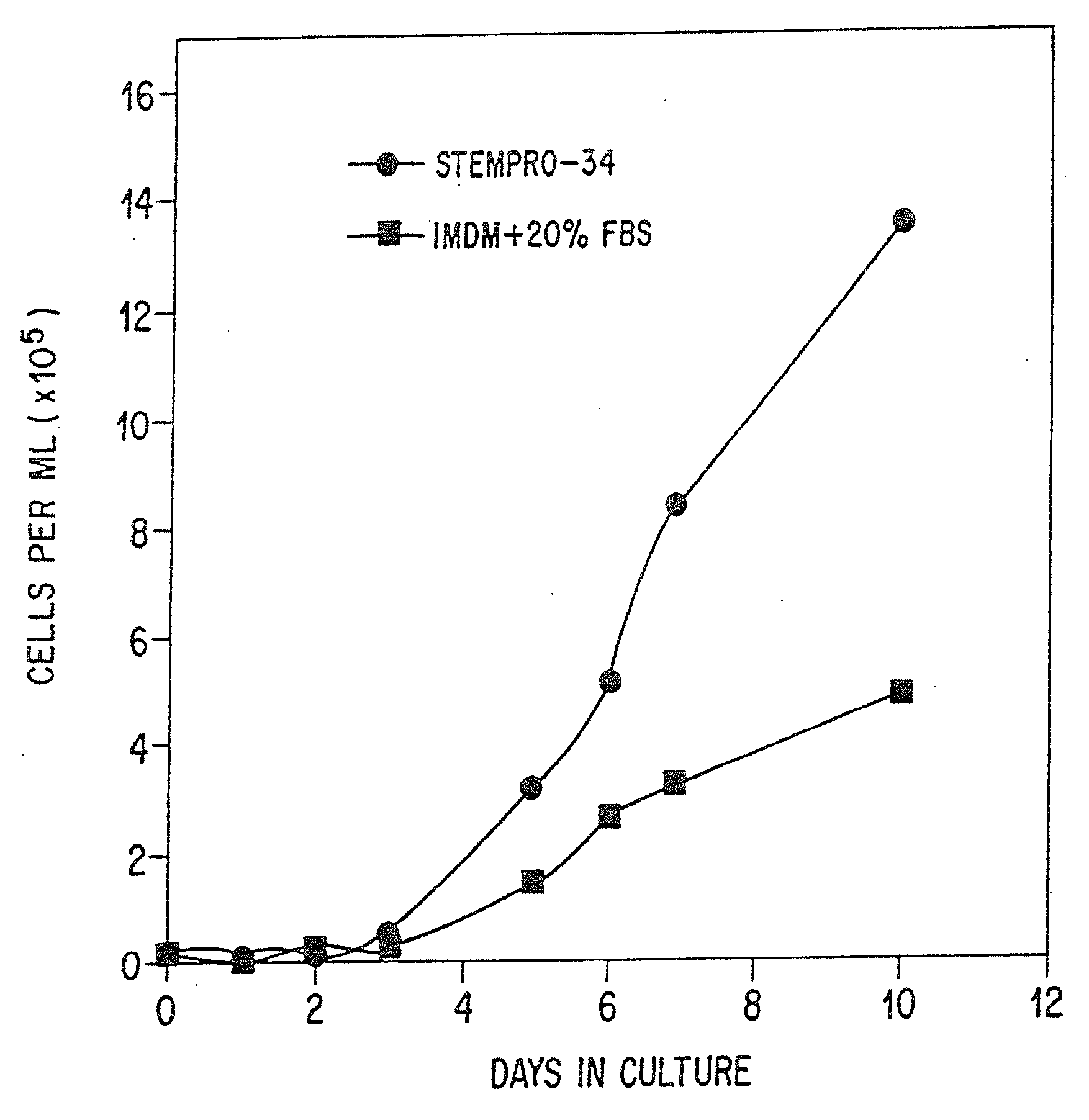
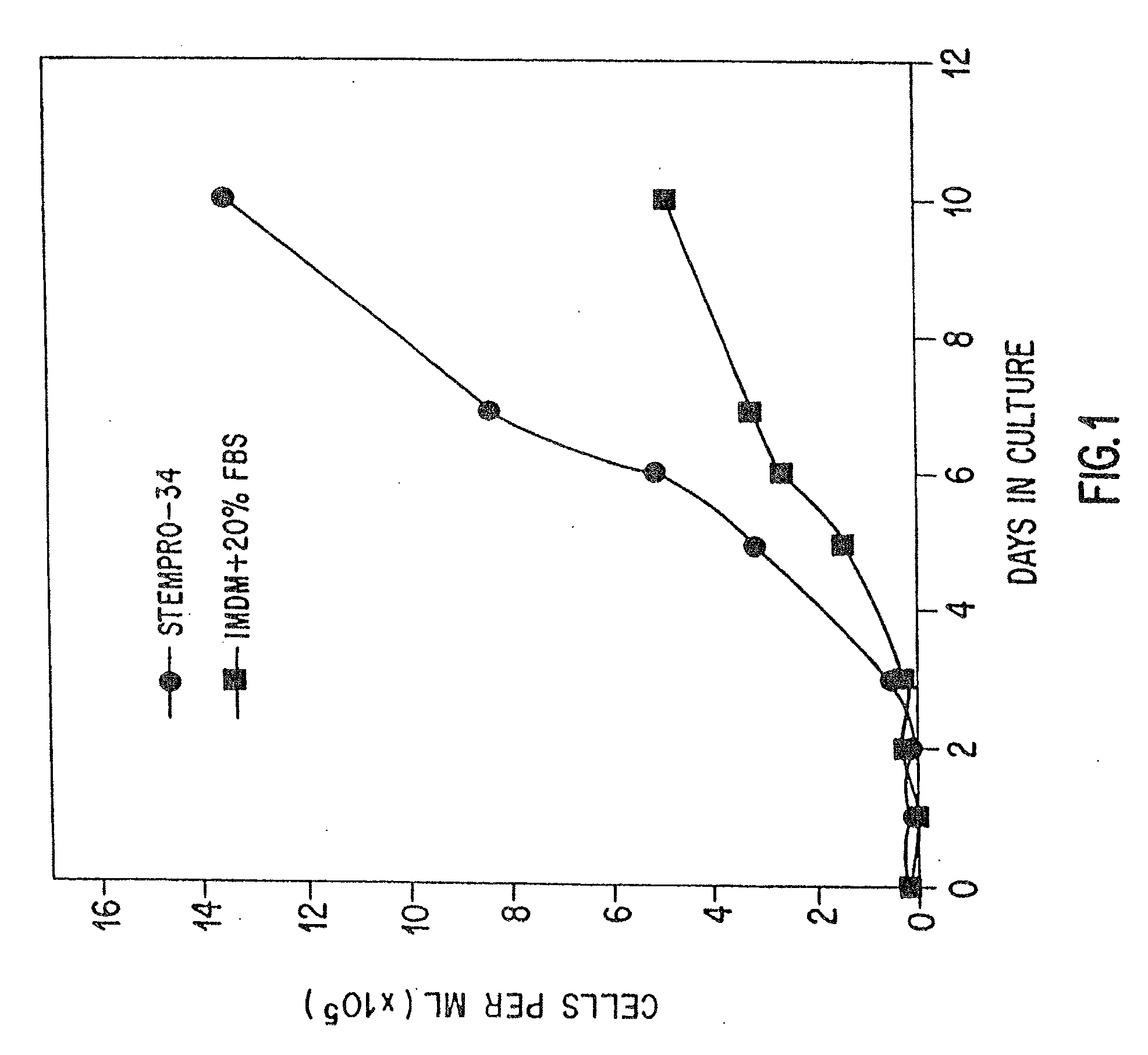
[0137]The kinetics of cell expansion in StemPro34™ SFM were compared to the kinetics of cell expansion in serum-containing medium. CD34+ bone marrow cells were seeded at an initial density of 2×10⁴ cells / well in 24 well plates. Final concentrations of human recombinant factors SCF (100 ng / mL), IL-3 (50 ng / mL) and GM-CSF (25 ng / mL) were added to either StemPro™-34 SFM or IMDM / 20% FBS at setup. On the days indicated, wells were harvested and the cells counted using a hemocytometer and trypan blue dye exclusion. Results are depicted in FIG. 1.

[0138]In both StemPro34™ SFM and the serum-supplemented cultures, an initial lag phase (about 3 days) was observed to precede cell expansion. This initial lag phase may reflect experimental observations that the majority of hematopoietic stem cells (i.e., CD34+ / CD33− / CD38−) are in a quiescent G0 state and require stimulatory signals for expansion and subsequent differentiation (Traycoff, C. M. et al., Exp. Hematol. ...

the structure of the environmentally friendly knitted fabric provided by the present invention; figure 2 Flow chart of the yarn wrapping machine for environmentally friendly knitted fabrics and storage devices; image 3 Is the parameter map of the yarn covering machine
Login to View More

PUM

PropertyMeasurementUnit
storage temperaturesaaaaaaaaaa
concentrationaaaaaaaaaa
Login to View More

Abstract

The present invention provides a serum-free supplement which supports the growth of hematopoietic cells in culture. Also provided are a medium comprising a basal medium supplemented with the serum-free supplement of the present invention. The present invention also provides methods for culturing and for differentiating hematopoietic cells.

Description

FIELD OF THE INVENTION[0001]The present invention relates to a replacement for the serum supplementation normally required for ex vivo expansion of CD34+ hematopoietic cells and cells of myeloid lineage.BACKGROUND OF THE INVENTION[0002]Blood cells in the mammal can be divided into three main categories or families: red cells, white cells of myeloid lineage, and white cells of the lymphocytic lineage. Red blood cells carry oxygen from the lungs to the tissues and cells of the body and transport CO2 from the tissues and cells back to the lungs for elimination. White cells of myeloid lineage include: neutrophils, basophils, eosinophils, megakaryocytes, monocytes / macrophages, and dendritic cells. These cells play a role in the identification and elimination of foreign organisms (e.g. bacteria) or damaged tissue, cells and substances from the body. White cells of lymphocytic lineage are divided into two main subgroups: T lymphocytes (helper cells, killer cells, suppressor cells), which a...

Claims

the structure of the environmentally friendly knitted fabric provided by the present invention; figure 2 Flow chart of the yarn wrapping machine for environmentally friendly knitted fabrics and storage devices; image 3 Is the parameter map of the yarn covering machine
Login to View More

Application Information

Patent Timeline
no application Login to View More
Patent Type & Authority Applications(United States)
IPC IPC(8): A61K35/12C12N5/071C12N5/078A61P43/00A61K35/28C12N5/10C12N5/02C12N5/0789
CPCC12N5/0647C12N2500/25C12N2500/32C12N2500/36C12N2501/39C12N2500/99C12N2501/125C12N2501/23C12N2500/38C12N2500/90A61P43/00
Inventor DALEY, JOHN P.DADEY, BARBARA M.BIDDLE, WILLIAM C.WYSOCKI, MICHELLE G.
Owner LIFE TECH CORP
Features
  • R&D
  • Intellectual Property
  • Life Sciences
  • Materials
  • Tech Scout
Why Patsnap Eureka
  • Unparalleled Data Quality
  • Higher Quality Content
  • 60% Fewer Hallucinations
Social media
Patsnap Eureka Blog
Learn More