However,
polymerization toner has such a drawback as not to be easily removed from a photoreceptor by a cleaning blade.
However, as disclosed in Japanese published unexamined application No.
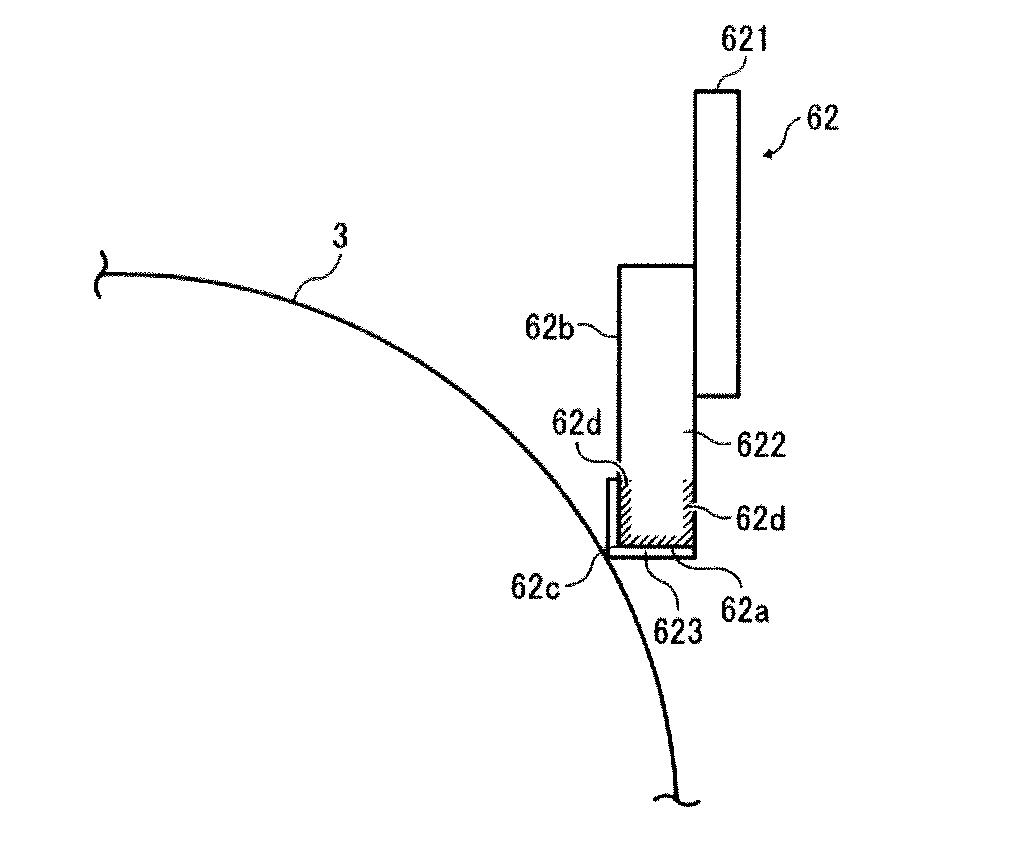
In this regard, the thus everted tip has a
restoring force, and therefore the tip tends to vibrate, resulting in generation of fluttering sounds.
However, even when the above-mentioned cleaning blades are used, occurrence of the above-mentioned problems is hardly prevented if images having a high
image area proportion (such as image having large
solid images) are continuously produced (i.e., if the amount of residual toner on a photoreceptor to be removed by the cleaning blade is large).
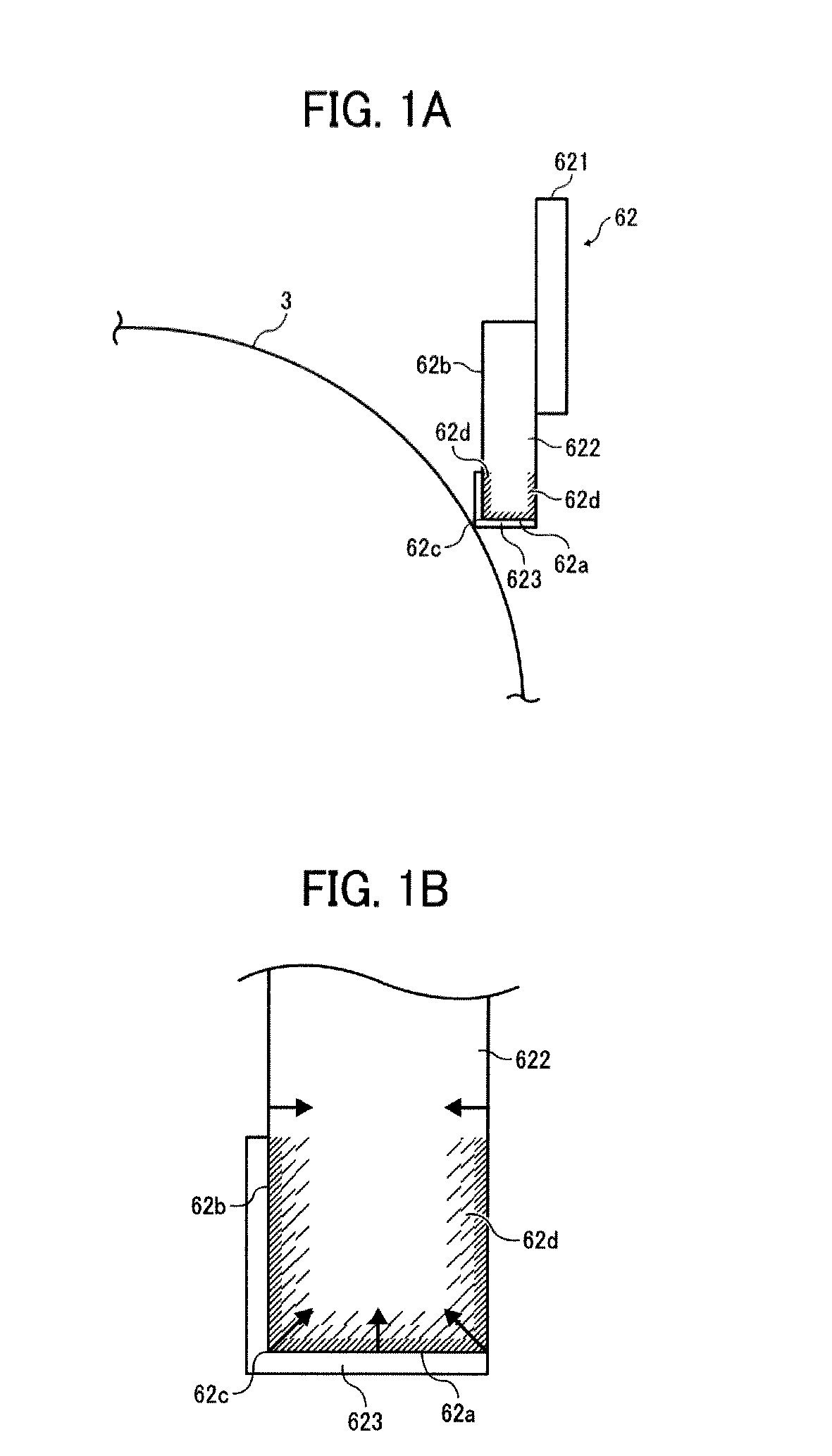
Specifically, since the blade has a cover layer on the tip thereof or includes a crosslinked material in a surface portion thereof in the longitudinal direction thereof, the elastic property of the rubber of the blade tends to deteriorate.
In addition, when images having high
image area proportions are continuously produced and a large amount of residual toner is present on the surface of the photoreceptor, the large amount of toner is collected at the tip of the blade by being blocked by the blade.
In this case, the residual toner at the tip of the blade tends to pass through a relatively large gap formed between a portion of the blade and the surface of the photoreceptor, which are contacted with each other at a relatively low pressure due to eccentricity of the photoreceptor or waving of the surface thereof, resulting in occurrence of the above-mentioned abnormal image problem.
Such an elastic blade deteriorates in elasticity and followability to eccentric variation of a photoreceptor, resulting in poor
cleanability.
Then, when the
surface layer thickness is made thicker, the elastic blade deteriorates in elasticity and followability to eccentric variation of a photoreceptor, resulting in poor
cleanability.
However, when a large amount of the
ultraviolet crosslinkable material is impregnated, the impregnated part is formed too hard and deep, resulting in deterioration of elasticity of the elastic blade.
Therefore, the edge line of the cleaning blade deteriorates in followability to the surface of a photoreceptor, resulting in poor
cleanability.
In addition, when a cleaning blade having an edge line harder than the elastic blade is used, the surface of a photoreceptor is abraded earlier than when only the elastic blade is used, resulting in deterioration of
image quality such as background
fouling.
Hard
layers contact each other with friction, abrasion of the cleaning blade or the photoreceptor is accelerated as time passes, resulting in poor cleanability.


 Login to View More
  Login to View More