Reputation System in a Default Network

US20150101008A1Active Publication Date: 2015-04-09FOXWORDY
10 Cites 40 Cited by

Patent Information

Authority / Receiving Office
US · United States
Patent Type
Applications(United States)
Current Assignee / Owner
Publication Date
2015-04-09

Smart Images

  • Figure 1
    Figure 1
  • Figure 2
    Figure 2
  • Figure 3
    Figure 3
Patent Text Reader

Abstract

A system and a method are disclosed for computing a reputation score for user profiles of a social network according to actions taken by user profiles of the social network. The reputation score may be based on interactions of a user profile with a content item or based on interactions of user profiles with other user profiles. Actions may be weighted differently in calculating a reputation score as a sum of products of action counts and actions weights. Reputation scores calculated may be used to rank user profiles and to determine reputation levels for user profiles based on exceeding a threshold in reputation score or reputation ranking.
Need to check novelty before this filing date? Find Prior Art

Description

CROSS REFERENCE TO RELATED APPLICATIONS

[0001] This application claims the benefit of U.S. Provisional Application No. 61 / 889,009, filed Oct. 9, 2013, which is incorporated by reference in its entirety.BACKGROUND

[0002] 1. Field of Art

[0003] The disclosure generally relates to the field of social networking, and more particularly, to quantifying user reputation in a social network computing system.

[0004] 2. Description of the Related Art

[0005] Professionals in a work environment may judge the quality of each other's work and advice based on prior experiences with a colleague giving advice as well as knowledge about the colleague's expertise. In interactions with an unmet interlocutor through a website or a social network, professionals have little information to judge the quality of advice, opinions, or work received. Additionally, many website and social networks allow the use of full anonymity through pseudonyms that may entirely obscure an interlocutor's identity. Interlocutors may clai...

Examples

example architectural

Configuration

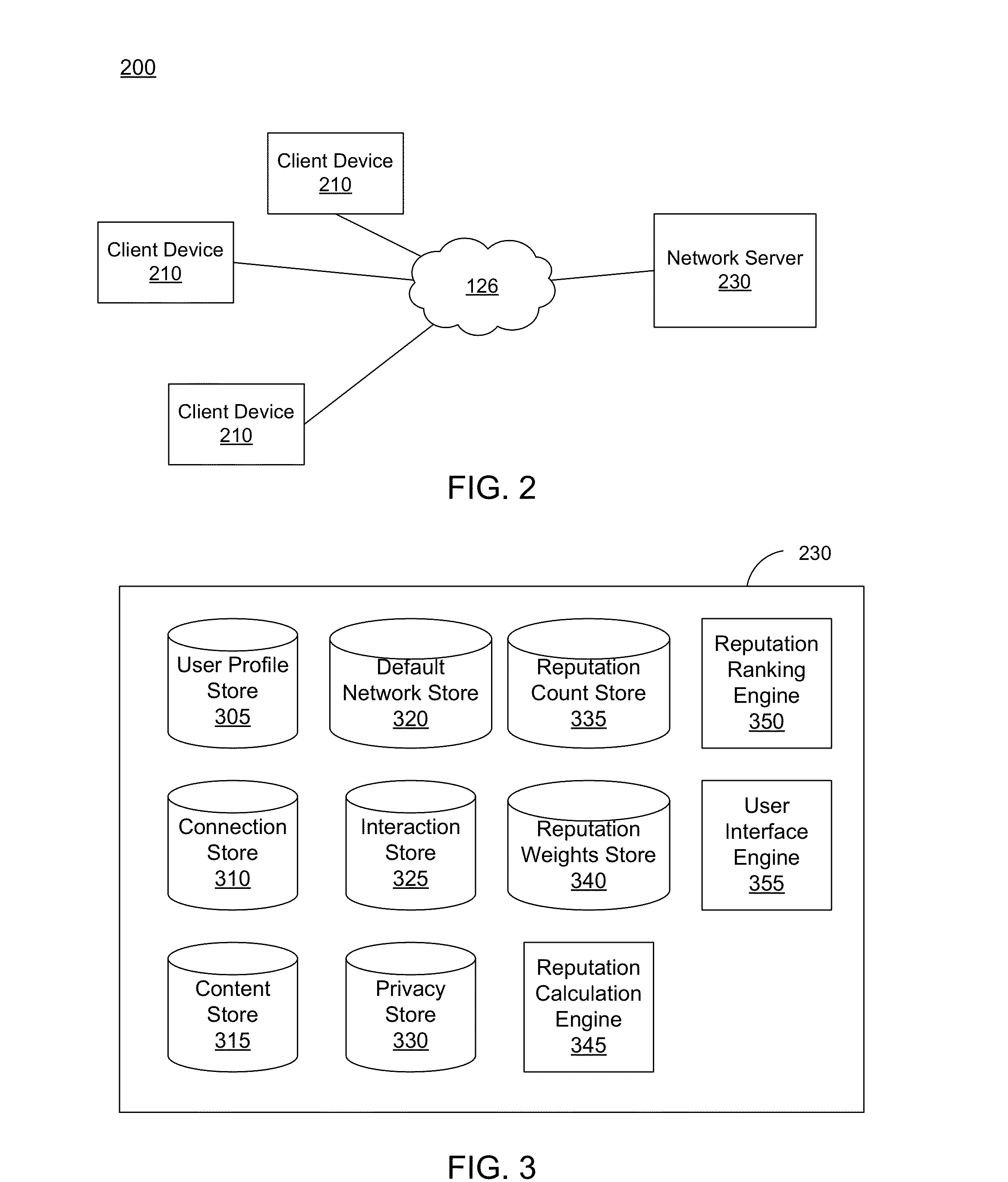
[0024]Referring now to FIG. 2, illustrated is a block diagram of a default network environment 200 in an example embodiment. The default network environment 200 includes one or more client device 210 (e.g., a personal computer, a tablet, a smartphone, a cellular phone, a terminal, a smart television, a personal digital assistant (PDA), a smart watch, a wearable computer), a network 126, and a network server 230. A computer system 100 may be used in some embodiments of the client device 210 and / or network server 230. The one or more client devices 210 are coupled to the network 126, which is in turn coupled to the network server 230. In an alternate embodiment, additional networks 126, client devices 210, and / or network servers 230 may be present. For example, an additional network server 230 may act as a proxy server between the one or more client devices 210 and another network server 230.

[0025]The one or more client devices 210 may be used by users to view, upload, su...