
Capacitive occupant sensor for a vehicle seat
a technology for occupant sensors and vehicle seats, applied in the field of capacitance sensors, can solve the problems of disturbing the relationship between capacitance change and applied force, and the area of the bladder that is able to expand,
- Summary
- Abstract
- Description
- Claims
- Application Information
AI Technical Summary
Benefits of technology
Problems solved by technology
Method used
Image

Examples
Embodiment Construction
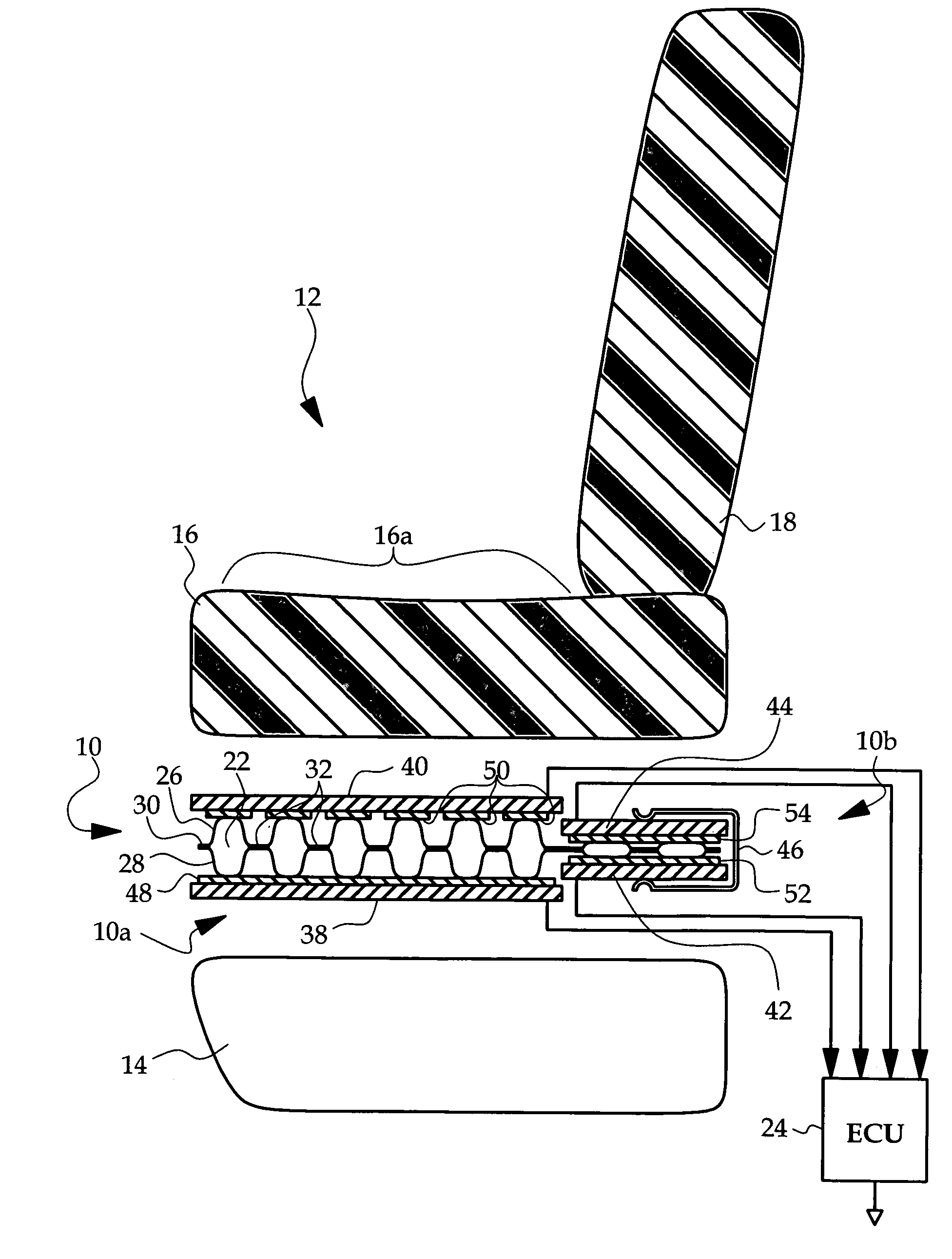
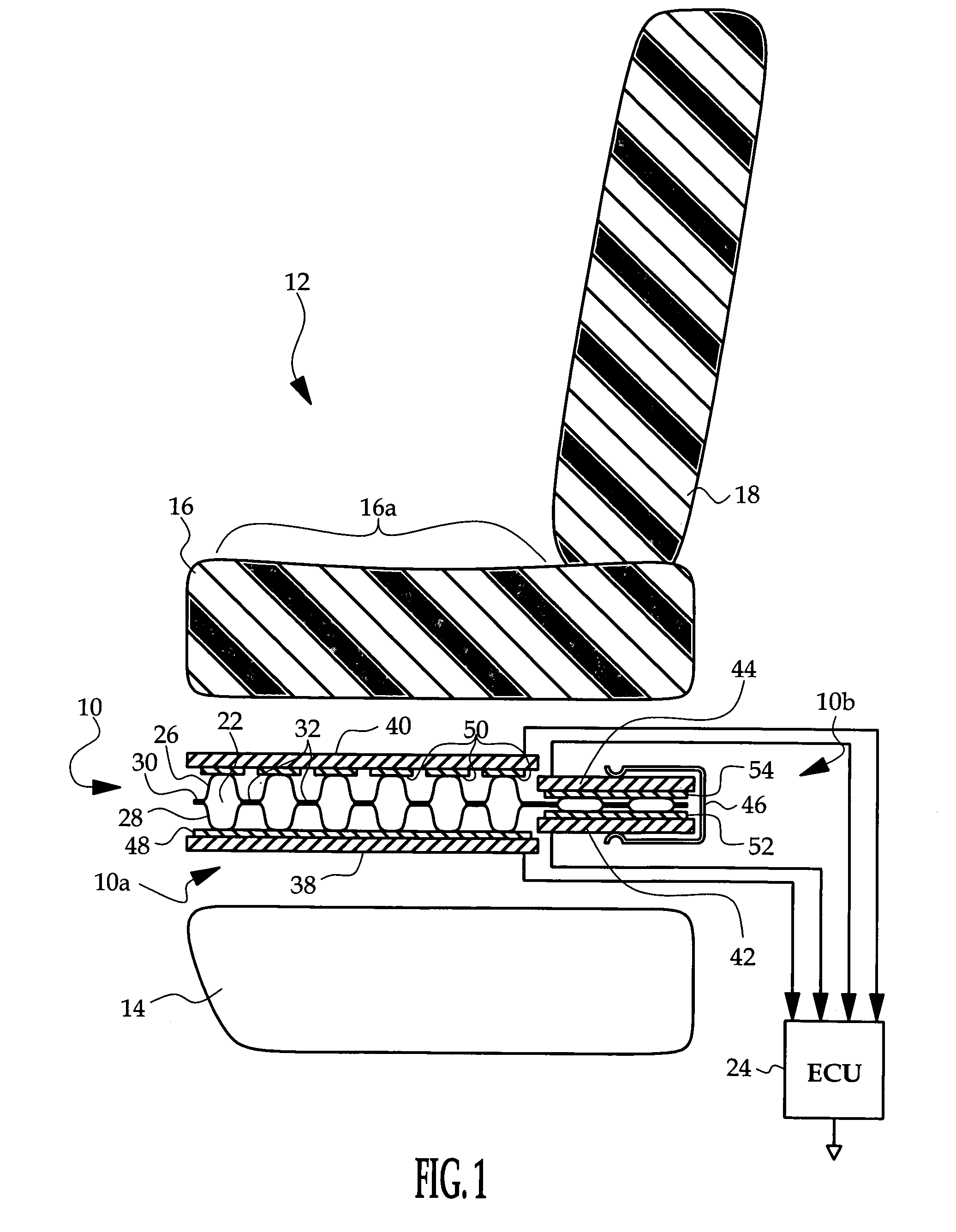
[0011]Referring to FIG. 1, the reference numeral 10 generally designates the capacitive occupant sensor of this invention in the context of a vehicle seat 12 comprising a seat frame 14, a foam seat cushion 16 and a foam back cushion 18. The sensor 10 includes a primary region 10a and a secondary region 10b. The primary region 10a is disposed between the seat frame 14 and the seating surface 16a of seat cushion 16 so that occupant-related forces applied to the seating surface 16a are transmitted to primary region 10a through the seat cushion 16. One the other hand, the secondary region 10b is positioned such that it is shielded from forces applied to the seating surface 16a. In the illustration, this is achieved by locating the secondary region 10b under the back cushion 18; a more detailed discussion of various locations of the secondary region 10b is presented below in reference to FIGS. 3A–3B.
[0012]In general, the sensor 10 comprises various conductor plates oppositely disposed ab...
PUM
 Login to View More
 Abstract
Description
Claims
Application Information
 Login to View More