

Image display device
a technology of image display and display screen, which is applied in the direction of lighting and heating equipment, television systems, instruments, etc., can solve the problems of reducing and achieve the effect of improving the utilization efficiency of lights
- Summary
- Abstract
- Description
- Claims
- Application Information
AI Technical Summary
Benefits of technology
Problems solved by technology
Method used
Image



Examples
first embodiment
[First Embodiment]
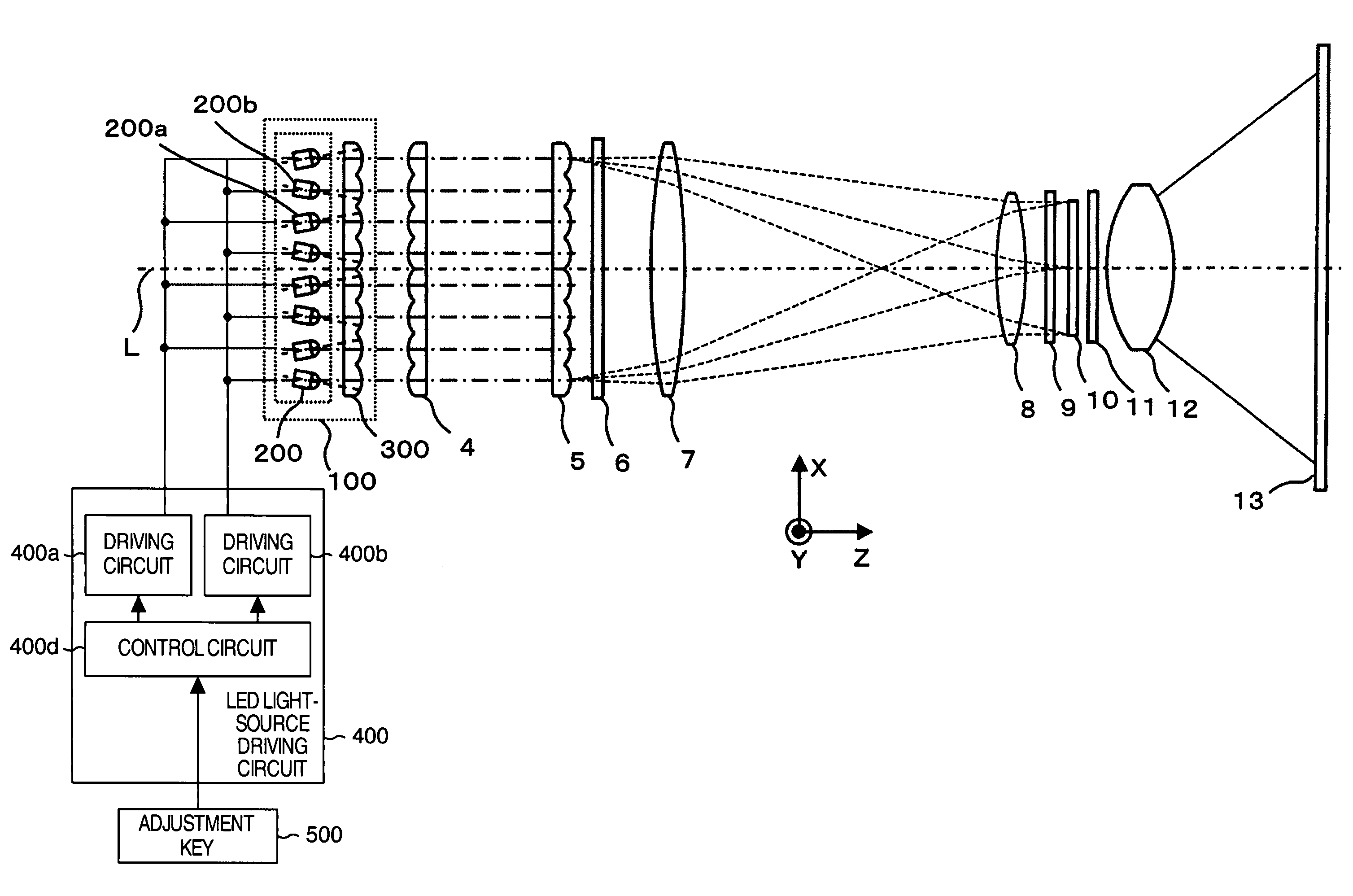
[0034]FIG. 1 is a schematic configuration diagram acquired by seeing from above an image display device which is a first embodiment according to the present invention.
[0035]In FIG. 1, a reference numeral 100 denotes a light-source unit. The light-source unit 100 is configured by a LED light source 200 including a plurality of LED elements for emitting monochromatic light, and a collimator lens (i.e., parallelizing unit) 300 for parallelizing the light from the LED light source 200. Numerals 4 and 5 respectively denote a first lens array and a second lens array which configure an integrator optical system. Numerals 6, 7, 8, 9, 10, 11, 12, and 13 denote a polarization conversion element, a light-converging lens, a condenser lens, an incoming-side sheet polarizer, a transparent-type liquid-crystal panel which is an image display element, an outgoing-side sheet polarizer, a projection lens, and a screen, respectively. A numeral 400 denotes a LED light-source driving ci...
second embodiment
[Second Embodiment]
[0076]In the first embodiment, with reference to the respective cell-lens optical axes of the collimator lens 300, the optical axes of the respective LED elements corresponding thereto are inclined. As a result, the lights on the optical axes outgoing from the light-emitting centers of the respective LED elements are caused to income into the rectangle-shaped configurations of the cell lenses of the first lens array 4 in such a manner that the lights have shifted (i.e., have deviated) from the centers of the rectangle-shaped configurations. This allows the lights on the optical axes of the respective LED elements to be illuminated onto the liquid-crystal panel and superimposed with each other thereon in such a manner that the lights are shifted from the central point of the liquid-crystal panel. This is because the light-source images from the respective LED elements formed on the cell lenses of the first lens array 4 are projected onto the liquid-crystal panel.
[0...
third embodiment
[Third Embodiment]
[0086]FIG. 10 is a schematic configuration diagram of an image display device which is a third embodiment according to the present invention. In FIG. 10, for each of LED panels designed for red, green, and blue lights, there is provided an illumination optical system whose configuration is the same as that of the illumination optical system in FIG. 1 for illuminating the light from the LED light-source unit onto the liquid-crystal panel.
[0087]In FIG. 10, numeral 100R denotes a red-oriented light-source unit, numeral 100G denotes a green-oriented light-source unit, and numeral 100B denotes a blue-oriented light-source unit.
[0088]The red-oriented light-source unit 100R is configured by a red-oriented LED light source 200R including a plurality of LED elements arranged in an array-like manner (m2 row×n2 column) and emitting red light, and a collimator lens 300R including a plurality of cell lenses which are similarly arranged in an array-like manner (m2 row×n2 column)...
PUM
| Property | Measurement | Unit |
|---|---|---|
| semiconductor | aaaaa | aaaaa |
| angles | aaaaa | aaaaa |
| optical axes | aaaaa | aaaaa |
Abstract
Description
Claims
Application Information
 Login to View More