
Umpire counter with null indicators
a technology of indicators and umpires, applied in the field of umpire counters, can solve problems such as disrupting the rhythm of the gam
- Summary
- Abstract
- Description
- Claims
- Application Information
AI Technical Summary
Benefits of technology
Problems solved by technology
Method used
Image

Examples
first embodiment
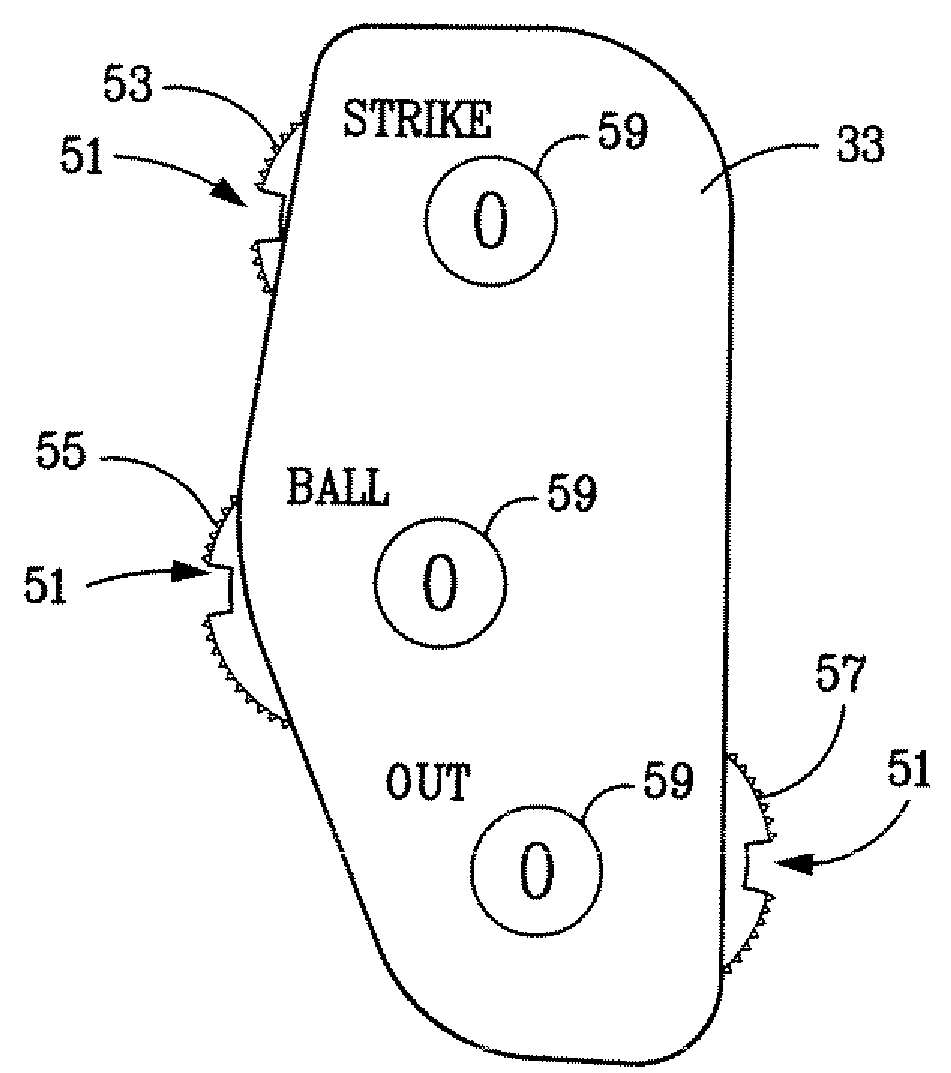
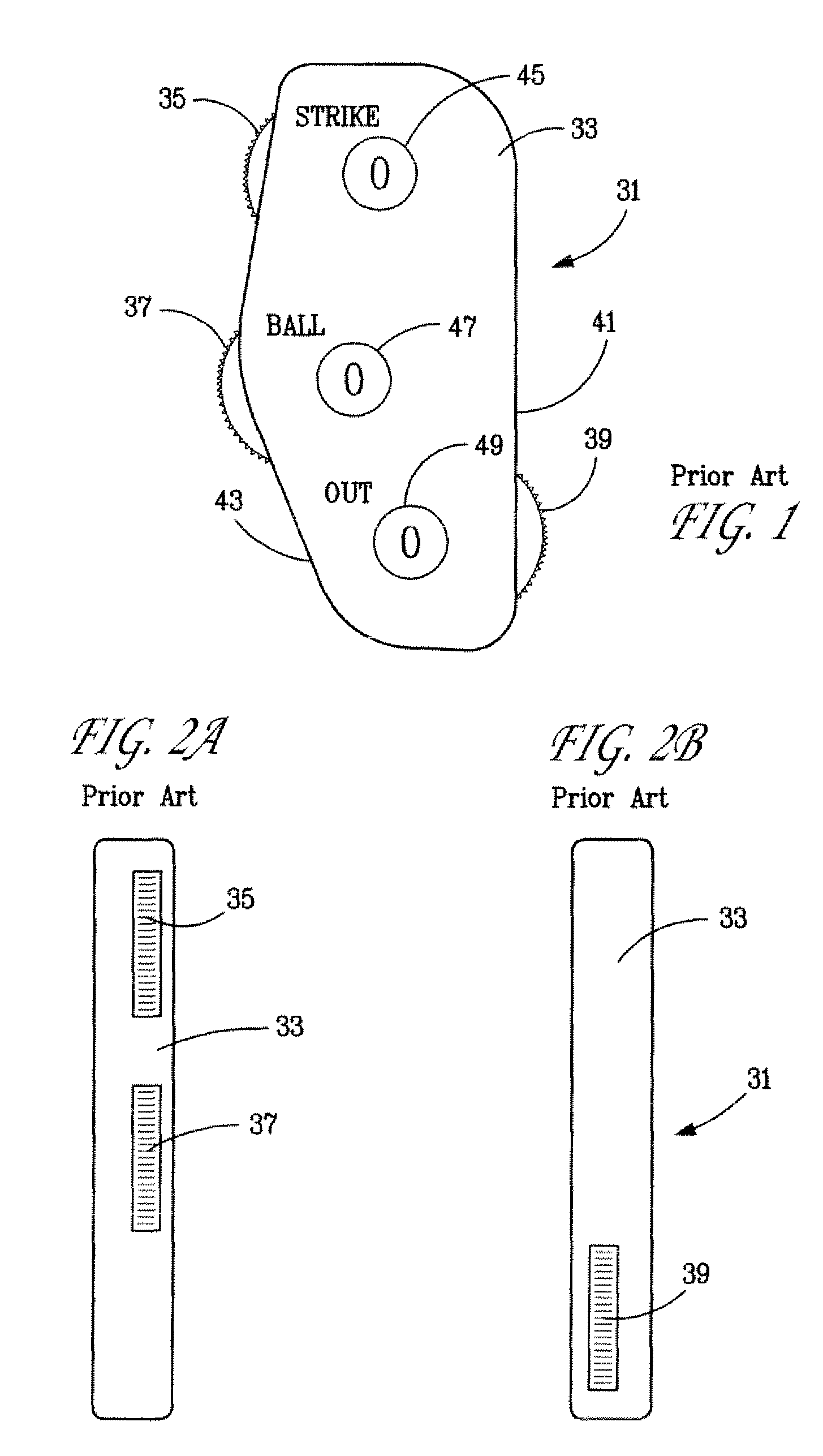
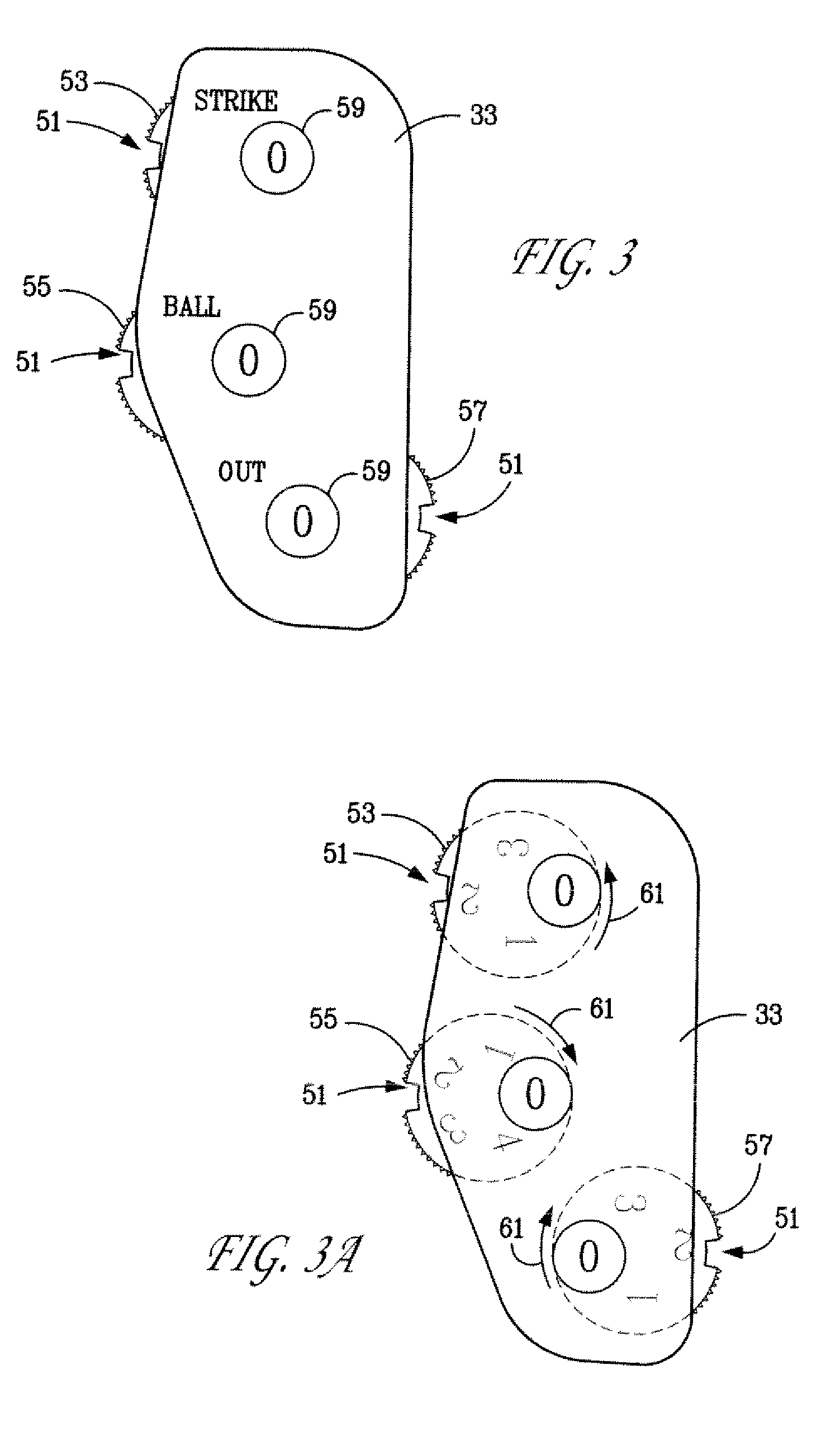
the invention, FIGS. 3-8a, has a single, smooth-walled, large notch 51 having an absence of serrations and extending into the circumferential edge of each round disk-shaped counter dial 53, 55 and 57, FIGS. 3 and 3a. Each of the notched dials 53, 55, 57 is about one inch in diameter and carries an otherwise serrated circumferential edge. For a dial 53, 55, 57 which is about one inch in diameter, each notch is about 1 / 16 inch deep and about ⅛ to 3 / 16 inches wide at its “mouth”, wherein each notch 51 has an arc width of about 15 to 20 circular degrees. Each of the notched dials 53 and 57 carries numbers on its front face from “0” to “3”, FIGS. 3a and 7a. The notched dial 55 carries numbers on its front face from “0” to “4”.
Each of the dials 53, 55, and 57 has its numbers spaced evenly around the periphery of its top face, FIGS. 7a, 7b and 8a in “merry-go-round” fashion. The numbers on each dial 53, 55, 57 are viewable through the top face of the counter case through a respective round...
PUM
 Login to View More
 Abstract
Description
Claims
Application Information
 Login to View More