Unlock instant, AI-driven research and patent intelligence for your innovation.

Method for recognizing and locating object

a technology of object recognition and object location, applied in image analysis, instruments, computing, etc., can solve the problems of unstable location, sad algorithm fails to overcome the problem, and difficult to segment the binary image of the object clearly, etc., and achieve the effect of effective recognition and location

Active Publication Date: 2016-07-19
DELTA ELECTRONICS INC
View PDF6 Cites 0 Cited by
  • Summary
  • Abstract
  • Description
  • Claims
  • Application Information

AI Technical Summary

Benefits of technology

The patent is about a method for recognizing and locating objects in a live image, even if they are broken, hidden, or if the background is complicated or has non-linear light intensity variations. The goal is to increase the accuracy of recognition and reduce the complexity of calculations.

Problems solved by technology

Moreover, if the change of the ambient light intensity is very obvious, it is difficult to segment the binary image of the object clearly.
However, the SAD algorithm fails to overcome the problem caused by the linear light intensity variation.
Under this circumstance, an unstable location problem occurs.
However, if the background of the image is complicate and the number of the non-edge parts of the object is huge, the votes for the location of the object produce many false positives.
In other words, the detection result is unstable.
However, if the object has a hidden part and many non-edge parts of the object are generated, the locating efficacy is impaired.

Method used

the structure of the environmentally friendly knitted fabric provided by the present invention; figure 2 Flow chart of the yarn wrapping machine for environmentally friendly knitted fabrics and storage devices; image 3 Is the parameter map of the yarn covering machine
View more

Image

Smart Image Click on the blue labels to locate them in the text.
Viewing Examples
Smart Image
  • Method for recognizing and locating object
  • Method for recognizing and locating object
  • Method for recognizing and locating object

Examples

Experimental program
Comparison scheme
Effect test

Embodiment Construction

[0020]The present invention will now be described more specifically with reference to the following embodiments. It is to be noted that the following descriptions of preferred embodiments of this invention are presented herein for purpose of illustration and description only. It is not intended to be exhaustive or to be limited to the precise form disclosed.

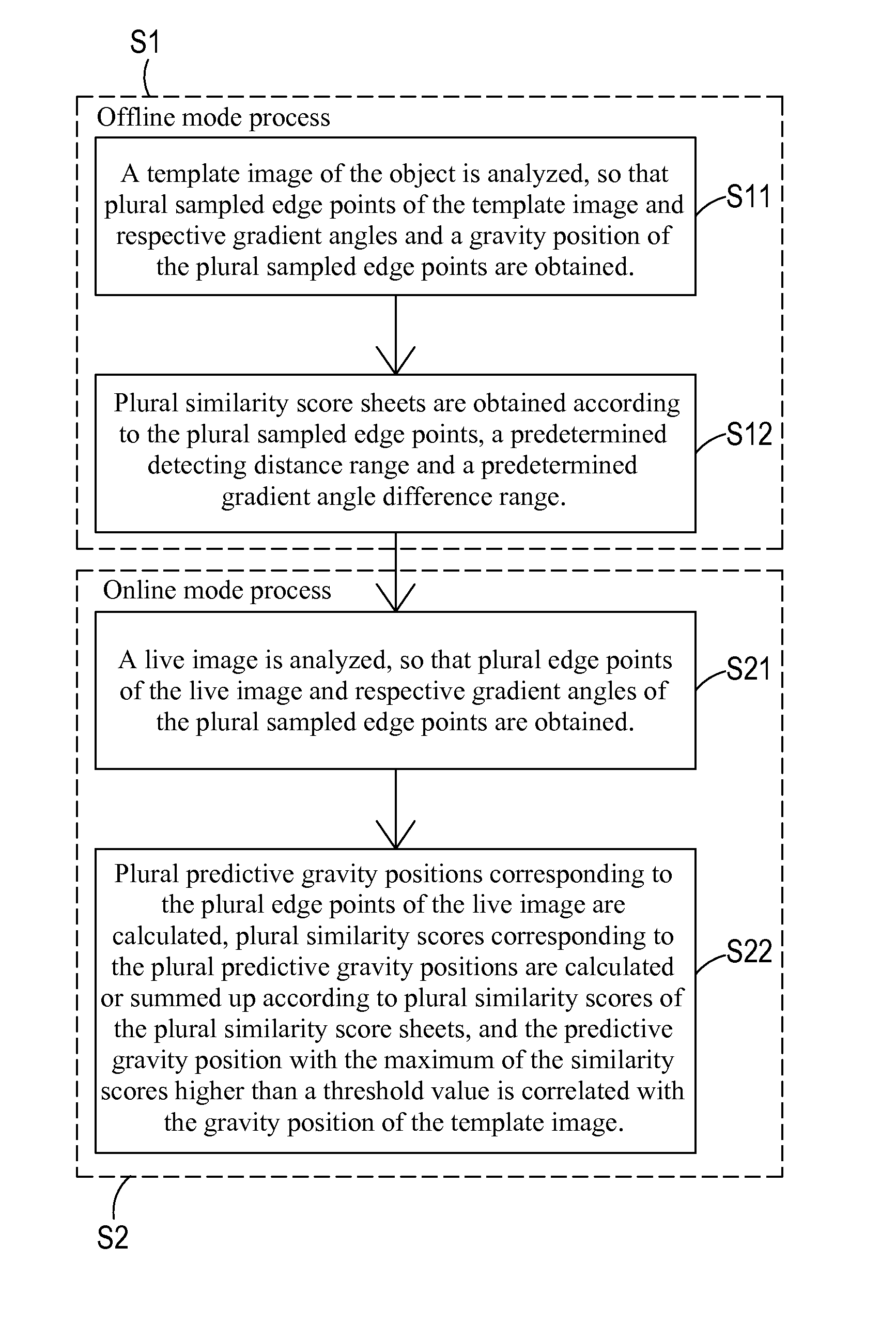
[0021]FIG. 1 is a flowchart illustrating a method for recognizing and locating an object according to an embodiment of the present invention. The method of the present invention is capable of recognizing and locating a user-defined object in a two-dimensional live image. The method comprises an offline mode process S1 and an online mode process S2. The offline mode process S1 comprises the steps S11 and S12. In the step S11, an image of an object selected by the user is defined as a template image. After the template image of the object is analyzed, plural sampled edge points of the template image and respective gradient angles a...

the structure of the environmentally friendly knitted fabric provided by the present invention; figure 2 Flow chart of the yarn wrapping machine for environmentally friendly knitted fabrics and storage devices; image 3 Is the parameter map of the yarn covering machine
Login to View More

PUM

No PUM Login to View More

Abstract

A method for recognizing and locating an object includes an offline mode process and an online mode process. In the offline mode process, plural sampled edge points of a template image of the object and respective gradient angles and a gravity position of the plural sampled edge points are obtained, and plural similarity score tables are obtained according to the plural sampled edge points, a predetermined detecting distance range and a predetermined gradient angle difference range. In the online mode process, plural edge points of a live image and respective gradient angles are obtained, plural predictive gravity positions are calculated, and plural similarity scores corresponding to the plural predictive gravity positions are summed up. The predictive gravity position with the local maximum of the similarity scores higher than a threshold value is correlated with the gravity position of the template image so as to recognize and locate the object.

Description

FIELD OF THE INVENTION[0001]The present invention relates to a method for recognizing and locating an object, and more particularly to a method for recognizing and locating an object in order to increase the recognizing accuracy and reducing the computational complexity.BACKGROUND OF THE INVENTION[0002]As known, the methods for recognizing and locating objects play very important roles in machine vision. Before the procedure of measuring and detecting the under-test material in the production line, it is necessary to recognize and locate the position of the under-test material in order to compensate the placement position error of the under-test material. Moreover, for gripping and assembling the material in the production line by a robot, it is necessary to recognize and locate the material.[0003]In a conventional object identification and location method, a connected component analysis is employed. Firstly, a foreground of a binary image is obtained. Then, the axis length, the are...

Claims

the structure of the environmentally friendly knitted fabric provided by the present invention; figure 2 Flow chart of the yarn wrapping machine for environmentally friendly knitted fabrics and storage devices; image 3 Is the parameter map of the yarn covering machine
Login to View More

Application Information

Patent Timeline
no application Login to View More
Patent Type & Authority Patents(United States)
IPC IPC(8): G06K9/00G06K9/32G06T7/20G06T7/00G06V10/40
CPCG06K9/3241G06K9/00201G06K9/3275G06T7/0083G06T7/2033G06T7/73G06T7/12G06T7/66G06V20/64G06V10/255G06V10/243G06V10/40G06V10/751
Inventor YANG, YUAN-HSIANG
Owner DELTA ELECTRONICS INC