
A kind of red light material and its preparation method and application
A red light and reaction technology, applied in luminescent materials, chemical instruments and methods, semiconductor/solid-state device manufacturing, etc., can solve problems such as the reduction of fluorescence quantum yield, and achieve reduced quenching effect, good fluorescence quantum efficiency, high efficiency and stability The effect of red light emission
Patent Information
- Authority / Receiving Office
- CN · China
- Patent Type
- Patents(China)
- Current Assignee / Owner
- Publication Date
- 2016-03-23
Smart Images
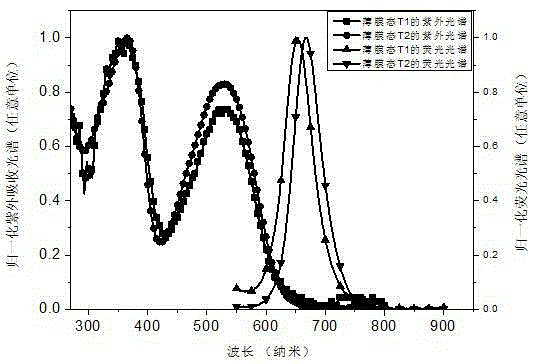
Figure 1 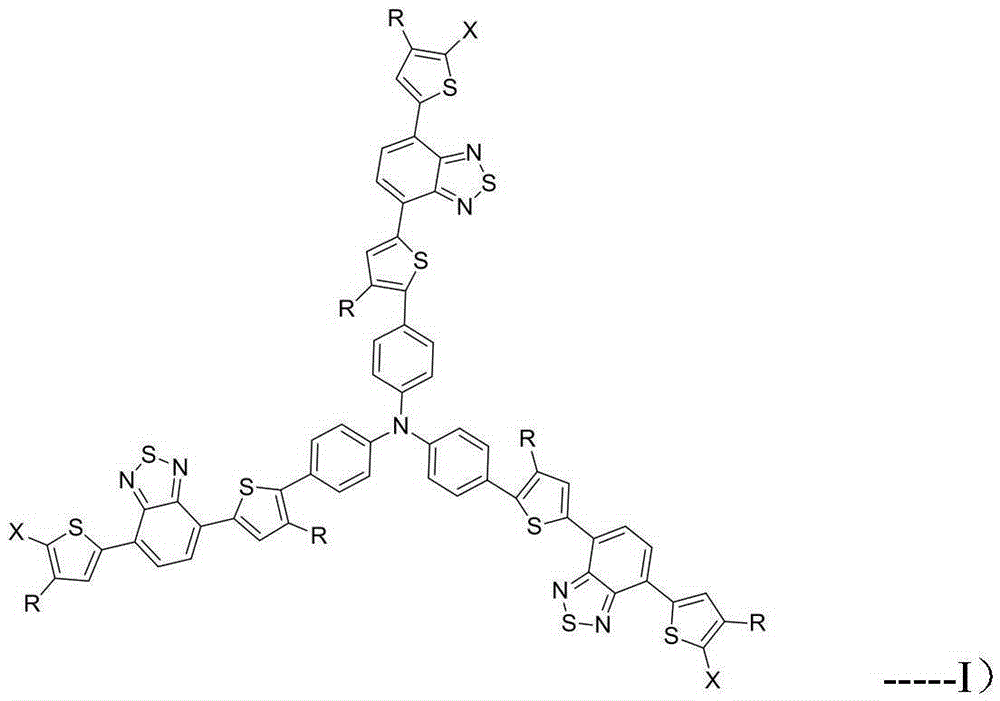
Figure 2 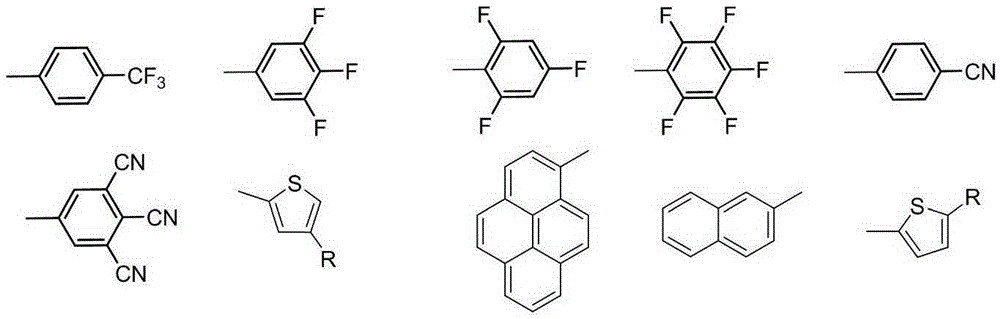
Figure 3
Abstract
Description
Technical field:
[0001] The invention belongs to the technical field of optoelectronic materials and applications, and specifically relates to an organic electroluminescent material, more specifically to a multi-arm structure material and its preparation method and application; the material uses triphenylamine as the core and thiophene-benzene The thiazole derivatives are multi-substitution compounds of branches, and can be widely used as light-emitting materials in organic light-emitting devices, especially stable and efficient red organic electroluminescent thin film devices. Background technique:
[0002] Organic / Polymer Light-Emitting Device (OLED / PLED) is one of the current research hotspots in the scientific and industrial circles, and it shows broad application prospects in the fields of information display and solid-state lighting. Red light-emitting materials are one of the three primary colors (red, green, blue) materials that are essential to realize information d...
Examples
Embodiment 1
[0033]
[0034] Target compound T1
[0035] 【Reaction route】
[0036]
[0037] According to the reaction scheme, compound 1 and 4-(4-hexylthiophen-2-yl)-7-(5-bromo-4-hexylthiophen-2-yl)benzothiadiazole were catalysts Compound 2 was prepared by Suzuki coupling reaction under the conditions of , and NBS dissolved in DMF was slowly added dropwise in ice bath and protected from light to obtain compound 3 . Finally, the target compound T1 was prepared by Suzuki coupling reaction between 3 and boronate of pyrene under the condition of tetrakistriphenylphosphopalladium as catalyst. The specific steps of the Suzuki coupling reaction are as follows: in a 50 mL two-necked round-bottomed flask with a magnetic stirrer, sequentially add compound 13 (0.40 g, 0.21 mmol), pyrene borate (0.32 g, 0.96 mmol) and Pd(pph 3 ) 4 (10mg), vacuum three times for nitrogen. Add deoxygenated toluene (20mL), and then add K 2 CO 3 aqueous solution (2M, 8 mL). Turn on the condensed water, heat ...
Embodiment 2
[0039]
[0040] Target compound T2
[0041] 【Reaction route】
[0042]
[0043] According to the reaction scheme, 3 and 2-naphthylboronic acid undergo Suzuki coupling reaction under the condition of tetrakistriphenylphosphopalladium as a catalyst to obtain the target compound T2. The specific steps are: under the condition of avoiding light, in a 50mL two-necked round bottom flask with a magnetic stirrer, sequentially add compound 13 (0.30g, 0.16mmol), 2-naphthylboronic acid (0.14g, 0.72mmol), Pd (pph 3 ) 4(10mg), vacuum three times for nitrogen. Add deoxygenated toluene (20mL), and then add K 2 CO 3 aqueous solution (2M, 8 mL). Turn on the condensed water, heat to reflux at 95°C, and react for 48h. Extract with dichloromethane and water, dry the organic phase with anhydrous magnesium sulfate, filter with suction, and spin dry the organic phase. The eluent of column chromatography was dichloromethane and petroleum ether (1:3 by volume), and 0.164 g of the target pr...
Embodiment 3
[0045]
[0046] Target compound T3
[0047] 【Reaction route】
[0048]
[0049] According to the reaction scheme, 3 and p-trifluoromethylphenylboronic acid were subjected to Suzuki coupling reaction under the condition of tetrakistriphenylphosphopalladium as a catalyst to obtain the target compound T3. The specific reaction steps are: under dark conditions, in a 50mL two-necked round-bottomed flask with a magnetic stirrer, sequentially add compound 13 (0.30g, 0.16mmol), p-trifluoromethylphenylboronic acid (0.14g, 0.72mmol), Pd(pph 3 ) 4 (10mg), vacuum three times for nitrogen. Add deoxygenated toluene (20mL), and then add K 2 CO 3 aqueous solution (2M, 8 mL). Turn on the condensed water, heat to reflux at 95°C, and react for 48h. Extract with dichloromethane and water, dry the organic phase with anhydrous magnesium sulfate, filter with suction, and spin dry the organic phase. The eluent of column chromatography was dichloromethane and petroleum ether (1:3 volume r...