
Preparation method for afatinib compound
A technology for afatinib and compounds, applied in the field of chemical synthesis, can solve the problems of unsuitability for large-scale industrial production, high production cost, low total yield, etc., and achieves suitable industrial production, low production cost, and low environmental pollution. Effect
Patent Information
- Authority / Receiving Office
- CN · China
- Current Assignee / Owner
- Publication Date
- 2014-04-30
- Estimated Expiration
- Not applicable · inactive patent
Smart Images
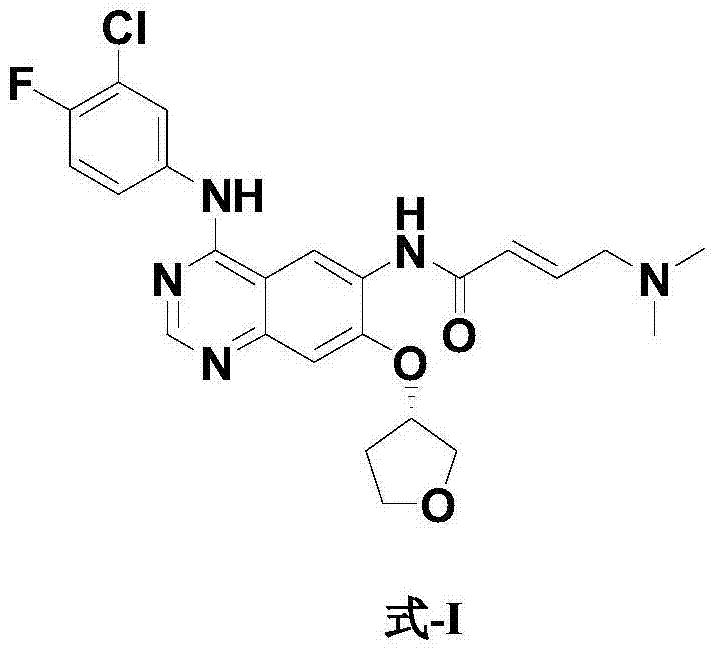
Figure 1 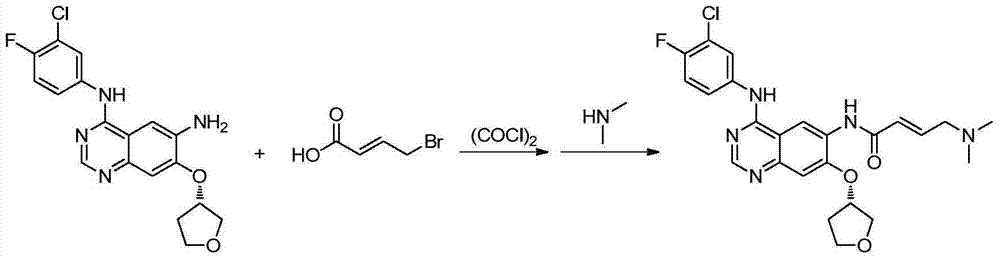
Figure 2 
Figure 3
Abstract
Description
technical field
[0001] The invention relates to the field of chemical synthesis, in particular to a new synthetic method of afatinib. Background technique
[0002] Afatinib, chemical name (E)-4-dimethylamino-but-2-enoic acid-(4-(3-chloro-4-fluoro-phenylamino)-7-((S )-tetrahydrofuran-3-yl oxygen)-quinazolin-6 base)-amide, its structure is shown in formula-I:
[0003]
[0004] Afatinib is a multi-target small molecule oral drug developed by Boehringer Ingelheim, Germany, which belongs to the irreversible inhibitor of epidermal growth factor receptor (EGFR) and human epidermal receptor (HER2) tyrosine kinase . As the first drug for the treatment of lung cancer after the failure of epidermal growth factor receptor inhibitor therapy, it is mainly aimed at the treatment of advanced breast cancer and non-small cell lung cancer in clinical practice
[0005]
[0006] CN1481370A embodiment 1 discloses afatinib (compound 10), and discloses a kind of synthetic method of afatini...
Examples
Embodiment 1
[0041] Heat 76mL of diethyl malonate and 150mL of dimethylaminoacetaldehyde diethyl acetal at 105±5°C for 4 hours, TLC detects that the reaction is complete, cool to room temperature, add 150mL of n-heptane and stir evenly, at 0±5°C Cool and crystallize for 12 hours, filter and drain to obtain 99.6 g of condensate with a yield of 86.9%.
Embodiment 2
[0042] Embodiment 2 Preparation of dimethylaminocroton hydrochloride
[0043] Add 95g of the condensate obtained in Example 1 into 800mL of 6N hydrochloric acid aqueous solution, heat to reflux for 10 hours, TLC detects that the reaction is complete, cool and crystallize at 5±5°C for 6 hours, filter and drain, and the obtained solid is at 45±5°C After vacuum drying for 12 hours, 57.7 g of dimethylaminocroton hydrochloride was obtained, with a yield of 84.1%.
Embodiment 3
[0044] Example 3 Synthesis of Afatinib
[0045] Add 53.8g of 1,1-carbonyldiimidazole into 500mL of anhydrous tetrahydrofuran, heat to 40°C to dissolve, add 55g of dimethylaminocroton hydrochloride, react at 40°C for 30 minutes, and set aside.
[0046] 103.7g N 4-(3-Chloro-4-fluoro-phenyl)-7-((S)-tetrahydrofuran-3-yloxy)quinazoline-4,6-diamine was added to 500 mL of anhydrous tetrahydrofuran, and the above solution was added, React at 30°C for 2 hours, TLC detects that the reaction is complete, cool to 10±5°C, and add 1% aqueous sodium hydroxide solution dropwise to the reaction solution at this temperature until the pH is 8-9, add 8L of purified water, and precipitate a large amount of solid , filtered, washed the solid with water until the filtered water was neutral, and dried to obtain 117.2 g of crude product, with a yield of 87.2%.