
A kind of nanocomposite material and preparation method thereof
A nano-composite material and nano-silicon technology, applied in separation methods, chemical instruments and methods, and other chemical processes, can solve problems such as small adsorption capacity, uncontrollable pore structure of adsorbents, and small specific surface area, and achieve simple characterization methods , good CO2 adsorption performance, and the effect of mild reaction conditions
Patent Information
- Authority / Receiving Office
- CN · China
- Patent Type
- Patents(China)
- Current Assignee / Owner
- Publication Date
- 2016-08-10
- Estimated Expiration
- Not applicable · inactive patent
Smart Images
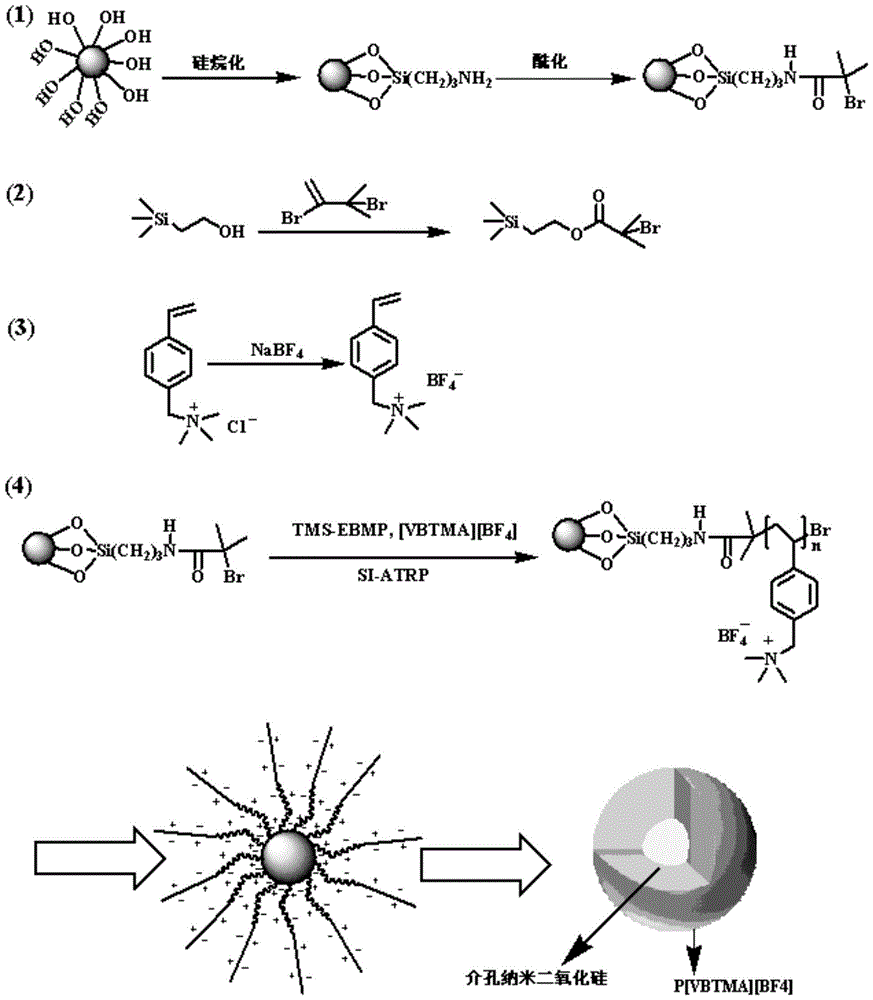
Figure 1 
Figure 2 
Figure 3
Abstract
Description
technical field
[0001] The invention relates to a nanocomposite material, in particular to a 2 An organic-inorganic nanocomposite material with adsorption properties and a core-shell mechanism and a preparation method thereof. Background technique
[0002] The climate change caused by the "greenhouse effect" has become a global environmental problem, and it has attracted more and more attention from all countries in the world. Among the various greenhouse gases, CO 2 It has a high content in the atmosphere and a long life span of about 50-200 years. It contributes the most to the greenhouse effect. How to reduce CO 2 emissions, reducing CO in the atmosphere 2 Concentration is a common problem faced by human beings. At the same time, CO 2 It is also a very important industrial raw material, and CO is captured and recovered from the flue gas of the power plant 2 Not only to alleviate CO 2 The most direct and effective means of the emission crisis, but also through the ...
Examples
Embodiment 1
[0050] The organic-inorganic nanocomposite material in this example is prepared through the following steps:
[0051] 1) Preparation of mesoporous nano-silica atom transfer radical surface initiator:
[0052] a) First, add 1 part of mesoporous nano-silica in the reactor according to the mass ratio, dissolve it with toluene, and disperse it ultrasonically. After sealing, vacuumize the reactor and pass high-purity nitrogen, and add 1 part of 3 -Aminopropyltrimethoxysilane, reflux reaction at 80°C in an oil bath for 12 hours; centrifuge the product, pour off the upper solvent, wash it with toluene and acetone ultrasonically in turn, remove the adsorbed silane coupling agent, and dry it under vacuum at 45°C A silane coupling agent-modified nano silicon dioxide is obtained.
[0053] b) Add 1 part of nano-silica modified by silane coupling agent into the reactor according to the mass ratio, dissolve it with toluene, disperse it ultrasonically, vacuumize the reactor after sealing an...
Embodiment 2
[0065] In this embodiment, the organic-inorganic nanocomposite material has the following differences from Example 1 through the following steps, and all the others are the same:
[0066] 3 parts of 3-aminopropyltrimethoxysilane in step a) of step 1), 1.5 parts of triethylamine in b) and 2.16 parts of 2-bromoisobutyryl bromide;
[0067] Step 2) 3 parts of 2-bromoisobutyryl bromide;
[0068] Step 3) sodium fluoroborate is 3 parts;
[0069] Step 4) 1.5 parts of CuCl, 1.5 parts of 1,1,4,7,7-pentamethyldiethylenetriamine, 0.1 parts of TMS-EBMP, ionic liquid monomer (p-vinylbenzyl)- Trimethyl ammonium tetrafluoroborate is 100 parts.
[0070] Measure the molecular weight M of the surface polymer of the composite material obtained by sacrificing the initiator method in the present embodiment n,NMR for 8160.
Embodiment 3
[0072] In this embodiment, the organic-inorganic nanocomposite material has the following differences from Example 1 through the following steps, and all the others are the same:
[0073] The reaction temperature in a) of step 1) is 120°C, the reflux time is 24 hours, and the reaction temperature in step b) is 30°C and the reaction time is 30 hours;
[0074] In step 2), the reaction temperature is 30° C. and the reaction time is 30 hours;
[0075] In step 3), the reaction temperature is 30° C. and the reaction time is 24 hours;
[0076] Step 4) The reaction temperature is 85°C and the reaction time is 12 hours.
[0077] Measure the molecular weight M of the surface polymer of the composite material obtained by sacrificing the initiator method in the present embodiment n,NMR for 6581.