
Method and system for extracting image fingerprints based on representative local mode
A local pattern and image fingerprint technology, which is applied in the field of image processing, can solve the problems of poor robustness, large memory consumption, and high complexity of feature matching, and achieve the effect of fast matching speed, less memory occupied by features, and less memory occupied by global features
Patent Information
- Authority / Receiving Office
- CN · China
- Patent Type
- Applications(China)
- Current Assignee / Owner
- Publication Date
- 2015-09-02
Smart Images
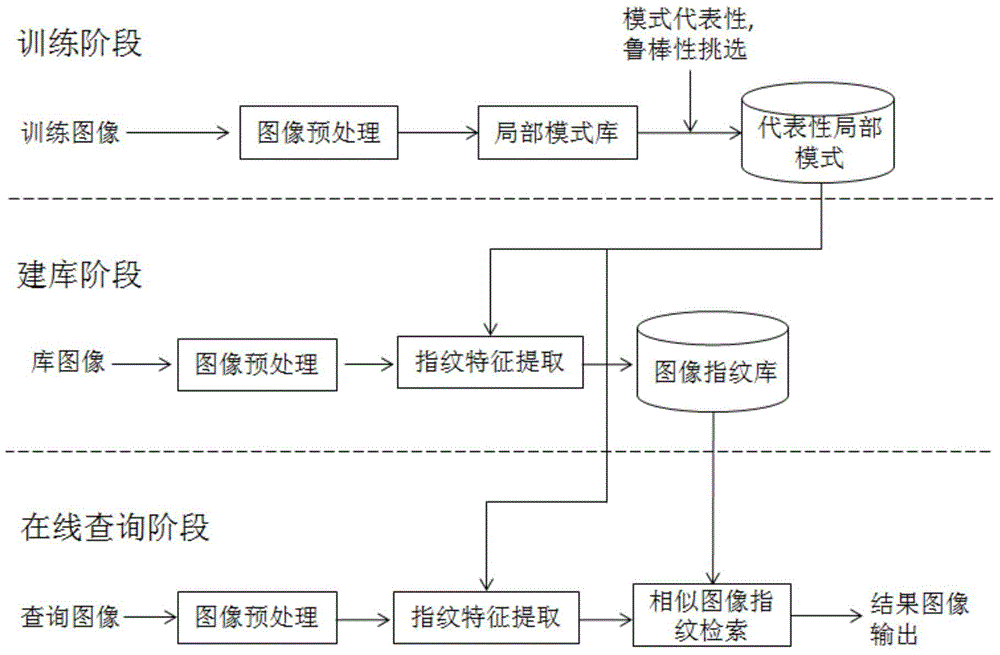
Figure 1 
Figure 2 
Figure 3
Abstract
Description
technical field
[0001] The invention relates to the field of image processing, in particular to an image fingerprint extraction method and system based on representative local patterns. Background technique
[0002] Image copy detection has always been one of the hot research areas of computer vision. Its general strategy is to extract a few features from the image and integrate them into a feature vector that can reflect the content of the image. From the perspective of the composition of image features, it is generally divided into global features and local features. The following is a brief discussion of the development status of these two features. As early as 1999, Naphade was the first method to extract the histogram of the image in the LUV color space as an image signature, and then Mohan used the block method to extract the average gray value of each block, according to the gray value of these blocks Size sorting construction features; a relatively influential image...
Examples
Embodiment Construction
[0042] The present invention proposes a method for extracting image fingerprints based on representative local patterns, the specific process of which is as follows: figure 1 As shown, the main process of the present invention is divided into three stages: training stage, database building stage and online query stage. The three stages include image preprocessing, which is mainly to unify and smooth the size of the original image. The main steps of the three stages are introduced below:
[0043] Training stage: This stage is mainly to perform various image attack simulation processing on the library image, mainly including scale change, subtitle or logo embedding, cropping, blurring, etc., and then use the FAST algorithm to extract key points in the image, (“key point” refers to The most important thing is the local structure that contains important information in the image. For example, the eyes and nose of the face are more prominent than the forehead and contain more inform...