
PC (Propylene Carbonate)-based high-voltage electrolyte and lithium ion battery
A lithium-ion battery and electrolyte technology, applied in secondary batteries, circuits, electrical components, etc., can solve the problems of irreversible capacity increase, capacity loss, battery self-discharge, etc., to achieve the inhibition of metal ion dissolution and excellent cycle performance , the effect of good cycle life
Patent Information
- Authority / Receiving Office
- CN · China
- Current Assignee / Owner
- Publication Date
- 2016-11-23
- Estimated Expiration
- Not applicable · inactive patent
Smart Images
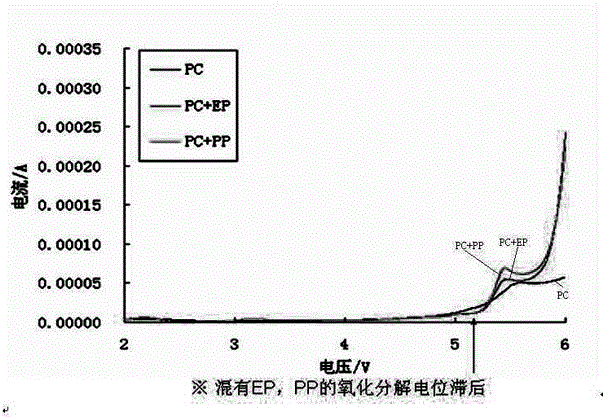
Figure 1 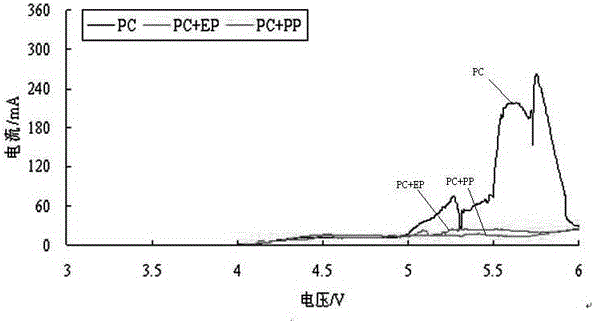
Figure 2 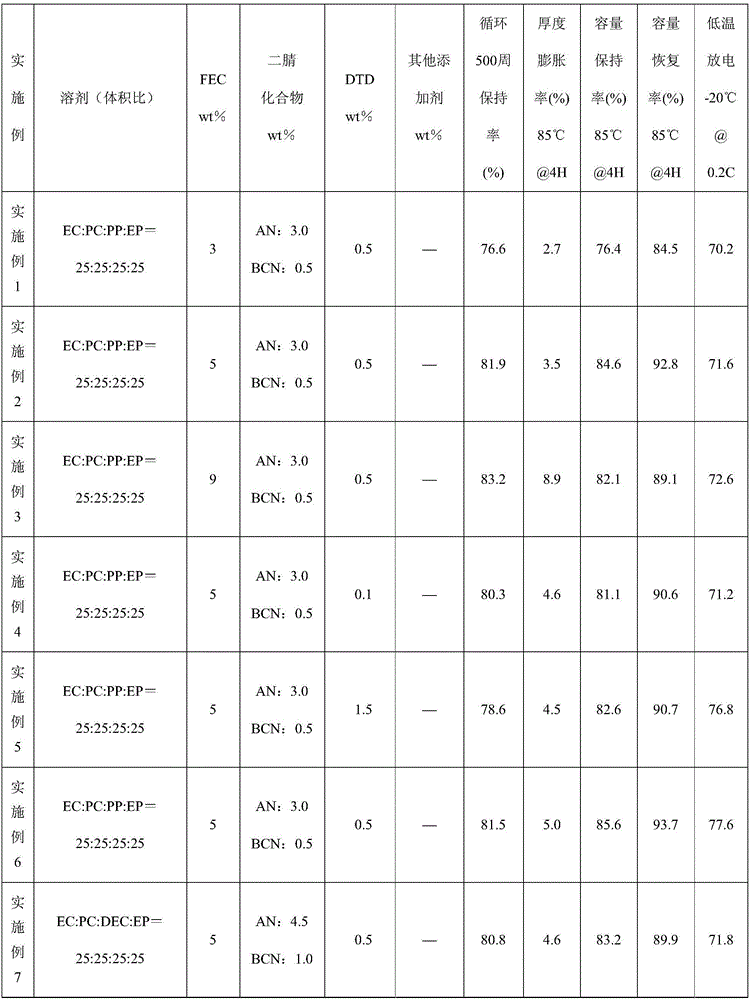
Figure 3
Abstract
Description
technical field
[0001] The invention relates to the technical field of lithium-ion battery preparation, in particular to a PC-based high-voltage electrolyte and a lithium-ion battery. Background technique
[0002] Lithium-ion battery is the most competitive battery of the new generation, known as "green energy", and is the preferred technology to solve contemporary environmental pollution and energy problems. In recent years, lithium-ion batteries have achieved great success in the field of high-energy batteries, but consumers still expect batteries with higher comprehensive performance, which depends on the research and development of new electrode materials and electrolyte systems.
[0003] At present, electronic digital products such as smartphones and tablet computers have higher and higher energy density requirements for batteries, making it difficult for commercial lithium-ion batteries to meet the requirements. The energy density of the battery can be improved by: se...
Examples
Embodiment 1
[0035] The preparation method of the high-voltage lithium-ion battery in this embodiment includes a positive electrode preparation step, a negative electrode preparation step, an electrolyte preparation step, a diaphragm preparation step, and a battery assembly step;
[0036] The preparation step of the positive electrode is: mix the high-voltage positive electrode active material lithium cobaltate, conductive carbon black and binder polyvinylidene fluoride at a mass ratio of 96.8:2.0:1.2, and disperse them in N-methyl-2-pyrrolidone , to obtain the positive electrode slurry, the positive electrode slurry is evenly coated on both sides of the aluminum foil, after drying, calendering and vacuum drying, and after welding the aluminum lead-out wires with an ultrasonic welder, the positive electrode plate is obtained. The thickness of the electrode plate is 100- Between 110μm;
[0037]The preparation steps of the negative electrode are: mixing graphite, conductive carbon black, bin...
Embodiment 2
[0063] Embodiment 2 compares with comparative example 1, comparative example 2 and comparative example 3 as known, in the same additive, does not contain the comparative example 1 of PC and linear carboxylate, does not contain the comparative example 2 of linear carboxylate and does not contain In Comparative Example 3 of PC, the capacity retention rate of the 500th cycle of normal temperature cycle is 68.6%, 37.9% and 76.9%, which is lower than the retention rate of 81.9% in Example 2, corresponding to the low capacity retention rate of high temperature storage, and serious battery inflation .
[0064] figure 1 In order to use the Pt electrode as the working electrode, lithium metal as the reference electrode and the counter electrode to perform linear sweep voltammetry, the results show that the oxidation decomposition potential of the system mixed with linear carboxylate EP or PP in PC is hysteresis, indicating that PC and EP or PP The mixed solvent system has improved oxi...