
Pesticide composition containing spirodiclofen and flufenoxuron
A technology of pesticide composition and flubronuron, which is applied to acaricides, animal repellents, plant growth regulators, etc., can solve the problems of different mechanisms of action, reduce mu dosage, reduce adverse effects, and easily overcome effect of resistance
Patent Information
- Authority / Receiving Office
- CN · China
- Patent Type
- Applications(China)
- Current Assignee / Owner
- Publication Date
- 2017-01-04
- Estimated Expiration
- Not applicable · inactive patent
Smart Images
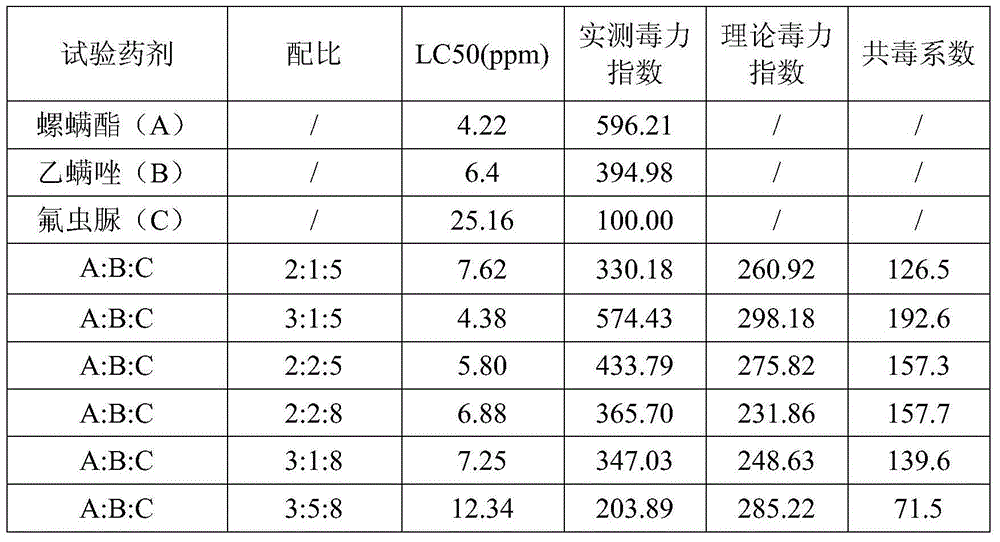
Figure 1 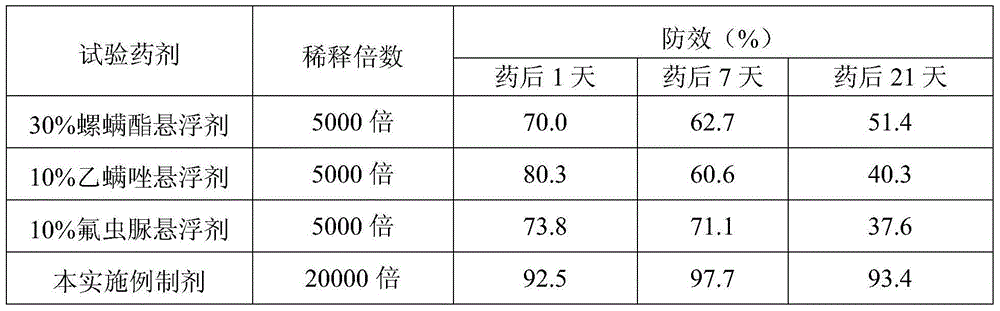
Figure 2
Abstract
Description
technical field
[0001] The invention relates to a pesticide composition, in particular to an acaricidal composition containing spirodiclofen and flufenuron, which is used for preventing and controlling harmful mites of citrus trees. Background technique
[0002] Citrus spider mite, also known as Citrus Panonychus, belongs to Acaridae and Tetranychidae. It is distributed in Sichuan, Yunnan, Guangxi, Guangdong and other provinces. It gathers adults and nymphs on leaves, twigs and peels to absorb juice, often causing massive Symptoms such as leaf fall, spotted fruit, and fruit drop. Due to its strong reproductive ability, short life cycle, and frequent attacks all year round, red spiders are very easy to develop resistance to acaricides and the efficacy of the drugs is significantly reduced. Therefore, compounds with new acaricidal sites and different mechanisms of action are developed The combination of specific pesticides is the best way to solve the problem of resistance. ...
Examples
Embodiment 1
[0010] Example 1: Toxicity determination of spirodiclofen, etoxazole and flubenzuron and different ratios to Panonychus citrus
[0011] The test method refers to the "People's Republic of China Agricultural Industry Standard NY / T1154.12-2006". The female adults of Panonychus citrus collected from the field were reared indoors for 30 generations, and the female adults with uniform growth were selected as the test insects. Adopt the small seedling method, that is, inoculate 50-60 heads of all claw mites on small pots of citrus seedlings, check the base number one day later, pick out dead mites, and add live adult mites, and keep the number of mites for each treatment at about 50. Spray the seedlings with mites using a spray tower, move them to culture at 25°C and 90% relative humidity, check after 15 days, record the number of survivors, use DPS data processing software for statistical analysis, calculate the regression curve, and calculate the LC 50 , using the co-toxicity coe...
Embodiment 2
[0021] Example 2: Preparation method and field test of 18% spirodiclofen·etoxazole·flubenzuron suspension concentrate
[0022] Formula: Spirodiclofen 6%, Etoxazole 2%, Flubenzuron 10%, Nonylphenol Polyoxyethylene Ether 12%, Sodium Methyl Naphthalene Sulfonate Formaldehyde Condensate 8%, Xanthan Gum 5%, Deionized Water makes up 100%.
[0023] According to the requirements of the formula, the above components are uniformly mixed according to the amount of the formula, and the 18% spirodiclofen·etoxazole·flubenzuron suspension concentrate is obtained after being ground by a sand mill.
[0024] The preparation of this embodiment is used to prevent and control Panonychus citrus in the sugar orange orchard. The test time is August 2014. The conventional foliar spray is used to uniformly prevent and control, and the leaves are wet. There were more adult mites of Panonychus spp. in the field when the pesticide was applied. A total of 4 treatments were set up in the experiment, and e...