

Synthesis method of 3,4-diaminotoluene
A technology of diaminotoluene and a synthesis method, applied in the field of organic synthesis, can solve the problems of low content of finished products, brown appearance, unstable quality, etc., and achieve the effects of reduced raw material cost, high product purity, and fewer reaction steps.
Patent Information
- Authority / Receiving Office
- CN · China
- Patent Type
- Applications(China)
- Current Assignee / Owner
- Publication Date
- 2017-01-25
- Estimated Expiration
- Not applicable · inactive patent
Smart Images
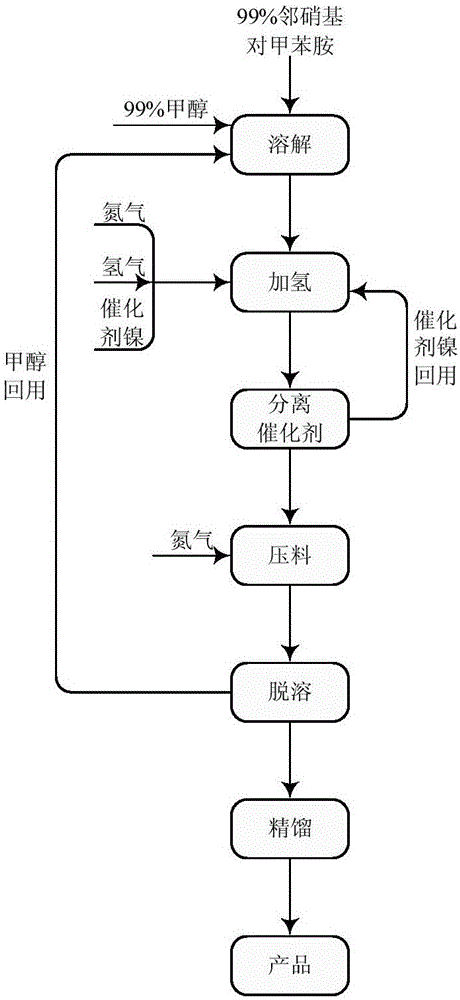
Figure 1 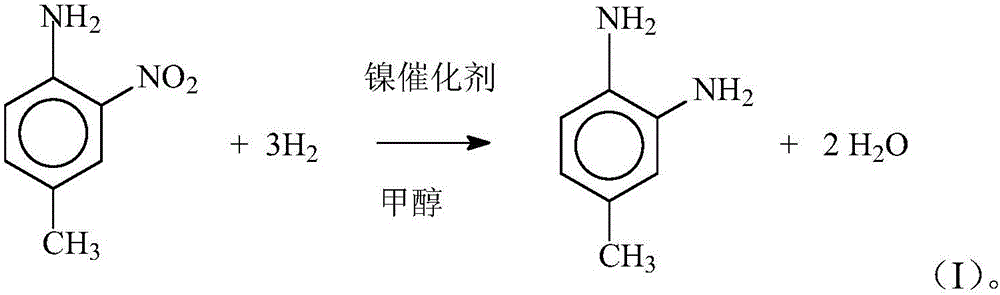
Figure 2
Abstract
Description
technical field
[0001] The invention relates to a synthesis method of 3,4-diaminotoluene, which belongs to the technical field of organic synthesis. Background technique
[0002] 3,4-diaminotoluene (also known as 4-methyl-o-phenylenediamine) is an important organic intermediate used in the synthesis of high-grade organic pigments to disperse fluorescent yellow and in the synthesis of metals (such as silver, copper, lead, nickel, Zinc, etc.) antirust agent and corrosion inhibitor (5-methylbenzotriazole), widely used in antirust oil (grease) products, mostly used for copper and copper alloy vapor phase corrosion inhibitor circulating water treatment Agents, automotive antifreeze, polymer stabilizers, plant growth regulators, lubricating oil additives, ultraviolet absorbers, etc.
[0003] In the prior art, the synthetic method of 3,4-diaminotoluene has two kinds, and a kind of is to adopt ortho-nitro-p-toluidine as raw material, through alkali sulfide reduction, after the redu...
Examples
Embodiment 1
[0016] Add 300 grams of o-nitro-p-toluidine to a 1500 ml three-necked flask equipped with a reflux condenser, then add 450 grams of methanol, stir, and heat the material to 50-55 ° C for 30 minutes to dissolve. Add the above-mentioned methanol solution of o-nitro-p-toluidine to a 1-liter autoclave, then add 30 grams of Ni catalyst, and replace with nitrogen and hydrogen. Start stirring and heat up to 60°C, start hydrogenation, control hydrogenation pressure 1-3MPa, temperature 65-75°C, maintain for 1 hour after hydrogenation, exhaust hydrogen, discharge, remove methanol under normal pressure, and then under reduced pressure The water was removed, and finally 233.6 g of 3,4-diaminotoluene was obtained through rectification under reduced pressure, with a content of 99.5% and a yield of 97%.
[0017] Concrete reaction steps are shown in formula (I):
[0018]
Embodiment 2
[0020] Add 300KG o-nitro-p-toluidine into a 1500L enamel reaction kettle equipped with a reflux condenser, then add methanol 450kg methanol, start stirring, and raise the temperature of the material to 50-50 to dissolve for 30 minutes. The above-mentioned methanol solution of o-nitro-p-toluidine was poured into a 1000-liter autoclave with a stainless steel pump, and then 30 kg of Ni catalyst was added, and replaced with nitrogen and hydrogen. Turn on stirring and heat up to 60°C, start hydrogenation, control hydrogenation pressure 1-3MPa, temperature 65-75°C, keep hydrogenation for 1 hour, exhaust hydrogen, discharge, methanol is removed under normal pressure, and then under reduced pressure The water was removed, and finally 233kg of 3,4-diaminotoluene was obtained through rectification under reduced pressure, with a content of 99.6% and a yield of 96.7%.