
Biimidazole cation alkaline anion exchange membrane based on polyphenylene ether and preparation method thereof
A basic anion and biimidazolium cation technology, which is applied in the field of biimidazolium cation basic anion exchange membrane and its preparation, can solve the problems of low mechanical strength and difficult membrane electrodes, and achieve simple preparation process, excellent alkali resistance, and preparation The effect of simple and safe process
Patent Information
- Authority / Receiving Office
- CN · China
- Patent Type
- Applications(China)
- Current Assignee / Owner
- Publication Date
- 2017-11-24
Smart Images
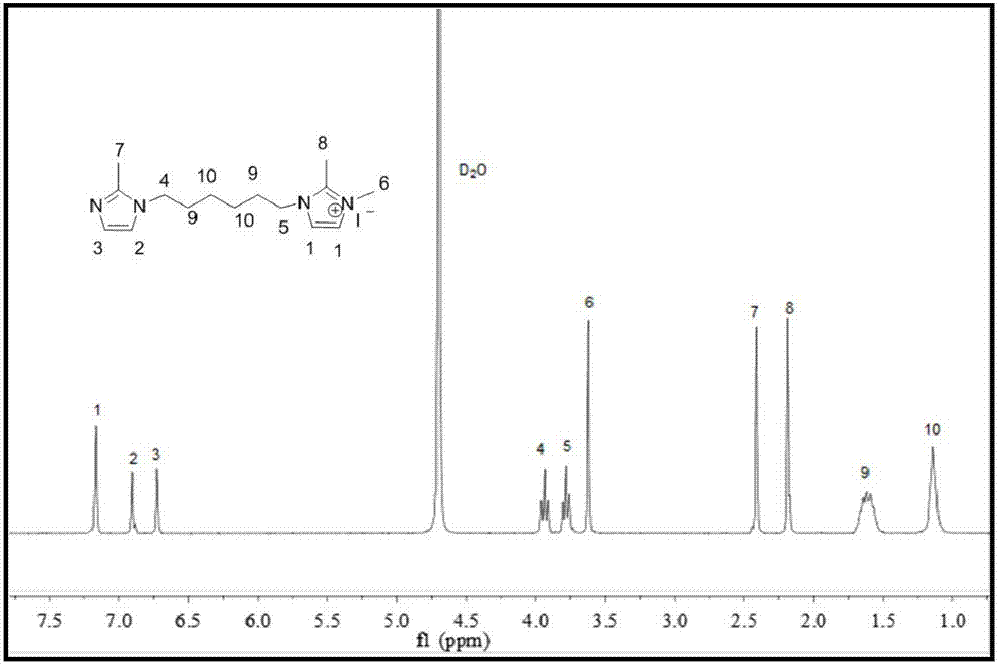
Figure 1 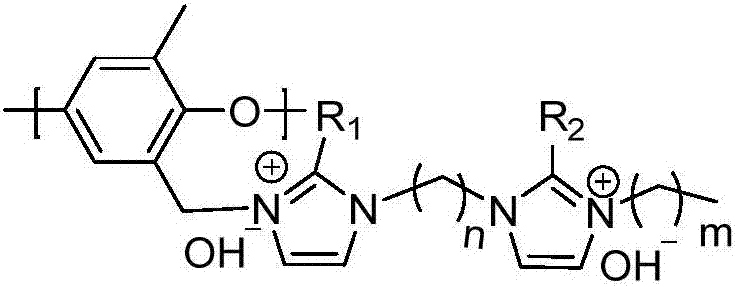
Figure 2 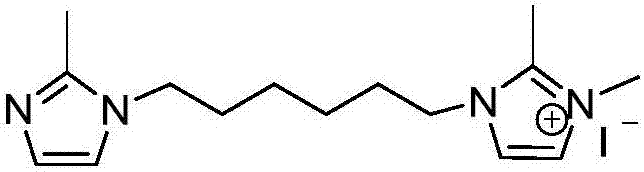
Figure 3
Abstract
Description
technical field
[0001] The invention belongs to the field of preparation of anion exchange membranes for fuel cells, in particular to a polyphenylene ether-based bisimidazolium cation alkaline anion exchange membrane and a preparation method thereof. Background technique
[0002] Anion exchange membranes consist of matrix materials and active groups, and are widely used in water treatment, chemical separation, and alkaline fuel cells. The common preparation method of the traditional anion exchange membrane is to chloromethylate the commercially available polymer, and then carry out reactions such as quaternization and anion exchange. Among them, the highly toxic carcinogen chloromethyl ether will be used in the chloromethylation process, which is very harmful to the environment and the human body. Moreover, the thermal stability and chemical stability of traditional polymer anion exchange membranes are low. Under high temperature or alkaline conditions, the quaternary ammon...
Examples
Embodiment 1
[0026] Dissolve 3.00g (36.50mmol) 2-methylimidazole in 25ml acetonitrile, add 4.45g (18.25mmol) 1,6-dibromohexane and 4.1g (73.00mmol) KOH, nitrogen protection, room temperature (25°C, The same below), reacted for 24 hours, dissolved the crude product in water, extracted the crude product with dichloromethane, repeated three times, and dried the product to obtain a white solid product;
[0027] 1.00g (4.06mmol) of the white solid product prepared above and 0.58g (4.06mmol) of methyl iodide were dissolved in 25ml of ethyl acetate, reacted at room temperature for 4 hours, separated and purified to obtain the functional monomer containing the biimidazole structure, the molecule The structure is:
[0028]
[0029] The preparation of other functional monomers containing bis-imidazole structure can also refer to this preparation method.
Embodiment 2
[0031] 0.4g (2.86mmol) bromination degree is 25% BrPPO and 0.74g (2.86mol) prepared in Example 1 Dissolve in 25ml of N-methylpyrrolidone, react at 30°C for 6 hours, place the mixed solution in a polytetrafluoroethylene template, and dry at 70°C for 2 hours to prepare a halogen-type anion exchange membrane;
[0032] Place the obtained halogen-type anion exchange membrane in 1M KOH solution and soak it at 60°C for 24 hours. After the halogen anion is completely exchanged into OH-, remove the residual KOH with deionized water to obtain the OH-type anion-exchange membrane.
[0033] The OH-type anion exchange membrane obtained in this example has a water absorption rate of 55.56%, a swelling degree of 21.36%, an ion exchange capacity of 1.25 mmol / g, and an ion conductivity of 11.57 mS cm at room temperature. -1 , the ion conductivity at 90°C is 32.40mS·cm -1 .
[0034] The membrane was immersed in 1M KOH solution for 400 hours, and its conductivity was measured again. The ion co...
Embodiment 3
[0036] 0.4g (2.71mmol) of BrPPO with a bromination degree of 35% and 0.67g (2.71mmol) Dissolve in 25ml of N-methylpyrrolidone, react at 50°C for 4 hours, place the mixed solution in a polytetrafluoroethylene template, and dry at 70°C for 2 hours to prepare a halogen-type anion exchange membrane;
[0037] Place the obtained halogen-type anion exchange membrane in 1M KOH solution and soak it at 60°C for 24 hours. After the halogen anion is completely exchanged into OH-, remove the residual KOH with deionized water to obtain the OH-type anion-exchange membrane.
[0038] The OH-type anion exchange membrane obtained in this example has a water absorption rate of 58.14%, a swelling degree of 21.58%, an ion exchange capacity of 1.31 mmol / g, and an ion conductivity of 14.23 mS cm at room temperature. -1 , the ion conductivity at 90°C is 35.02mS·cm -1 .
[0039] The membrane was immersed in 1M KOH solution for 400 hours, and its conductivity was measured again. The ion conductivity ...