
Method for preparing graphene-loaded antimony nanotube negative electrode material for sodium ion battery and application of graphene-loaded antimony nanotube negative electrode material
A technology for sodium ion batteries and negative electrode materials, which is applied in battery electrodes, secondary batteries, circuits, etc., and can solve problems such as poor electrode stability, particle pulverization, and capacity reduction.
Patent Information
- Authority / Receiving Office
- CN · China
- Current Assignee / Owner
- Publication Date
- 2018-08-14
Smart Images
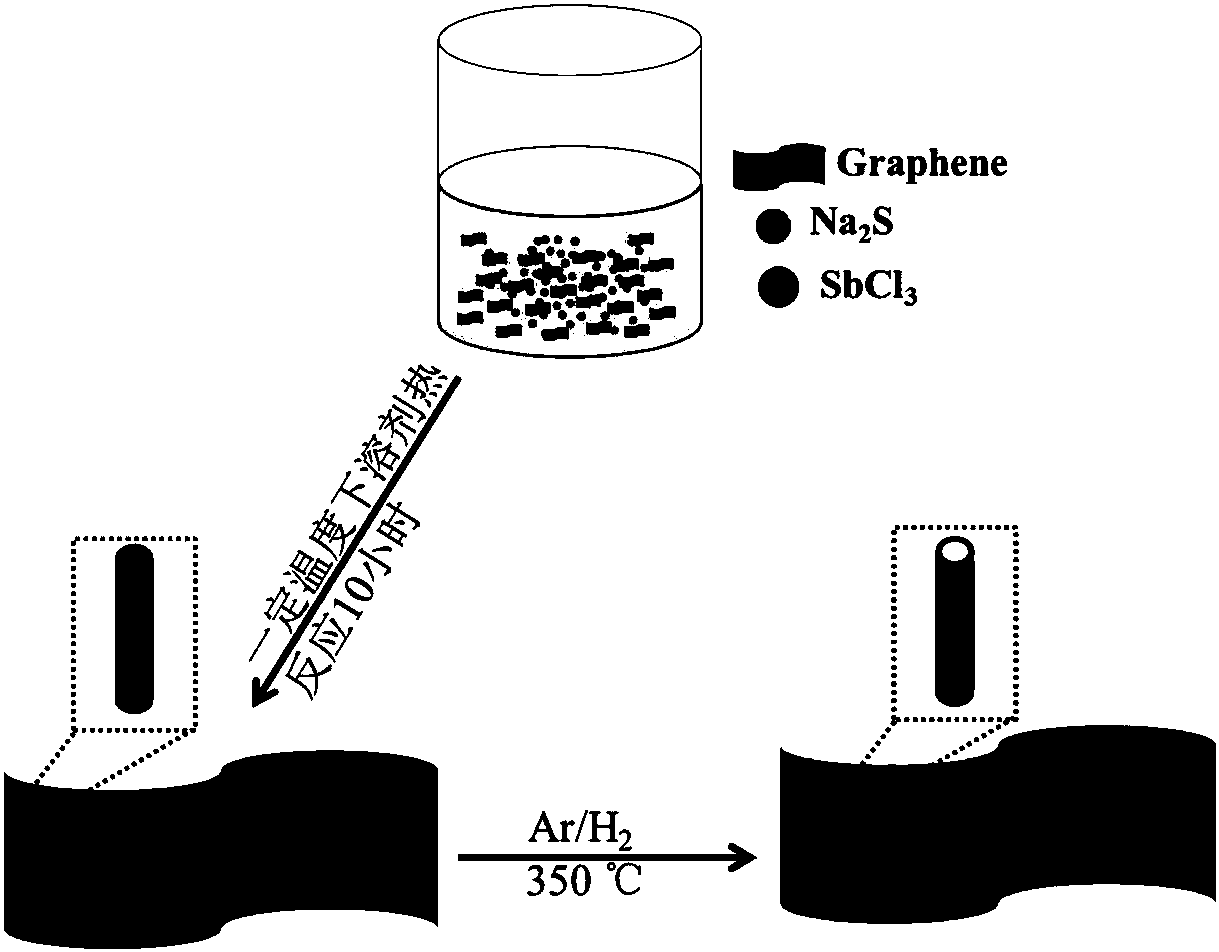
Figure 1
Abstract
Description
technical field
[0001] The invention relates to the technical field of battery materials, in particular to a method for preparing a graphene-supported antimony nanotube negative electrode material for a sodium ion battery and an application thereof. Background technique
[0002] With the rapid development of the battery industry, the disadvantages of lithium-ion batteries are becoming more and more obvious. Lithium resource reserves are limited and can no longer meet people's growing energy needs. However, sodium-ion batteries will gradually become the mainstream due to their low cost, abundant reserves and wide distribution. Ideal replacement for lithium-ion batteries.
[0003] Battery technology is the threshold for the vigorous promotion and development of electric vehicles, and the current battery industry is at a time when both lead-acid batteries and traditional lithium batteries are facing bottlenecks. bring about new changes.
[0004] Graphene is a planar film comp...
Examples
Embodiment 1
[0034] (1). Add 3mmol Na 2 S·9H 2 O is dissolved in 20ml ethylene glycol to obtain solution A;
[0035] (2). Add 1mmol SbCl 3 Dissolve in 20ml ethylene glycol to obtain solution B;
[0036] (3). Add solution B dropwise to solution A and stir to obtain solution C;
[0037] (4). 2ml concentration of 1mg / ml graphene dispersion was added to solution C and transferred to a polytetrafluoroethylene-lined autoclave, and synthesized product D was obtained after maintaining at 120°C for 3h;
[0038] (5). The product D was synthesized by solvothermal reaction at 120°C for 10 hours, centrifuged at 10,000 rpm, washed with deionized water and ethanol, and dried at 85°C for 12 hours to obtain product E;
[0039] (6). Product E in H 2 Annealed at 350 °C for 12 h in a mixed atmosphere with Ar to obtain graphene-supported antimony nanotube composites. (Such as figure 1 shown)
[0040] Gained graphene-supported antimony nanotube composite material is used as a sodium-ion battery negative...
Embodiment 2
[0043] (1) Add 3mmol Na 2 S·9H 2 O is dissolved in 20ml ethylene glycol to obtain solution A;
[0044] (2) 2mmolSbCl 3 Dissolve in 20ml ethylene glycol to obtain solution B;
[0045] (3) Add solution B dropwise to solution A and stir to obtain solution C;
[0046] (4) 2ml concentration of 1mg / ml graphene dispersion was added to solution C and transferred to a polytetrafluoroethylene-lined autoclave, kept at 120°C for 3h to obtain synthetic product D;
[0047] (5) The synthesized product D was synthesized by solvothermal reaction at 120°C for 10 hours, centrifuged at 10,000 rpm, washed with deionized water and ethanol, and dried at 85°C for 12 hours to obtain product E;
[0048] (6) The product E is in H 2 Or annealing at 350° C. for 12 h in an Ar atmosphere to obtain a graphene-supported antimony nanotube anode material.
[0049] Gained graphene loaded antimony nanotube negative electrode material electrochemical test method is as follows:
[0050] A button cell is used...
Embodiment 3
[0052] (1) Add 3mmol Na 2 S·9H 2 O is dissolved in 20ml ethylene glycol to obtain solution A;
[0053] (2) 3mmolSbCl 3 Dissolve in 20ml ethylene glycol to obtain solution B;
[0054] (3) Add solution B dropwise to solution A and stir to obtain solution C;
[0055] (4) 2ml concentration of 1mg / ml graphene dispersion was added to solution C and transferred to a polytetrafluoroethylene-lined autoclave, kept at 120°C for 3h to obtain synthetic product D;
[0056](5) The synthesized product D was synthesized by solvothermal reaction at 200°C for 10 hours, centrifuged at 10,000 rpm, washed with deionized water and ethanol, and dried at 85°C for 12 hours to obtain product E;
[0057] (6) The product E is in H 2 Or annealing at 350° C. for 12 h in an Ar atmosphere to obtain a graphene-supported antimony nanotube anode material.
[0058] Gained graphene loaded antimony nanotube negative electrode material electrochemical test method is as follows:
[0059] A button cell is used ...