
Preparation method of landiolol hydrochloride
A technology for landiolol hydrochloride and salt formation, applied in the field of preparation of landiolol hydrochloride, can solve problems such as affecting product quality and yield, malodorous thioether, insufficient alkali stability and the like
Patent Information
- Authority / Receiving Office
- CN · China
- Current Assignee / Owner
- Publication Date
- 2018-11-06
Smart Images
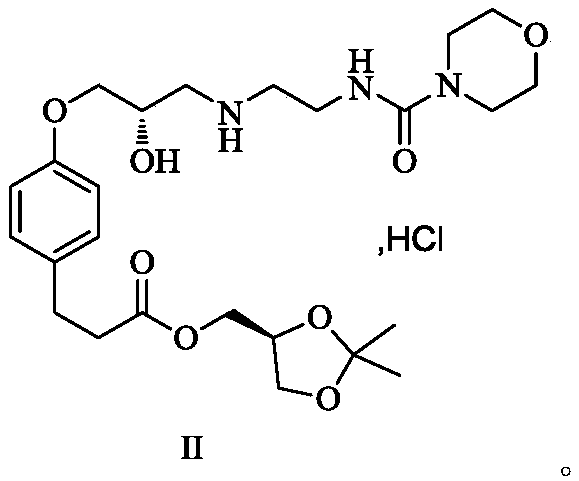
Figure 1 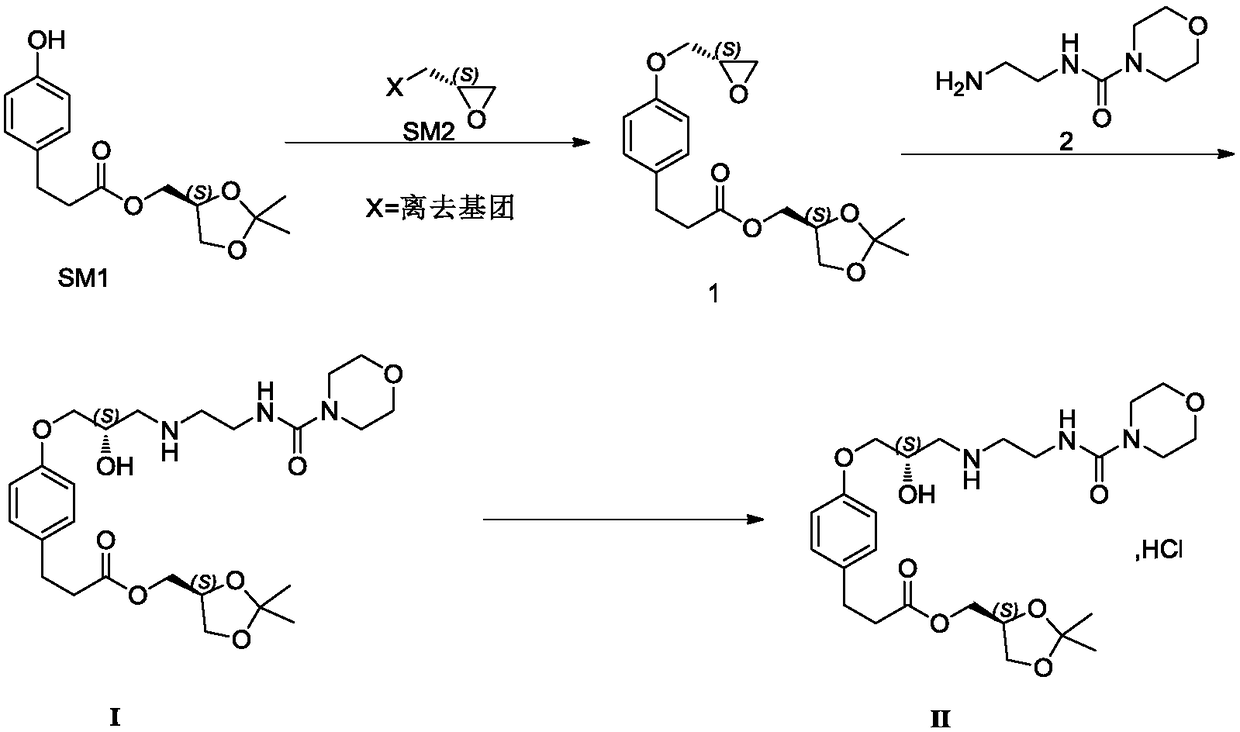
Figure 2 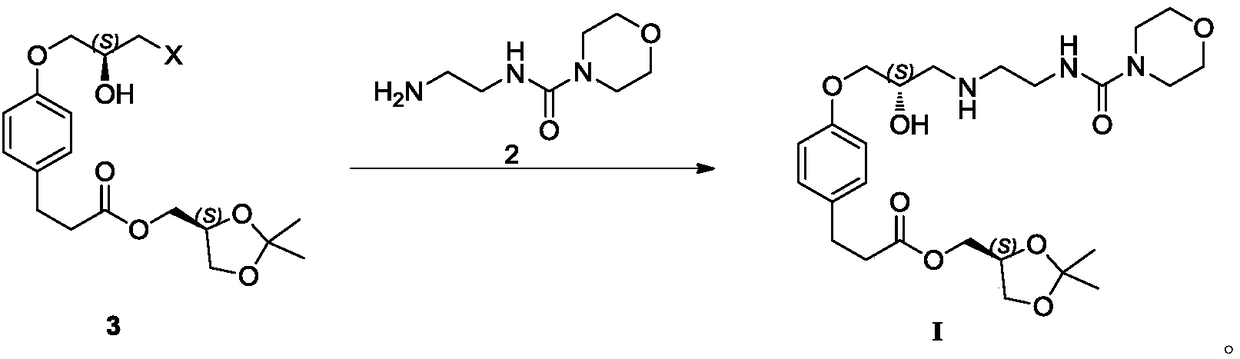
Figure 3
Abstract
Description
technical field
[0001] The invention relates to the field of drug synthesis, in particular to a preparation method of landisolol hydrochloride. Background technique
[0002] Landiolol hydrochloride (Landiolol hydrochloride, CAS: 133242-30-5), trade name: Onoact; chemical Chinese name: 4-[(2S)-2-hydroxy-3-[[2-[(4-morpholine Carbonyl)amino]ethyl]amino]propoxy]phenylpropanoic acid [(4S)-2,2-dimethyl-1,3-dioxolan-4-yl]methyl ester hydrochloride, which has Chemical structure as shown in formula II,
[0003]
[0004] Landiolol is a selective β1-receptor blocking drug with a broad-spectrum effect, and exists in the form of hydrochloride in specific applications. It mainly antagonizes the β1 receptor present in the heart and inhibits the increase in heart rate caused by catecholamines. The drug was first developed by Japan's Ono (Ono) Pharmaceutical Industry Co., Ltd., and was first listed in Japan in September 2002. It is used for tachycardia arrhythmias (including atrial fib...
Examples
specific Embodiment approach
[0049] The following examples are used to further describe the present invention, but these examples do not limit the scope of the present invention.
[0050] Test equipment used in the experiment:
[0051] Chromatographic column: Octadecylsilane bonded silica gel as filler
[0052] Detection wavelength: 223nm
[0053] Flow rate: 0.8ml / min
[0054] Mobile phase A: Phosphate solution (take 0.5g sodium heptanesulfonate and 3.9g sodium dihydrogen phosphate, add water 1000mL to dissolve)-methanol (60:40)
[0055] Mobile Phase B: Methanol
[0056] Carry out gradient elution according to the following table:
[0057]
[0058] The experimental methods not indicating specific conditions in the examples of the present invention are generally in accordance with conventional conditions, or in accordance with the conditions suggested by raw material or commodity manufacturers. Reagents without specific sources indicated are conventional reagents purchased in the market.
Embodiment 1、4
[0059] Example 1, 4-[(2S)-3-cyclopropoxy]phenylpropanoic acid [(4S)-2,2-dimethyl-1,3-dioxolan-4-yl]methyl ester ( The preparation of formula 1)
[0060]
[0061] Add acetonitrile (9.0kg) in reactor, 600g 4-hydroxyphenylpropionic acid [(4S)-2,2-dimethyl-1,3-dioxolan-4-yl] methyl ester and 566g (S )-glycidyl m-nitrobenzenesulfonate, then add potassium carbonate (1.18kg). Then the reaction system was raised to 62-70°C for reaction. After the reaction, the reaction system was cooled down to room temperature. After filtration, the filtrate was concentrated to dryness to obtain an oil, which was directly used in the next reaction.
Embodiment 2
[0062] Embodiment 2, the preparation of N-(2-aminoethyl)-4-morpholine formamide (formula 2 compound)
[0063]
[0064] After adding 30 kg of dichloromethane and 3.0 kg of N-(2-aminoethyl)-4-morpholine formamide oxalate into the reaction kettle, 5.0 kg of anhydrous sodium sulfate and 1.14 kg of sodium hydroxide were added. React at 30°C for 15-18h. After filtration, the filtrate was concentrated to dryness under reduced pressure to obtain about 1.97 kg of light yellow oil, with a yield of 99.5%.