
Biological pretreatment technology of low-grade refractory gold ore
A biological pretreatment and pretreatment technology, applied in the direction of improving process efficiency, etc., can solve the problems of hindering the oxidation and dissolution of gold ore, long biological oxidation cycle, and unsuitable high sulfur content, so as to achieve significant economic and social benefits and reduce biological Poisoned, obviously advanced effects
Patent Information
- Authority / Receiving Office
- CN · China
- Patent Type
- Applications(China)
- Current Assignee / Owner
- Publication Date
- 2018-11-23
- Estimated Expiration
- Not applicable · inactive patent
Smart Images
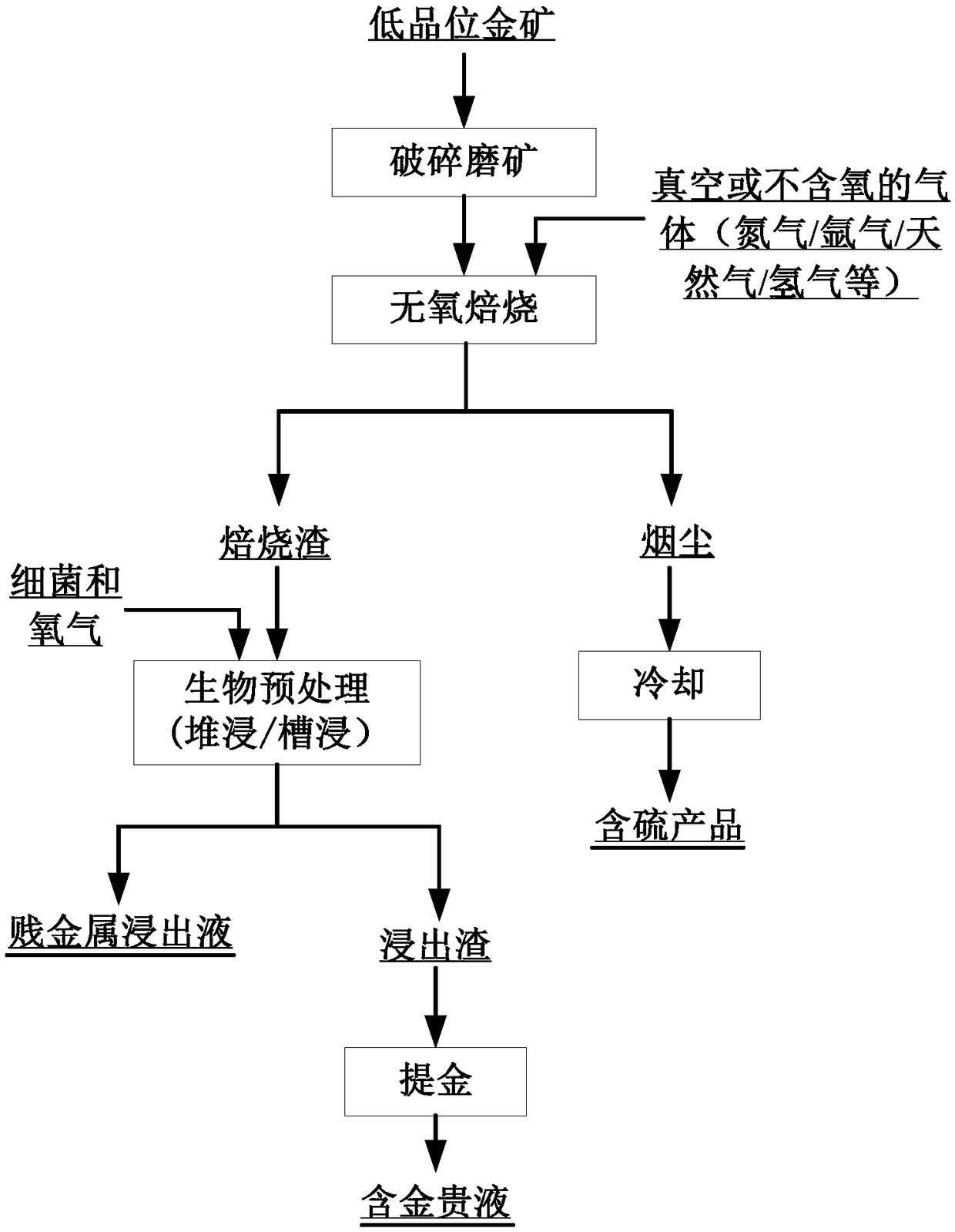
Figure 1
Abstract
Description
technical field
[0001] The invention relates to a biological pretreatment process of low-grade refractory gold ore, and belongs to the technical field of gold ore biological pretreatment. Background technique
[0002] As people's demand for gold and other precious metals continues to increase, gold mining companies have achieved unprecedented development. However, with the progress of gold mining, the resources of easy-to-handle gold mines are gradually exhausted. At present, most enterprises are faced with difficult-to-handle low-grade gold mines. Sulfur-containing low-grade gold ore is a typical type of refractory gold ore. It is directly treated by traditional cyanidation method, and the gold leaching rate is very low. The treatment process is different from conventional gold ore, and a pretreatment is required before cyanidation. The purpose of the process is to oxidize and decompose gold-bearing minerals such as pyrite, arsenopyrite and other metal sulfides, and separa...
Examples
Embodiment 1
[0047] In this embodiment, a refractory gold mine in Guangxi is selected. Most of the gold is wrapped in sulfide, and its composition is 1.4g / t of gold, 9.1% of iron, 1.6% of sulfur, and 1.1% of carbon. The specific operation steps and process parameters used in this example are as follows: take 100 grams of the refractory gold ore and crush it, ball mill it into powder, and the particle size is less than 20 mm, accounting for 95%, put it into a rotary kiln, put it into a closed heating, and feed nitrogen for anaerobic Roasting, the calcination temperature is controlled at 1000°C, and the calcination time is 0.25 hours. The smoke generated by roasting is cooled to obtain sulfur. The roasted slag is piled up and pretreated by bioheap leaching. The strains used are the mixed strains of Microspirillum ferrooxidans, Thiobacillus ferrooxidans, Thiobacillus sulfoxidans and Sulfolobus. Commercially available bacterial classifications can be used, such as the bacteria-containing rati...
Embodiment 2
[0051] In this embodiment, a refractory gold mine in Xinjiang is selected. The gold is wrapped in sulfide in the form of fine particles, and its composition is 10g / t gold, 8.5% iron, 3.1% sulfur, 0.7% copper, 1.8% arsenic, and 0.3% antimony. %. The specific operation steps and process parameters adopted in this example are as follows: 100 grams of this refractory gold ore is crushed, ball milled, and the particle size is less than 0.074 mm, accounting for 95%, and placed in a vacuum furnace for roasting, and the roasting temperature is controlled at 600 ° C. The calcination time is 4 hours, and the reaction residual pressure is 200Pa. Sulfur, arsenic, antimony, arsenic sulfide and antimony sulfide can be obtained by cooling the soot generated by roasting. The roasted slag is placed in the reaction kettle through pulping and adopts the pretreatment process of biological tank immersion. The mixed bacteria in the strain 4 used, that is, according to the proportion of the number ...
Embodiment 3
[0055] In this embodiment, a refractory gold mine in Liaoning is selected. The gold is wrapped in sulfide, and its composition is 0.1 g / t of gold, 5.3% of iron, 1.2% of sulfur, and 0.5% of arsenic. The specific operation steps and process parameters that this example adopts are as follows: get 100 grams of this refractory gold ore crushing, ball milling, particle size is to be less than 20mm and account for 75%, put the mixed gas of hydrogen and natural gas into heating furnace (both volumes The ratio is 1:1) for roasting, the roasting temperature is controlled at 700°C, and the roasting time is 2 hours. The soot generated by roasting is cooled to obtain products such as hydrogen sulfide. The roasted slag is piled up and pretreated by bioheap leaching. The bacteria used are in proportion to the number of bacteria: Microspiral ferrooxidans (BNCC173516) accounts for 1%, Thiobacillus ferrooxidans (BNCC170088) accounts for 40%, Sulfobacillus (BNCC173437) accounts for 34%, Sulfolo...