
Composition, kit and detection method for detecting gene SNP (Single Nucleotide Polymorphism) related to deafness
The technology of a composition and a kit is applied in the direction of biochemical equipment and methods, recombinant DNA technology, and the determination/testing of microorganisms, which can solve the problems of lack of reliable solutions, avoid adverse reactions, improve accuracy and sensitivity, Concise effect on graph
Patent Information
- Authority / Receiving Office
- CN · China
- Patent Type
- Applications(China)
- Current Assignee / Owner
- Publication Date
- 2022-05-27
Smart Images
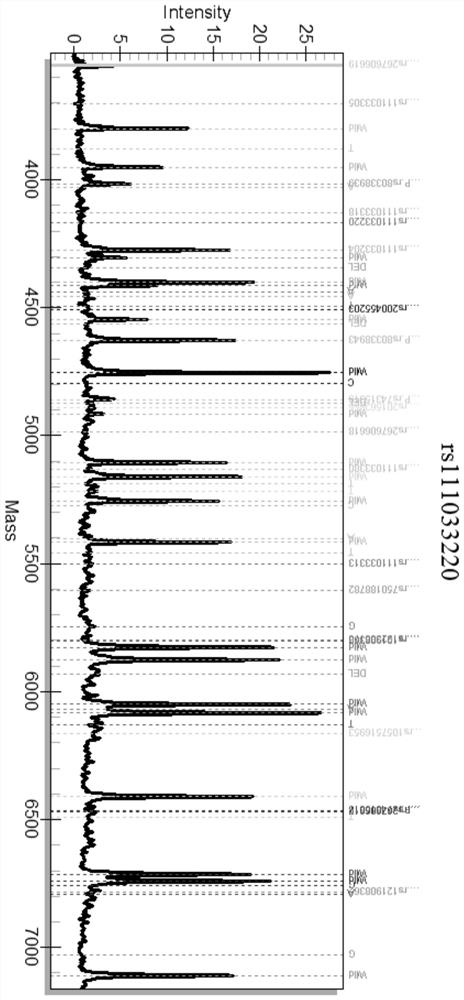
Figure 1 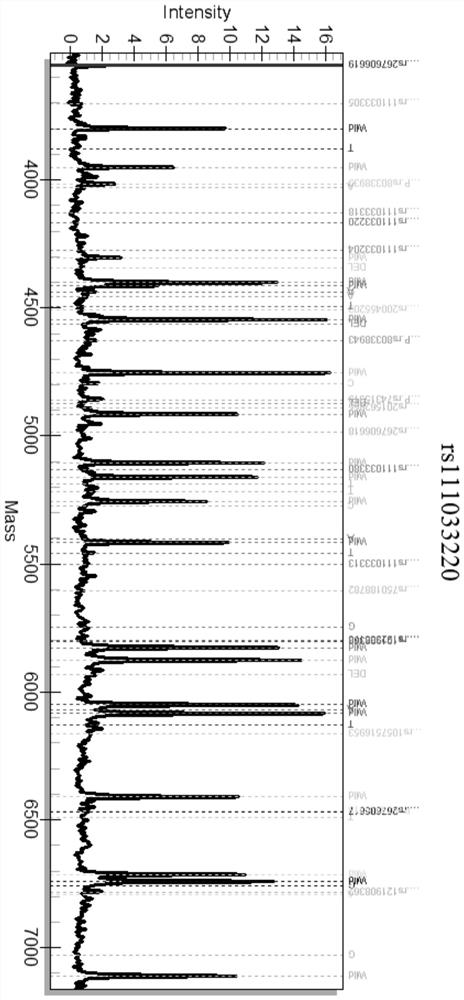
Figure 2 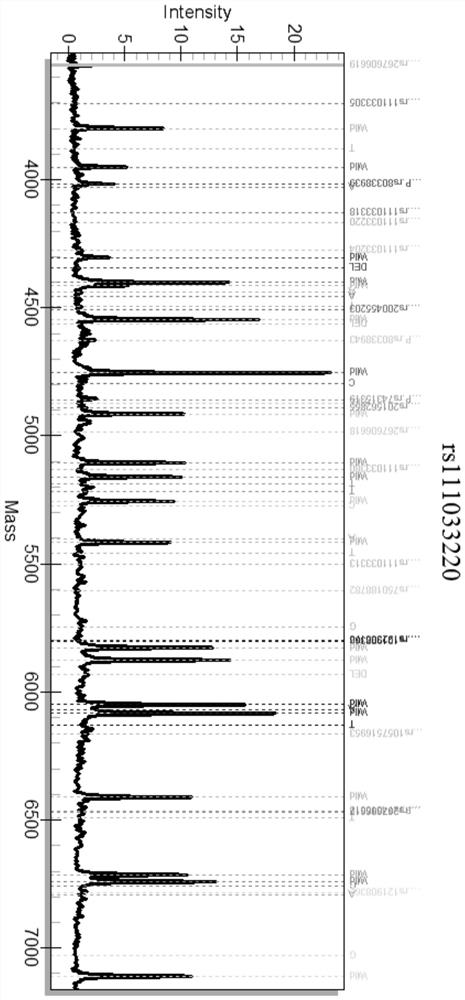
Figure 3
Abstract
Description
technical field
[0001] The invention relates to the field of biotechnology, in particular to a composition, a kit and a detection method for detecting a gene SNP related to deafness. Background technique
[0002] According to the "Report on the Prevention and Treatment of Birth Defects in China (2012)", my country is a country with a high incidence of birth defects, with up to 900,000 new cases of birth defects every year. The screening, treatment and prevention of birth defects are imminent. Birth defects mainly include: congenital malformations, chromosomal abnormalities, inherited metabolic diseases, functional abnormalities (such as blindness, deafness and intellectual disability, etc.).
[0003] Deafness is one of the most common birth defects, and the incidence of severe hearing impairment in newborns in my country is 1%-3%. Among all deafness factors, deafness caused by genetic factors accounts for about 60%. Among the people with normal hearing in my country, there...
Examples
Embodiment 1
[0041] Example 1 Primer design and synthesis
[0042] For GJB2 gene 35delG site, 176_191del16 site, 235delC site and 299_300delAT site; GJB3 gene 538C>T site and 547G>A site; SLC26A4 gene 281C>T, 589G>A, IVS7-2A>G, 1174A >T, 1226G>A, 1229C>T, IVS15+5G>A, 1975G>C, 2027T>A, 2162C>T and 2168A>G; 12SrRNA genes 1095T>C, 1494C>T and 1555A>G. 20 gene polymorphism sites related to deafness, design corresponding specific PCR primer core sequences (SEQ ID No. 1 to SEQ ID No. 26) and specific extension primer core sequences (SEQ ID No. 27 to SEQ ID No. 26) 46).
[0043] Among them, in order to prevent the PCR primers from entering the detection window of the mass spectrometer and interfere with the detection effect, a certain number of bases are added to the 5' end of each PCR primer on the basis of the core sequence (1 to 26), and the preferred 10bp tag (ACGTTGGATG) , so that the molecular weight of the PCR primers increases beyond the detection window of the mass spectrometer.
Embodiment 2
[0044] Example 2 Multiplex PCR, single base extension, mass spectrometer detection
[0045] Components used for PCR, PCR product purification and single base extension are:
[0046] Table 1
[0047] serial number component main ingredient 1 Reaction solution I Enzyme I buffer including dNTPs, Mg 2+ Wait
2 Enzyme I Amplase 3 Amplification primers No. 1-26 primer mix 4 Reaction solution II Enzyme II buffers, including Tris-HCl, etc. 5 Enzyme II shrimp alkaline phosphatase 6 Reaction solution III Enzyme III buffer including ddNTPs, Mg 2+ Wait
7 Enzyme III elongase 8 extension primer No. 27-46 primer mix
[0048] The specific operation method is as follows:
[0049] 1. PCR amplification
[0050] 1.1 In the PCR solution area, prepare a 200ul PCR reaction tube according to the number of samples to be tested (including positive quality control, negative control, and blank control), and mark th...
Embodiment 3
[0080] Example 3 On-machine detection and result interpretation.
[0081] As mentioned above, the 20 extension primers and their extension products at the 20 gene polymorphic sites have different molecular weights according to their respective genotypes, and these molecular weights correspond to their respective mass spectrometry peaks. Then it is judged that there is a substance corresponding to the molecular weight (extension primer or product):
[0082] Judgment Criteria:
[0083] (1) If the mass spectrum peak corresponding to the wild type and the mutant type does not appear, regardless of whether the mass spectrum peak corresponding to the extension primer exists, the experiment is judged to be a failure;
[0084] (2) If only one mass spectrum peak corresponding to the wild type or mutant type appears, it is judged as a homozygous type of the genotype corresponding to the mass spectrum peak that appears;
[0085] (3) If both the mass spectrum peaks corresponding to the ...