

Dyeing process of blended fabric
A blended fabric and process technology, applied in dyeing, textile and papermaking, physical treatment, etc., can solve the problems of large color difference in fabric dyeing, low color fastness, low color fastness, etc., to improve uniformity and color fastness Degree, the effect of improving hydrophilicity
Patent Information
- Authority / Receiving Office
- CN · China
- Patent Type
- Applications(China)
- Current Assignee / Owner
- Publication Date
- 2022-08-05
Smart Images
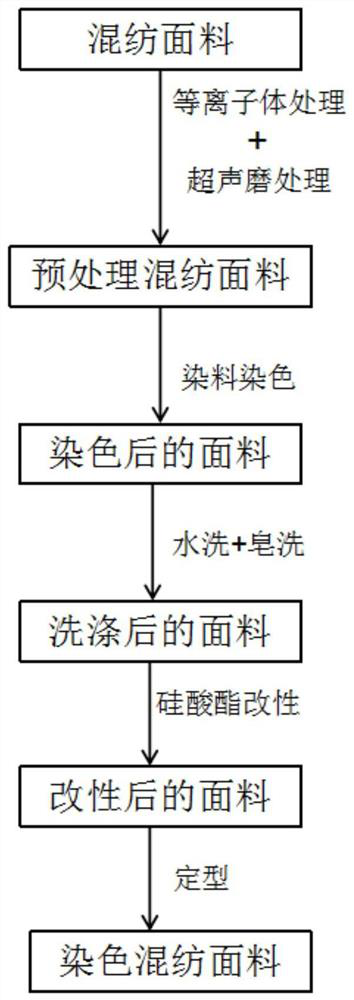
Figure 1 
Figure 2 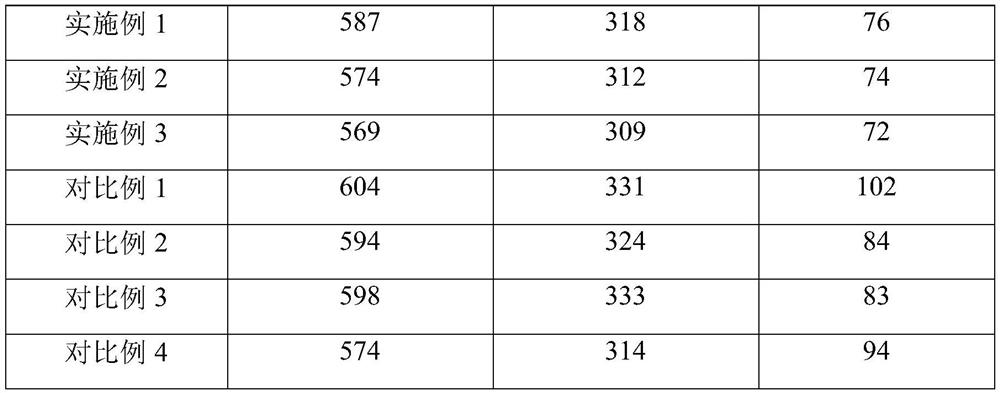
Figure 3
Abstract
Description
technical field
[0001] The present application relates to the technical field of fabric dyeing process, in particular to a dyeing process for blended fabrics. Background technique
[0002] Blended fabrics refer to textile products woven from a variety of fiber blended yarns. Blended fabrics can fully combine the advantages of various fabrics, so that the fabrics have better skin-friendly, elastic or mechanical strength and other properties to meet various usage scenarios. For example, polyester-cotton blends are textiles made of polyester as the main component and woven with 65-67% polyester and 33-35% cotton blended yarns; its characteristics are that it not only highlights the style of polyester but also the advantages of cotton fabrics, It has good elasticity and wear resistance in dry and wet conditions, stable size, small shrinkage, and has the characteristics of straightness, not easy to wrinkle, easy to wash, and quick-drying. Soak in boiling water.
[0003] There ...
Examples
Embodiment 1
[0037] 1. Blend polyester, acrylic and spandex in a ratio of 60:30:10 by knitting to obtain a blended fabric.
[0038] 2. Put the mixed fabric in the plasma cleaning machine, set the atmosphere to air atmosphere, the temperature is 25 ℃, and perform plasma treatment for 5 minutes to obtain the treated fabric, and then soak the treated blended fabric in 120g / L containing titanium dioxide nanoparticles Ultrasonic treatment was carried out in the aqueous solution of 3 h (ultrasonic power was 600W) to obtain the pretreated fabric.
[0039]3. Mix ethanol and water according to the volume ratio of 3:12, then the concentration of sodium sulfate is 75g / L, the concentration of sodium carbonate is 4g / L, the concentration of polyoxyethylene laurate is 6g / L, and the polyoxyethylene laurate is 6g / L. Ethylene glycol dioleate 12g / L, the above components were added to the mixed solvent of ethanol and water in turn, stirred to dissolve, then added safflower pigment to it according to the dye c...
Embodiment 2
[0045] The blended fabric is the same as Example 1.
[0046] 1. Put the mixed fabric in the plasma cleaning machine, set the atmosphere to air atmosphere, the temperature is 25 °C, and perform plasma treatment for 6 minutes to obtain the treated fabric, and then soak the treated blended fabric in 100g / L containing titanium dioxide nanoparticles. Ultrasonic treatment was carried out in the aqueous solution of 4h (ultrasonic power was 700W) to obtain the pretreated fabric;
[0047] 2. Mix ethanol and water according to the volume ratio of 3:12, then the concentration of sodium sulfate is 85g / L, the concentration of sodium carbonate is 2g / L, the concentration of polyoxyethylene laurate is 5g / L, and the polyoxyethylene laurate is 5g / L. Ethylene glycol dioleate 10g / L, the above components were added to the mixed solvent of ethanol and water in turn, stirred to dissolve, then safflower pigment was added to it according to the dye concentration 10% owf, heated to 50 ° C, stirred and ...
Embodiment 3
[0053] The blended fabric is the same as Example 1.
[0054] 1. Put the mixed fabric in the plasma cleaning machine, set the atmosphere to air atmosphere, the temperature is 25 ℃, and carry out plasma treatment for 8 minutes to obtain the treated fabric, and then soak the treated blended fabric in 150g / L containing titanium dioxide nanoparticles Ultrasonic treatment is carried out in the aqueous solution of 2h (ultrasonic power is 800W) to obtain the pretreated fabric;
[0055] 2. Mix ethanol and water according to the volume ratio of 3:12, then the concentration of sodium sulfate is 65g / L, the concentration of sodium carbonate is 5g / L, the concentration of polyoxyethylene laurate is 8g / L, and the polyoxyethylene laurate is 8g / L. Ethylene glycol dioleate 14g / L, the above components were added to the mixed solvent of ethanol and water in turn, stirred to dissolve, then added safflower pigment according to the dye concentration 14% owf, heated to 50 ° C, stirred and mixed. Afte...