
Process of synthesis of 5-methoxy-2-[(4-methoxy-3,5-dimethyl-2-pyridyl)methyl] sulfinyl-1 H-benzimidazole
a technology of methyl sulfinyl and h-benzimidazole, which is applied in the direction of carbonyl group formation/introduction, digestive system, organic active ingredients, etc., can solve the problems of risk of contamination of the final product with heavy metals, the ph of the aqueous phase over the reaction mixture has to be carefully monitored
Patent Information
- Authority / Receiving Office
- US · United States
- Patent Type
- Applications(United States)
- Current Assignee / Owner
- Publication Date
- 2002-01-17
- Estimated Expiration
- Not applicable · inactive patent
Smart Images
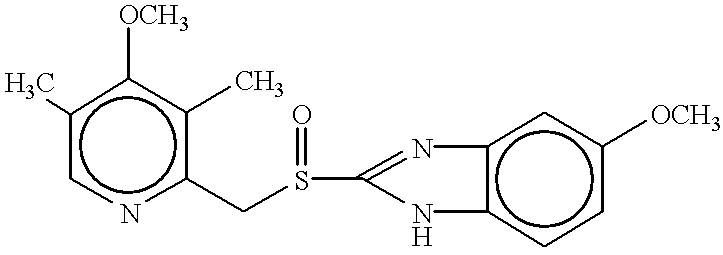
Figure 1 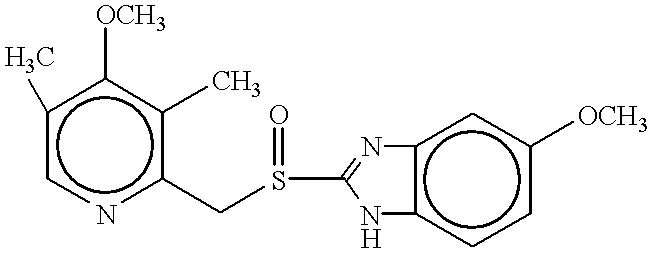
Figure 2
Abstract
Description
[0001] The present invention relates to an improved process of synthesis of 5-methoxy-2-[(4-methoxy 3,5-dimethyl-2-pyridyl)methyl]sulfinyl-1H-benz-imidazole (omeprazole) of the formula 1
[0002] wherein 5-methoxy-2-[[(4-methoxy-3,5-dimethyl-2-pyridyl)methyl]thio-]-benzimidazole is reacted with 3-chloroperoxybenzoic acid in ethyl acetate, wherein the final product--omeprazole--is poorly soluble.
[0003] Omeprazole is the first medicament from the group of formulations for controlling the secretion of gastric acid, from the group of proton pump inhibitors. Namely, it inhibits the enzyme H / K-ATPase (a proton pump) in a parietal cell and thus also inhibits the last phase of acid secretion.TECHNICAL PROBLEM
[0004] There is a constant need to prepare omeprazole of high purity in a simple and readily feasible way. In the literature processes of synthesis up to a crude omeprazole are disclosed; said omeprazole, however, contains by-products and hence it is not suitable for pharmaceutical use.PRI...
Examples
example 1
[0014] 5-methoxy-2-[[(4-methoxy-3,5-dimethyl-2-pyridyl)methyl]thio] benzimidazole (10 g; 0.0304 mole) was suspended in ethyl acetate (100 ml) and cooled below 0.degree. C. 3-chloroperoxybenzoic acid (5.25 g; 0.0304 mole) was added in such a manner that the temperature did not exceed 5.degree. C. After completed addition it was left to crystallize for another half an hour at a temperature below 5.degree. C. The product formed was filtered off, washed with ethyl acetate and dried in vacuo. Crude omeprazole (8.3 g; 79.1 %) was obtained.
[0015] Crude omeprazole (5 g) was dissolved in water (20 ml) and 40% aqueous methylamine (4 ml). The clear solution was diluted with acetone (30 ml) and the pH was adjusted to 7 to 8 with 1N HC1. To the suspension formed, water (70 ml) was added. The crystals separated were filtered off, washed with water and dried in vacuo. Pure omeprazole (4.6 g; 92%) was obtained.
example 2
[0016] 5-methoxy-2-[[(4-methoxy-3,5-dimethyl-2-pyridyl)methyl]thio]-benzim-idazole (10 g; 0.0304 mole) was suspended in ethyl acetate (100 ml) and cooled below 0.degree. C. 3-chloroperoxybenzoic acid (5.25 g; 0.0304 mole) was added in such a manner that the temperature did not exceed 5.degree. C. After the completed addition it was stirred for half an hour, the cooling was removed, a 4% sodium carbonate solution (40 ml) was added and it was stirred for another half an hour. The product was filtered off and washed with water. After drying in vacuo crude omeprazole (8.0 g; 76.2%) was obtained and it was purified according to the process disclosed in Example 1.