
Pramipexole-containing transdermal patch for treatment of neurodegenerative disease
a transdermal patch and pramipexole technology, applied in the direction of nervous disorders, drug compositions, organic active ingredients, etc., can solve the problems of hallucinations, delusions and cognitive impairment, and rls is not well known and may be easily overlooked, and affects the patients' daily life. , the effect of poor soluble conten
Patent Information
- Authority / Receiving Office
- US · United States
- Patent Type
- Patents(United States)
- Current Assignee / Owner
- Publication Date
- 2018-08-14
Smart Images
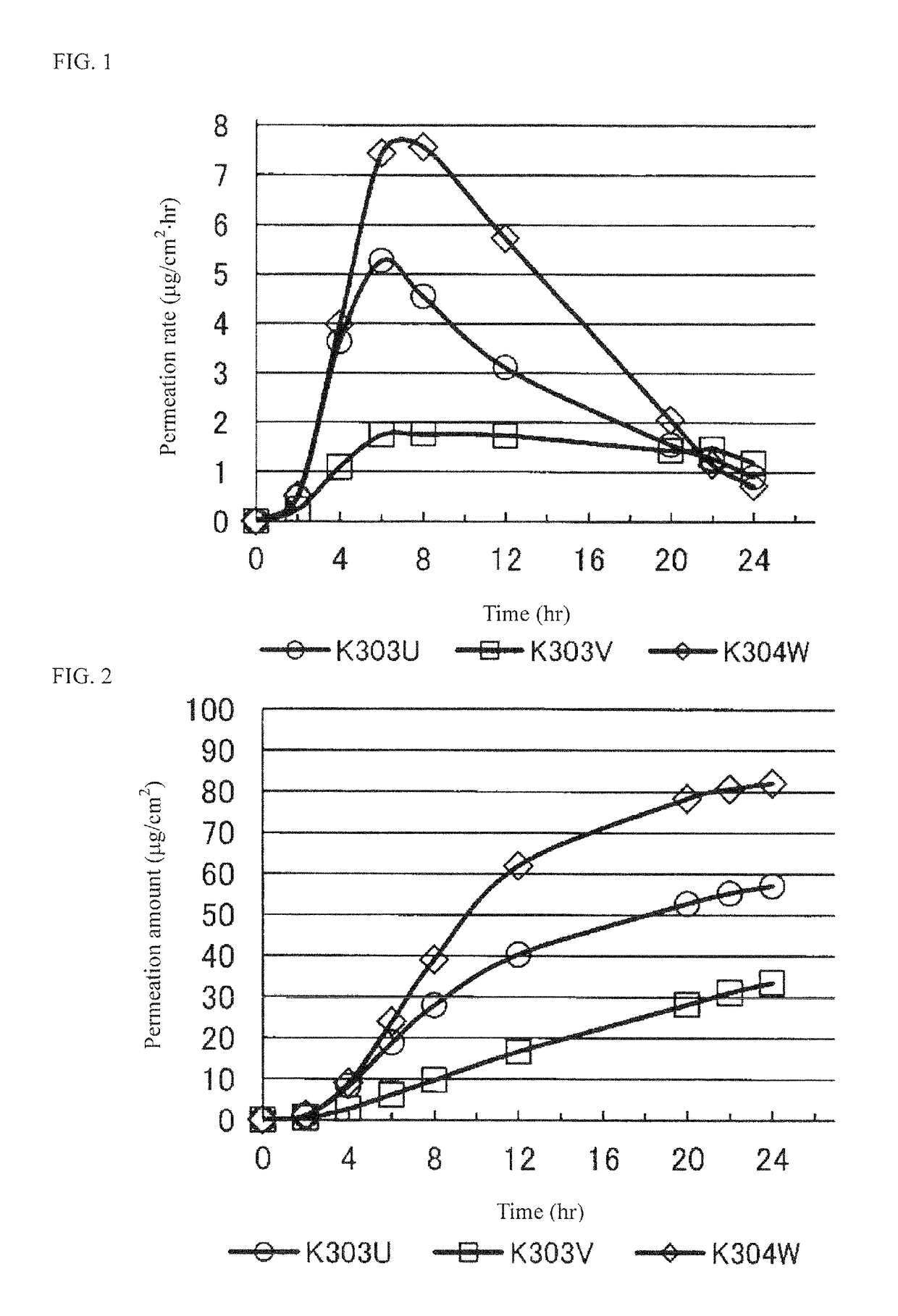
Figure 1 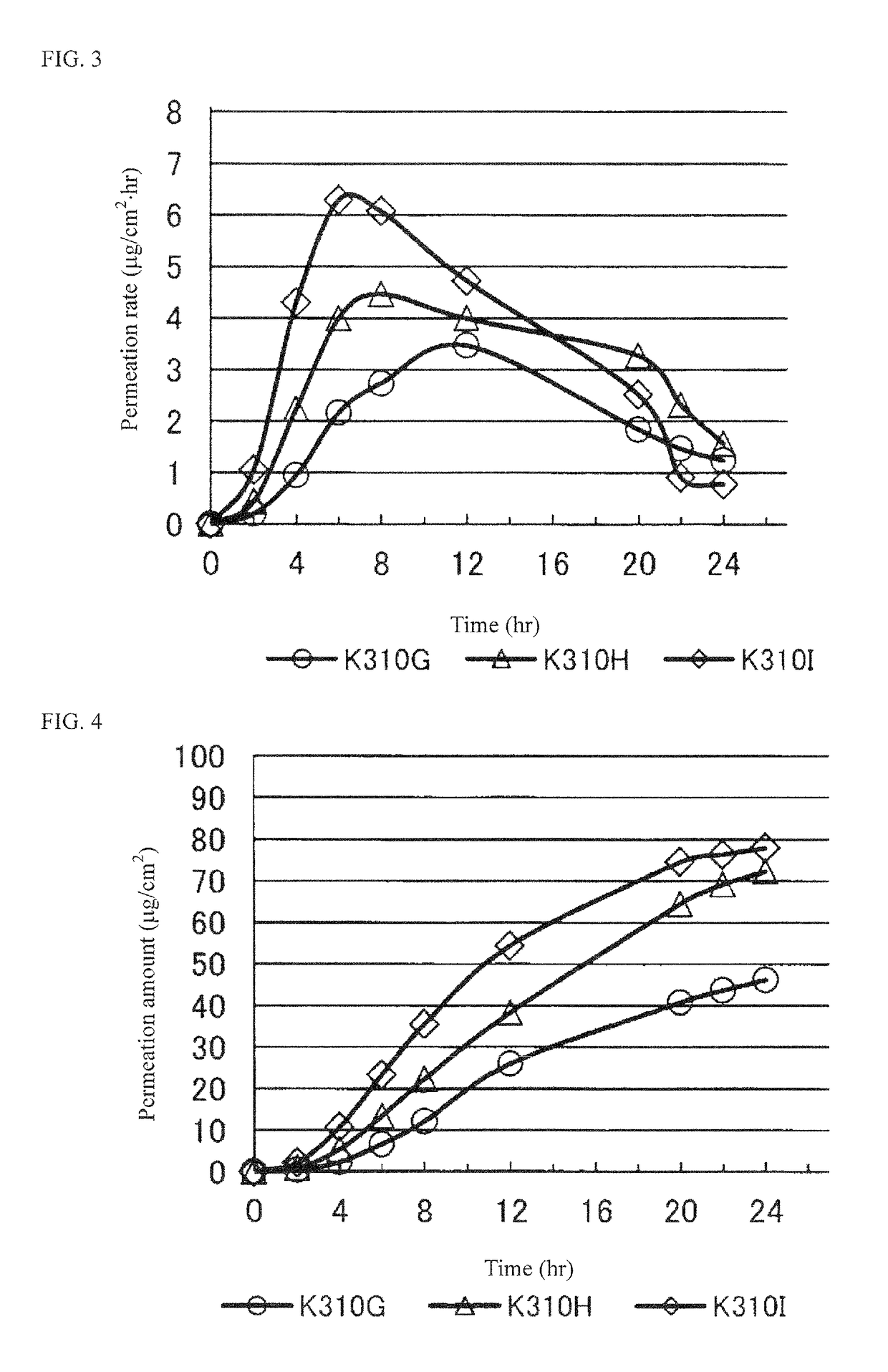
Figure 2 
Figure 3
Abstract
Description
TECHNICAL FIELD
[0001] The present invention relates to transdermal patch containing pramipexole that is used to treat neurodegenerative diseases (such as Parkinson's disease or restless legs syndrome).BACKGROUND ART
[0002] Parkinson's disease is one of the more common neurodegenerative diseases along with Alzheimer's disease. The prevalence of Parkinson's disease in Japan is currently about 150 persons for every 100,000 members of the population. This disease is known to be associated with four major symptoms consisting of tremors, akinesia, muscle rigidity and postural reflex disorders. Various disorders referred to as non-motor disorders also appear in addition to motor disorders. Namely, examples of these include autonomic nervous system disorders such as constipation, frequent urination (overactive bladder) or orthostatic hypotension (fainting), sensory disorders such as lower back pain or lower extremity pain, REM sleep behavior disorders (RBD) causing dream enactment such as call...
Examples
example 1
Selection of Preferable Ionic Liquid for Improving Percutaneous Absorption of Pramipexole
[0070]Pramipexole dihydrochloride monohydrate was used for the active ingredient and each reagent was weighed out in the composite ratios indicated below (wt %). First, the pramipexole dihydrochloride monohydrate was dissolved in a mixed solution of fatty acid ionic liquid and organic solvent. Next, the pramipexole hydrochloride solution was added to a solution obtained by dissolving a plaster base consisting of SIS, liquid paraffin or tackifier and the like in hexane followed by stirring until uniform. This uniformly stirred viscous solution was then applied to a coater to prepare tape preparations.
[0071]Percutaneous absorption of the resulting tape preparations was evaluated based on the permeated amount of pramipexole 8 hours later using a Franz diffusion cell. The results are shown in Table 1.
[0072]
Test No.K303VK303UK304WK313UK310GK310HK310IPramipexole1.01.01.01.01.01.01.02HCl•H2OIonic liqui...
example 2
Percutaneous Absorption Promoting Effect of Alkanolamine in Ionic Liquid
[0077]The type of alkanolamine in the fatty acid-based ionic liquid was changed while keeping the fatty acid composition the same followed by confirming the effect thereof. Reagents were weighed out as shown in the following Table 2 (wt %) and tape preparations were produced in the same manner as Example 1.
[0078]Percutaneous absorption of the resulting tape preparations was evaluated based on the permeated amount of pramipexole 8 hours later using a Franz diffusion cell. The results are shown in the following Table 3.
[0079]
TABLE 3Test No.K303UK304XK312KPramipexole 2HCl•H2O1.01.01.0Ionic liquid:Isostearic acid (C18)2.12.12.1Oleic acid (C18)2.12.12.1DIPA1.80.95TEA2.00.95Solvent:Propylene glycol13.013.013.0Diethyl sebacate7.07.07.0Isopropyl myristate3.03.03.0Plaster:SIS18.018.018.0Terpene resin6.06.06.0Liquid paraffin45.545.345.4Antioxidant:BHT0.50.50.5Total100.0100.0100.0Skin permeation amount:27.913.529.3After 8 ...
example 3
Effect of Filler
[0082]The fatty acid-based ionic liquid fulfills the role of a surfactant in that it dissolves pramipexole together with the organic solvent and causes the dissolved pramipexole solution to be dispersed in the plaster. Namely, the fatty acid-based ionic liquid forms micelles of an ionic liquid containing pramipexole that are dispersed in the plaster. However, since fluidity in the plaster is poor and mass transfer within the plaster is inhibited, it was difficult for the micelles to be released from the plaster. As a result, the drug easily remains within the transdermal patch and percutaneous absorption tended to be the rate-determining factor of release from the plaster.
[0083]As a result of previous research, the addition of a filler (powdered solid that is insoluble in the organic solvent, ionic liquid and plaster) to the plaster was determined to result in the formation of voids due to association among the filler, and the voids that formed were determined to be ...