
Fluid light guide
Patent Information
- Authority / Receiving Office
- US · United States
- Current Assignee / Owner
- Publication Date
- 2003-03-06
- Estimated Expiration
- Not applicable · inactive patent
Smart Images
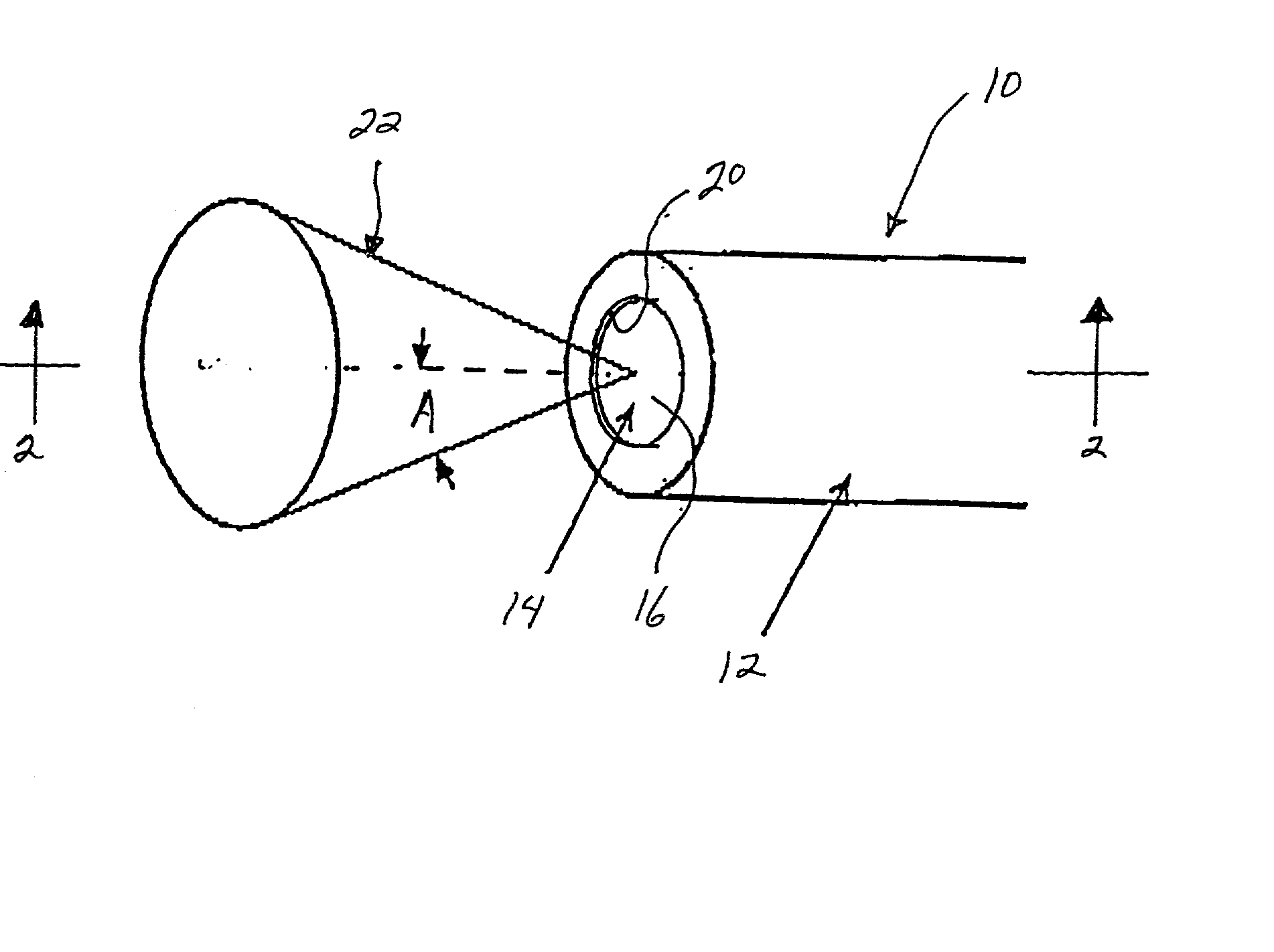
Figure 1 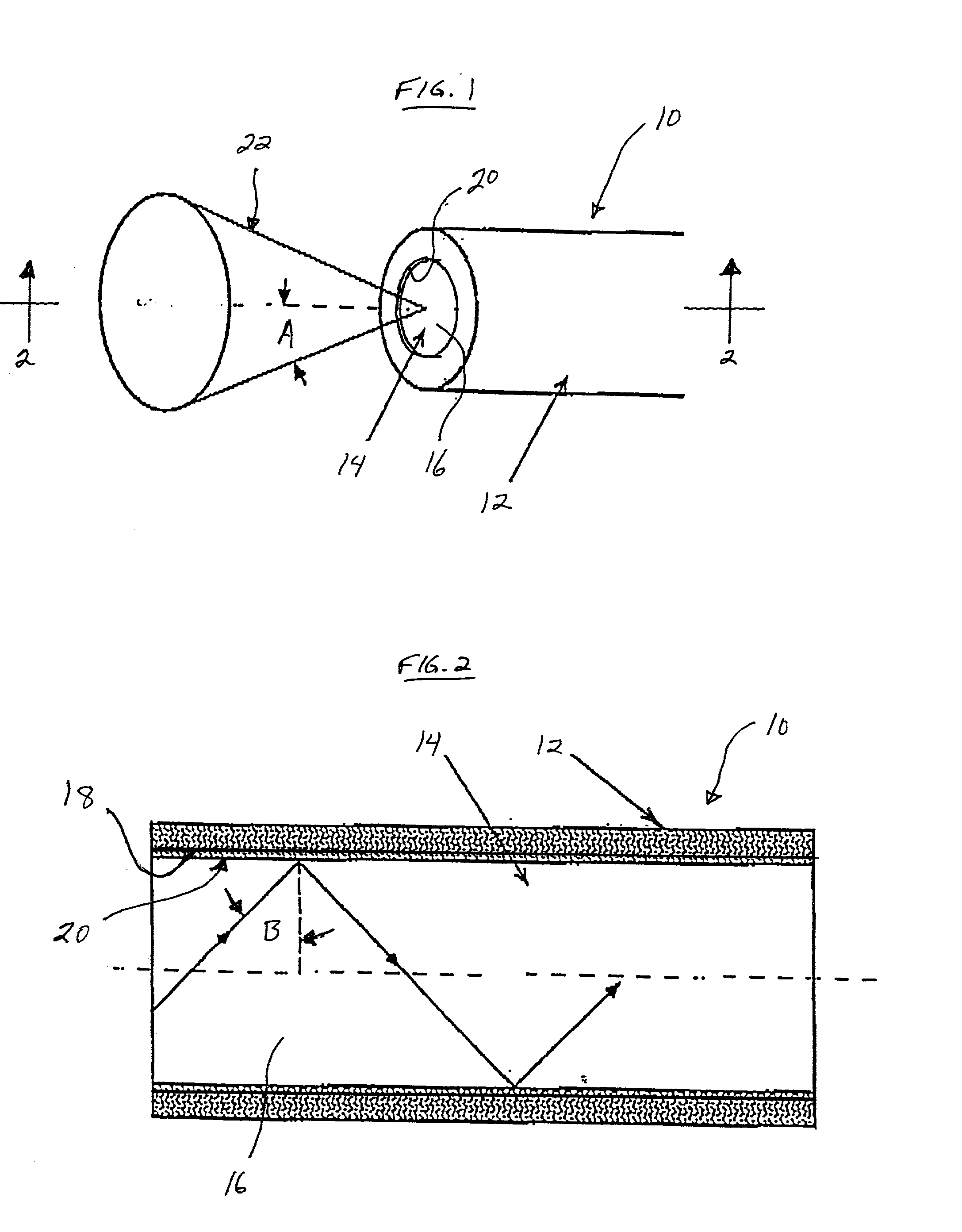
Figure 2 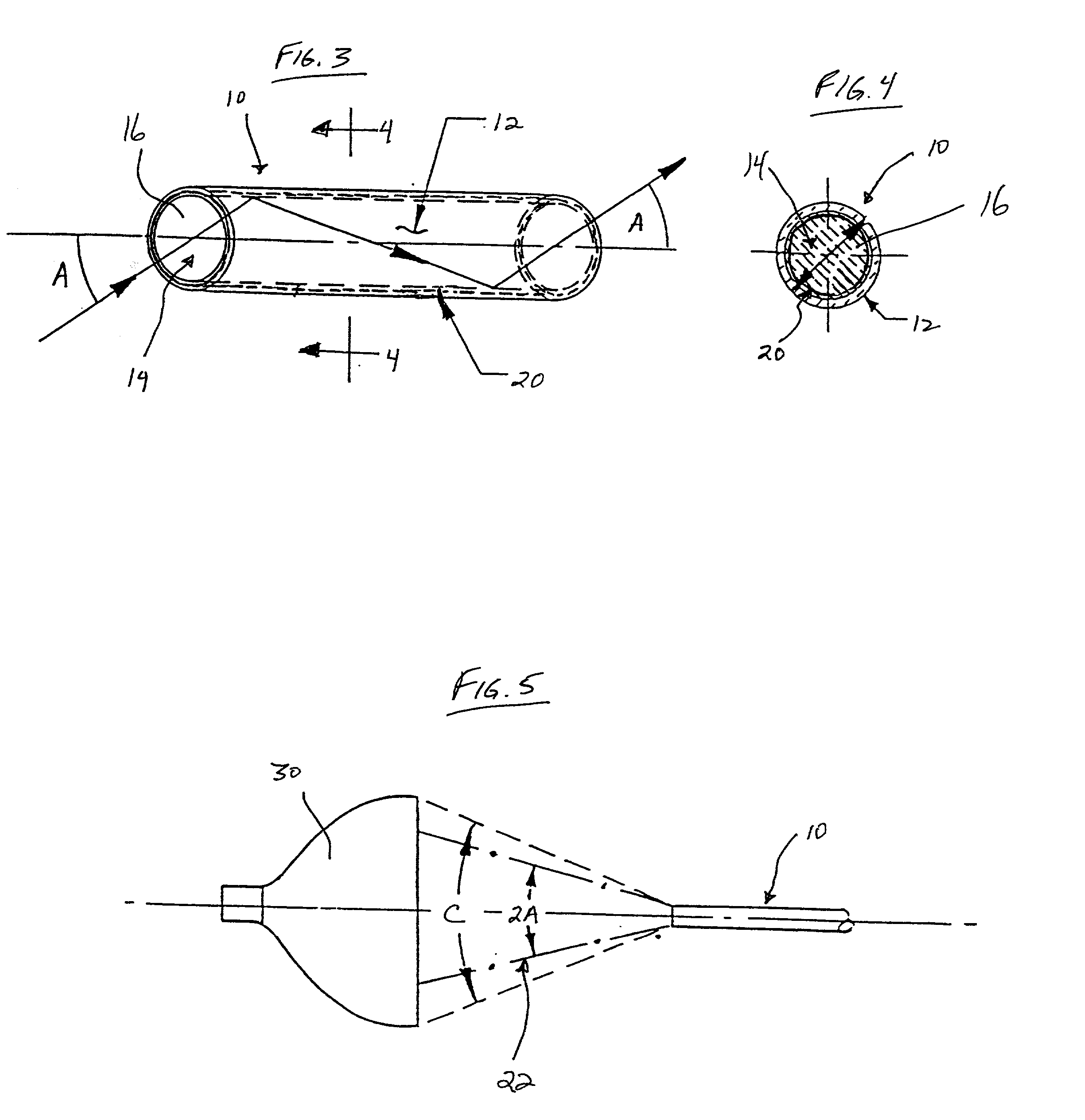
Figure 3
Abstract
Description
[0001] This is a continuation-in-part of pending U.S. patent application Ser. No. 09 / 132,710, filed Aug. 12, 1998, the contents of which are specifically incorporated herein by reference.
[0002] 1. Field of the Invention
[0003] The present invention relates generally to optical waveguides and, more particularly, to fluid light guides for the transmission of a wide range of wavelengths. Specifically, the present invention relates to liquid / gel light guides having a high critical angle of acceptance for illumination purposes and a continuous process for the manufacture thereof.
[0004] 2. Description of the Prior Art
[0005] Numerous kinds of waveguides or optical fiber structures have been developed for the transmission of electromagnetic radiation of various wavelengths between infrared to ultraviolet, and in particular in the visible light region. These fiber-optic devices are utilized in numerous industries, in particular the medical, communication and lighting industries, for a number ...
Examples
example ii
[0049] In a test similar to the above Example I, test films were prepared using the ambient temperature / pressure aerogel process that exploits reversible drying shrinkage. A silica gel was derivatized with hexamethyldisilazane, diluted with solvent and liquefied by ultrasound. The sol was then re-concentrated and dip coated onto a silicon substrate. Films were either dried at 100.degree. C. for five hours in nitrogen (film HMDS -100) or pyrolyzed to 450.degree. C. in nitrogen (film HMDS -450). The HMDS-100 film was measured first in air using a spectroscopic ellipsometer. The measurement results were a thickness of 761 nm and a refractive index of 1.07. The film was then put in water in the cell with the incident angle for the ellipsometer being 75.degree., and a total reflection was obtained. Fitting of the ellipsometric parameters gave a refractive index of only 1.09 for the film. Since the refractive index of water is 1.33, the critical angle for total reflection is 90.degree. -s...
example iii
[0051] The refractive index of the deposited coating 20 of the invention may be tailored to a preferred range of 1.1 to 1.2 by utilizing several parameters. These included varying the extent of derivatization of the siloxane polymers in the sol with organosilyl ligands, generally R.sub.3Si-, where R is methyl, ethyl, propyl, phenyl, fluoroalkyl and the like. The refractive index may also be tailored by the size and extent of condensation of the siloxane polymers and the nature of the R group. In preferred form, the optimum synthesis and processing variables achieve a refractive index of 1.12 combined with an acceptance angle of greater than 90.degree..
example iv
[0052] The present invention is directed to producing an interiorly coated tube to be used in the creation of a liquid or gel core light guide with low loss performance on the order of about 50% loss / 100 feet initially over the whole visible region of the electromagnetic radiation spectrum, and ultimately extending into the UV and IR regions of the spectrum. The tube of the invention is mechanically robust and resistant to deformation and abuse. The film 20 performs under normal wear and tear when the waveguide is bent, twisted and subjected to constant movement. In particular, silica aerogel layered on the inside surface of a polyethylene tube yielded significant results.