
Method for forming re coating film or re-cr alloy coating film through electroplating
Patent Information
- Authority / Receiving Office
- US · United States
- Current Assignee / Owner
- Publication Date
- 2005-06-16
- Estimated Expiration
- Not applicable · inactive patent
Smart Images
Figure 1 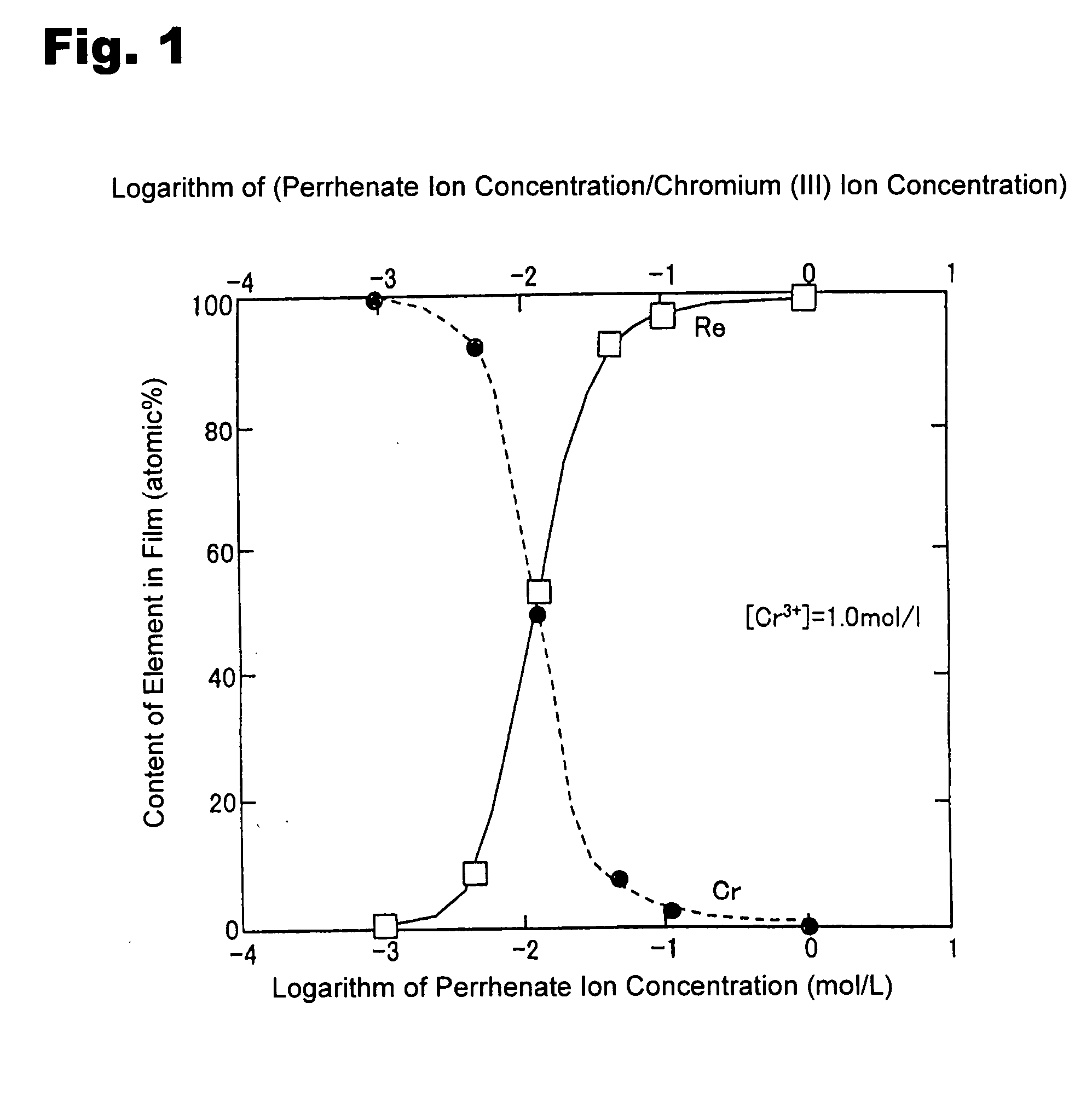
Figure 2 
Figure 3
Abstract
Description
TECHNICAL FIELD
[0001] The present invention relates to a method for forming a Re—Cr alloy or Re-based film usable as a corrosion-resistant coating for high-temperature components or the like. BACKGROUND ART
[0002] A Ni-based superalloy substrate for use in a blade for jet engines, gas turbines or the like is strictly required to have high oxidation resistance and corrosion resistance. Such required high-temperature oxidation resistance has been obtained through a surface diffusion treatment, for example, by coating a substrate surface with an Al2O3 film. For covering the insufficient performance of this treatment, there has also been developed a technique for forming a diffusion barrier layer of Pt or the like on a substrate. Rhenium (Re) can be used as the diffusion barrier layer to provide enhanced high-temperature corrosion resistance. Re excellent in thermal shock resistance is also used as high-temperature members or components of various combustors, such as a rocket-engine co...
Examples
##ventive example 1
INVENTIVE EXAMPLE 1
[0040] A copper plate was subjected to degreasing / cleaning, and used as a substrate. A solution was prepared using chromium chloride to have a Cr3+ ion in a concentration of 1.0 mol / L and a ReO4− ion in a concentration of 0.005 mol / L. In addition to the ReO4− ion and Cr3+ ion, 1.5 mol / L of acetic acid, 0.5 mol / L of ammonium chloride and 0.5 mol / L of potassium bromide were added to the solution to prepare a plating bath. The pH of the plating bath was adjusted at 4 using sulfuric acid and sodium hydrate. Then, an electroplating process was performed under a plating bath temperature of 35° C. and a current density of 100 mA / cm2.
##ventive example 2
INVENTIVE EXAMPLE 2
[0041] Except that the concentration of the ReO4− was set at 0.01 mol / L, an electroplating process was performed under the same conditions as those in Inventive Example 1.
##ventive example 3
INVENTIVE EXAMPLE 3
[0042] Except that the concentration of the ReO4− was set at 0.05 mol / L, an electroplating process was performed under the same conditions as those in Inventive Example 1.