
Method of manufacturing of 7-ethyl-10-[4-(1-piperidino)-1- piperidino]- carbonyloxy- camptothecin
a technology of carbonyloxycamptothecin and piperidino, which is applied in the direction of anti-antineoplastic agents, organic chemistry, drug compositions, etc., can solve the problems of only about 64% of the final product and substantial loss of the final produ
Patent Information
- Authority / Receiving Office
- US · United States
- Patent Type
- Applications(United States)
- Current Assignee / Owner
- Publication Date
- 2006-09-07
- Estimated Expiration
- Not applicable · inactive patent
Smart Images
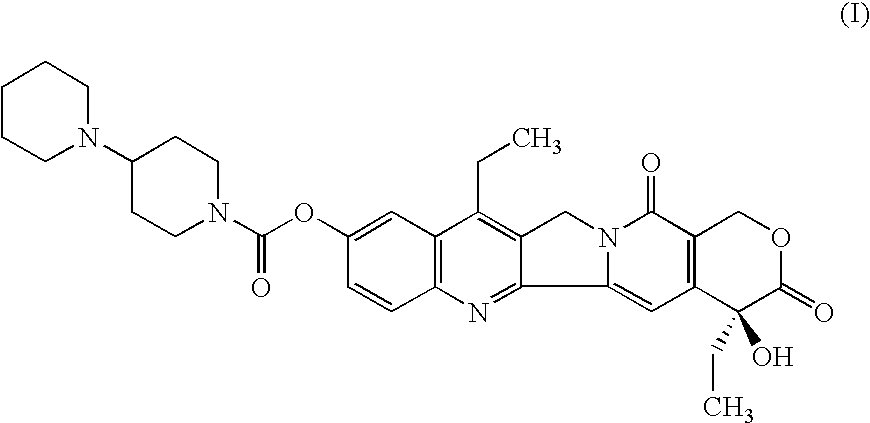
Figure 1 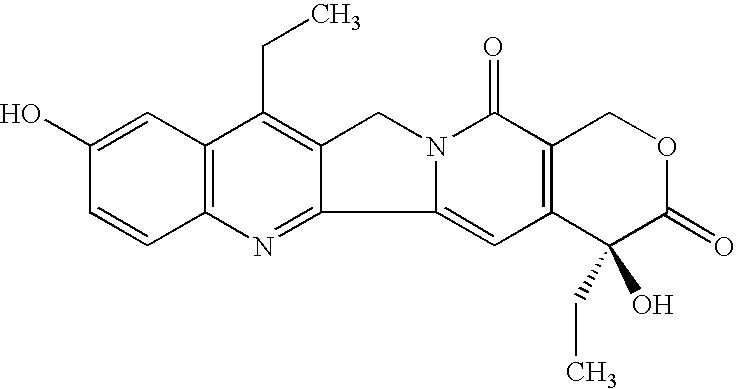
Figure 2 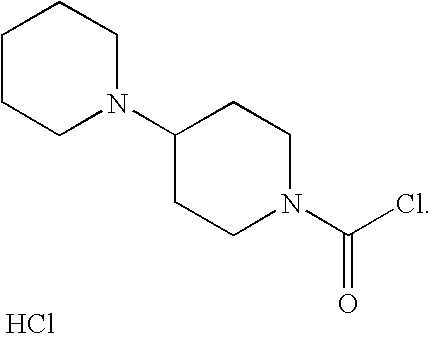
Figure 3
Abstract
Description
FIELD OF THE INVENTION
[0001] This invention relates to a method of manufacturing of 7-ethyl-10-[4-(1-piperidino)-1-piperidino]-carbonyloxycamptothecin of formula I
[0002] 7-Ethyl-10-[4-(1-piperidino)-1-piperidino]-carbonyloxycamptothecin, which is also known as irinotecan base, is used for manufacturing of the cytostatically active irinotecan hydrochloride trihydrate, a topoisomerase inhibitor which is used in treatment of lung and rectum cancer. BACKGROUND OF THE INVENTION
[0003] 7-Ethyl-10-[4-(1-piperidino)-1-piperidino]-carbonyloxycamptothecin has been hitherto prepared by condensation of 7-ethyl-10-hydroxycamptothecin of formula with 1-chlorocarbonyl-4-piperidinopiperidine hydrochloride of formula in pyridine at room temperature. This method of preparation has been described in U.S. Pat. No. 4,604,463. However, this method of preparation of irinotecan base suffers from the fact that in the condensation coloured impurities are formed which have to be removed by adsorption on...
Examples
example 1
[0007] Into a beaker in a sonication bath are placed 10 g (0.0247 mol) of 7-ethyl-10-hydroxycamptothecin and 99 ml of acetonitrile. The obtained suspension is stirred in the sonication bath to homogeneity. Then the suspension is transferred quantitatively into a three-necked Keller flask equipped with a mechanical stirrer, thermometer and reflux condenser. Into the now empty beaker are now placed 6.2 g (0.0502 mol) of crystalline 4-dimethylaminopyridine and 40 ml of acetonitrile. The mixture is stirred until the crystalline portion dissolves. The obtained solution is then added quantitatively to the suspension of 7-ethyl-10-hydroxycamptothecin. Into the empty beaker are then added 13.6 g (0.0434 mol) of 1-chlorocarbonyl-4-piperidinopiperidine hydrochloride and 79 ml of acetonitrile and the suspension is stirred in the sonication bath until homogeneous. The obtained suspension is transferred quantitatively into the three-necked Keller flask already containing 7-ethyl-10-hydroxycampto...