
Novel applications of omega-3 rich phospholipids
a technology of phospholipids and omega-3, applied in the field of omega-3 fatty acid compositions, can solve problems such as unconvincing, and achieve the effect of preventing induction of sustained ventricular tachycardia
Patent Information
- Authority / Receiving Office
- US · United States
- Patent Type
- Applications(United States)
- Current Assignee / Owner
- Publication Date
- 2008-03-06
- Estimated Expiration
- Not applicable · inactive patent
Smart Images
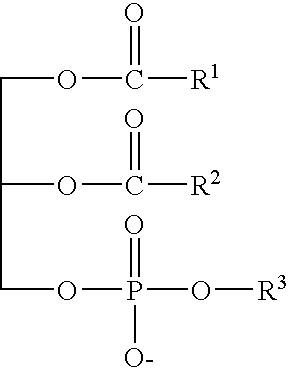
Figure 1 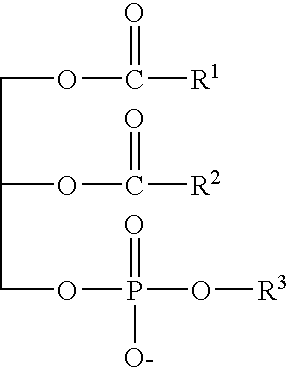
Figure 2 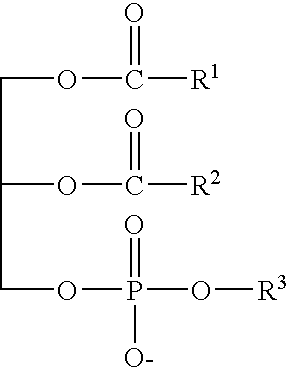
Figure 3
Abstract
Description
[0001] This application claims the benefit of U.S. Provisional Applications 60 / 798,026, 60 / 798,027, and 60 / 798,030, all filed May 5, 2006, and U.S. Provisional Application 60 / 872,096, filed Dec. 1, 2006, each of which is incorporated herein by reference in their entirety.FIELD OF THE INVENTION
[0002] The invention relates to the use of omega-3 fatty acid compositions, and in particular to phospholipid compositions comprising omega-3 fatty acids, to prevent / treat conditions such as rheumatoid arthritis, diabetes type II, low fertility, cardiac arrhythmia, obesity, blood lipids, insulin resistance, oxidative stress and muscle soreness. BACKGROUND OF THE INVENTION
[0003] Phospholipids can be isolated from a number of different natural sources such as fish, crustaceans and algae (marine phospholipids). Other sources can be soy, sunflower and maize (vegetable phospholipids). In addition phospholipids can be obtained from eggs. Phospholipids with desired fatty acid residues, so called fun...
Examples
example 1
[0045] Marine phospholipids were prepared using either 40% soy PC (American Lecithin Company Inc, Oxford, Conn., USA) (MPL1) or 96% pure soy PC (Phospholipid GmbH, Koln, Germany) (MPL2) according to a method described by others [4]. Fatty acid content and the level of bi-products are shown in table 1. The MPL treatments consisted of a mixture of phospholipids, lyso-phospholipids and glycerol-phospholipids. Looking only at the PC / LPC / GPC relationship, it was 64 / 33 / 2 and 42 / 40 / 18 for MPL1 and MPL2, respectively. Finally, all three treatments were emulsified into skimmed milk.
TABLE 1Composition of the phospholipids used in example 118:3CompositionPC / LPC / GPC18:2 (n-6)(n-3)EPADHAMPL164 / 33 / 2 129 mg / g9 mg / g51 mg / g171 mg / gMPL242 / 40 / 18124 mg / g9 mg / g96 mg / g 96 mg / g
[0046] 18 newly weaned Sprague-Dawley rats were fed the milk emulsions for 1 week. Each rat was placed in its own cage to ensure that they got an even amount of test substance and the milk was consumed by the rat pups ad libitum. ...
example 2
[0047] 18 healthy asthenozoospermic males (sperm motility <50%) are to be recruited in a fertility experiment. Other inclusion criteria are to be age (25-50), lack of ejaculation 2-5 days before sampling as well as a signed consent. Exclusion criteria are to be consumption of omega-3 products, use of carnitine, use of CoQ10, alcohol abuse and moderately severe co-morbid disease. The following variables are to be investigated at baseline and after 12 weeks: sperm motility, sperm count, sperm concentration, sperm morphology, sperm phospholipid fatty acid profile and pH. 6 males are to administer a marine phospholipid consisting of 700 mg / g EPA / DHA (ratio 2:1) daily for 12 weeks. 6 males are to administer olive oil and 6 males are to administer fish oil as described in the prior art [42] for 12 weeks. After 12 weeks administering marine phospholipids an improvement in sperm motility, sperm count, sperm concentration, sperm morphology is to be found compared to both placebo and fish oil...
example 3
[0048] Sprague-Dawley rats were fed different omega-3 fatty acid composition (TG, PL 1 and PL 2) as well as placebo (control) for 30 days. The rat feed was prepared using AIN-93 except that soybean oil was removed from the feed. The pelleted AIN-93 diet was ground and the marine lipid compositions (PL 1 and PL 2) as well as fish oil (TG oil) and control were added to this ground feed. The marine lipid compositions were prepared using enzymatic (lipase) catalyzed transesterification of soy lecithin with fish oil fatty acids according to the method described in Example 1. The concentration of EPA, DHA and 18:3 n-3 in the different diets can be seen in the table below (table 3).
TABLE 3Amount of different fatty acid in the final feed productsg / 100 gg / 100 gg / 100 gSUM g / 100 gEPADHA18:3n3EPA + DHA + 18:3n3ControlT4000.260.26TG OilT10.610.390.241.23PL 1T20.610.350.261.22PL 2T30.240.730.261.23
[0049] Thirty six newly weaned male Sprague Dawley rats (start weight 168±11 g) were used in the e...