
Toner and method for manufacturing toner
a manufacturing method and technology of toner, applied in the field of toner, can solve the problems of difficult shell cover all over the surface of the core particle, particle exposure partly, and insufficient triboelectric chargeability of the toner, so as to improve the low-temperature fixing performance, and suppress fogging and degradation of image quality
Patent Information
- Authority / Receiving Office
- US · United States
- Patent Type
- Applications(United States)
- Current Assignee / Owner
- Publication Date
- 2011-12-15
Smart Images
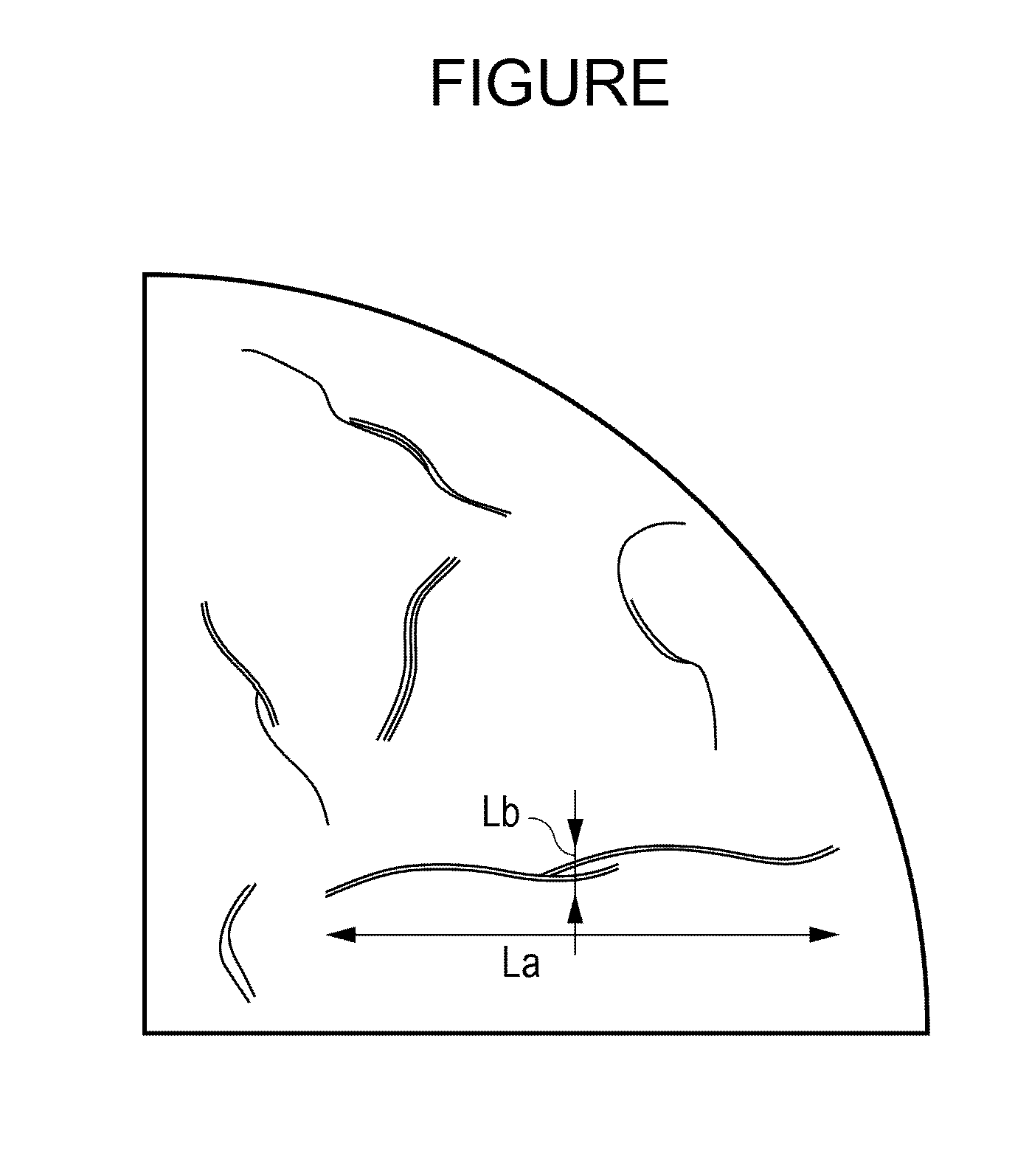
Figure 1
Abstract
Description
BACKGROUND OF THE INVENTION
[0001] 1. Field of the Invention
[0002] The present invention relates to a toner used for developing an electrostatic latent image formed by a method, e.g., electrophotography, an electrostatic recording method, a magnetic recording method, and a toner jet system recording method, and a method for manufacturing a toner.
[0003] 2. Description of the Related Art
[0004] A toner has been proposed, wherein a crystalline polyester having an excellent speed of response to heat, that is, having a sharp melt property, is added and, thereby, low-temperature fixing performance of the toner is improved.
[0005] Japanese Patent Laid-Open No. 2002-287426 has proposed a toner, wherein at least 90% of dispersed domains of crystalline polyester have diameters of 0.1 to 2 μm in order to obtain excellent low-temperature fixability.
[0006] Japanese Patent Laid-Open No. 2007-093809 has proposed a toner having a core layer containing an amorphous polyester and a crystalline polyester servi...
Examples
example 1
Preparation of Toner 1
Preparation of Core Particle
[0148]A mixture of monomers composed of[0149]Styrene: 74.0 parts[0150]n-Butyl acrylate: 26.0 parts[0151]Pigment Blue 15:3: 6.0 parts[0152]Aluminum salicylate compound 1.2 parts[0153](BONTRON E-88: produced by Orient Chemical Industries, Ltd.)[0154]Divinyl benzene: 0.04 parts[0155]Release agent paraffin wax: 9.0 parts[0156](HNP-51: produced by NIPPON SEIRO CO., LTD. melting point 74° C.)[0157]Polar resin 1: 15.0 parts[0158]Crystalline polyester 1: 10.0 parts
was prepared. A monomer composition was obtained by putting 15 mm ceramic beads into the mixture and performing dispersion for 2 hours through the use of an attritor (produced by Mitsui Miike Chemical Engineering Machinery Co., Ltd.). A dispersion medium system was prepared by adding 800.0 parts of ion-exchanged water and 3.5 parts of tricalcium phosphate to a container provided with a high-speed agitator TK-HOMOMIXER (produced by Tokushu Kika Kogyo Co., Ltd.), adjusting the numbe...
examples 2 to 16
, Comparative Examples 1 to 6
[0162]Toner particles and Toners 2 to 16 and 18 to 23 were obtained as in Example 1 except that the type and the usage of the raw materials, the polymerization condition, and the fixing condition in Example 1 were changed as shown in Table 4. The properties of the resulting Toners 2 to 16 and 18 to 23 are shown in Table 4 and Table 5.
example 17
[0163]Preparation of Toner 17
[0164]A core particle dispersion liquid was obtained as in Example 1. Dilute hydrochloric acid was added to the core particle dispersion liquid until the pH reached 1.5. Furthermore, washing with ion-exchanged water was performed sufficiently, and filtration and drying were performed, so as to obtain core particle. Then, Resin fine particle dispersion liquid 1 was washed with ion-exchanged water sufficiently and, thereafter, filtration, drying, and freeze pulverization were performed. Toner particle 17 was obtained by adding 5.0 parts of freeze-pulverized product of Resin fine particles 1, described above, to 100 parts of the above-described core particle and performing fixing through the use of an impact surface treatment apparatus (treatment temperature 50° C., rotary treatment blade 90 m / sec).
[0165]Subsequently, Toner 17 was obtained by performing the external addition and a classification treatment in a manner similar to that in Example 1. The proper...