
Nonlinear optical materials and nonlinear optical device using the same
a nonlinear optical and material technology, applied in the direction of optical elements, polarising elements, instruments, etc., can solve the problems of deterioration of nonlinear optical properties of materials, difficult production of large organic crystals needed for devices, and brittleness of organic crystals
Patent Information
- Authority / Receiving Office
- US · United States
- Current Assignee / Owner
- Publication Date
- 2015-01-15
- Estimated Expiration
- Not applicable · inactive patent
Smart Images
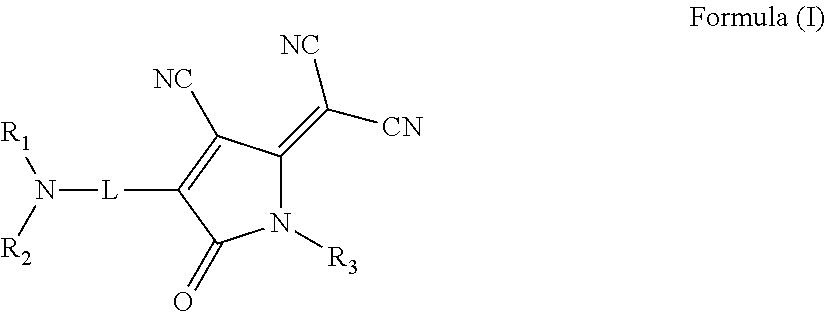
Figure 1 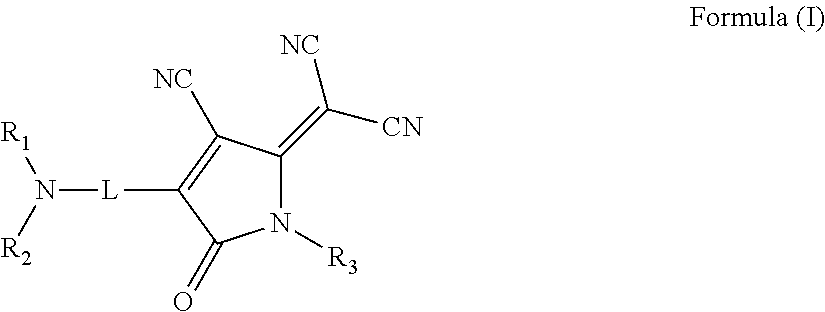
Figure 2 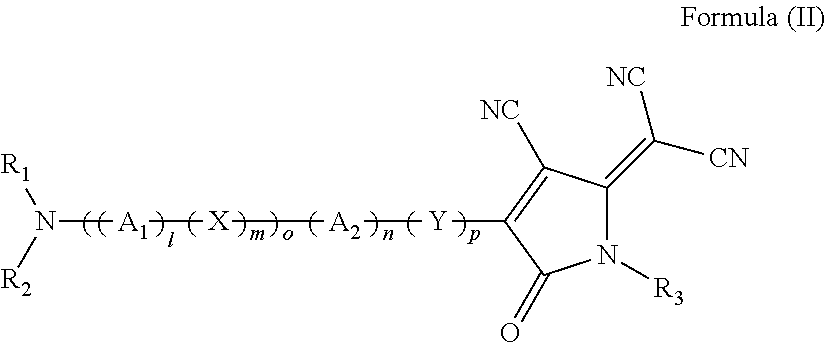
Figure 3
Abstract
Description
CROSS REFERENCE TO RELATED APPLICATION
[0001] This is a continuation of International Application No. PCT / JP2013 / 059102 filed on Mar. 27, 2013, and claims priority from Japanese Patent Application No. 2012-078096 filed on Mar. 29, 2012, the entire disclosures of which are incorporated herein by reference.TECHNICAL FIELD
[0002] The present invention relates an organic nonlinear optical material which is suitably used for an organic nonlinear optical device that is useful in the field of optoelectronics and photonics, which may be applied to optical modulators, optical switches, optical integrated circuits, optical computers, an optical memory, a wavelength conversion device, a hologram device or the like, which are useful in the field of optical information communication, optical information processing, imaging, using light.BACKGROUND ART
[0003] With the progress of advanced information society, numerous attempts to use optical technology with respect to the transmission, processing, and r...
Examples
synthesis example 1
Synthesis of Exemplary Compound (1)
[0258]Exemplary Compound (1) was synthesized according to the following scheme.
[0259]—Synthesis of Intermediate (A)—
[0260]350 ml of ethanol was added to 15.5 g (0.12 mol) of 2-amino-1,1,3-tricyano-1-propene and 27.3 g (0.24 mol) of ethyl pyruvate, and heated to reflux for 1 hour under nitrogen flow. After cooling, solution of 15.3 g (0.094 mol) of 4-acetamide benzaldehyde dissolved in 50 ml of 2-methoxyethanol was added to the reaction solution, and heated to reflux for 2 hours under nitrogen flow. After cooling to room temperature, the precipitated crystals were separated by filtration to yield 16.2 g (52% yield) of an intermediate (A).
[0261]—Synthesis of Intermediate (B)—
[0262]350 ml of ethanol was added to 15.0 g (0.046 mol) of the resulting intermediate (A), and heated to reflux, and 15 ml of the concentrated sulfuric acid was carefully added dropwise to the solution. Until the intermediate (A) was consumed, the concentrated sulfuric acid was a...
synthesis example 2
Preparation of Exemplary Compound (2)
[0269]Exemplary Compound (2) was synthesized according to the following scheme.
[0270]0.15 g (0.2 mmol) of Exemplary Compound (1), 0.092 g (0.35 mmol) of triphenylphosphine and 0.1 ml (1.1 mmol) of 1-butanol were dissolved in 4 ml of tetrahydrofuran, and 0.17 ml (0.37 mmol) of diethyl azodicarboxylate (2.2 mol / l toluene solution) was added dropwise under nitrogen flow condition and under ice-cooling. The reactants were warmed to room temperature and stirred for 5 hours, and the solvent was distilled off under reduced pressure. The resulting solid was washed with ethanol, and the crystals were separated by filtration. The obtained crystals were purified by silica gel column chromatography (chloroform) to yield Exemplary Compound (2). The quantity was 1.12 g, and the yield was 74%.
[0271]1H NMR (CDCl3) δ 8.50 (d, 1H), 7.92 (d, 2H), 7.90 (d, 2H), 7.79 (d, 2H), 7.28 (d, 1H), 6.91 (d, 2H), 4.34 (t, 4H), 4.19 (t, 2H), 3.77 (t, 4H), 2.27 (m, 2H), 1.39-1.7...
synthesis example 3
Preparation of Exemplary Compound (51)
[0273]Synthesis was performed, it was synthesized in the same manner in the synthesis of Exemplary Compound (1), except that N,N-bis(2-hydroxyethyl)-3-methoxyaniline was used instead of N-phenyethanolamine. N,N-bis(2-hydroxyethyl)-3-methoxyaniline was synthesized with reference to the method described in “Bio-Organic and Medicinal Chemistry Letters (Bioorg. Med. Chem. Lett)”, 21, (2011), pp. 940-943.