
Fuel additive for diesel engines
a technology for diesel engines and additives, applied in the direction of fuels, machines/engines, mechanical equipment, etc., can solve the problems of reducing or completely bocking the flow of fuel, undesirable engine performance, and deposited fuel in the fuel supply system, so as to improve the demulsibility of an additive containing diesel fuel and achieve superior power recovery and demulsibility. , the effect of improving the demulsibility
Patent Information
- Authority / Receiving Office
- US · United States
- Current Assignee / Owner
- Publication Date
- 2015-08-20
- Estimated Expiration
- Not applicable · inactive patent
Smart Images
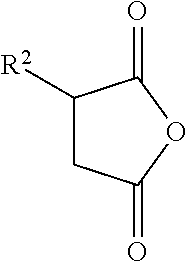
Figure 1
Abstract
Description
TECHNICAL FIELD
[0001] The disclosure is directed to fuel additives and to additive and additive concentrates that include the additive that are useful for improving the performance of fuel injected engines. In particular the disclosure is directed to a fuel additive that is effective to enhance the performance of fuel injectors for internal combustion engines.BACKGROUND AND SUMMARY
[0002] It has long been desired to maximize fuel economy, power and driveability in vehicles while enhancing acceleration, reducing emissions, and preventing hesitation. New engine technologies require more effective additives to keep the engines running smoothly. Additives are required to keep the fuel injectors clean or clean up fouled injectors for spark and compression type engines. Engines are also being designed to run on alternative renewable fuels. Such renewal fuels may include fatty acid esters and other biofuels which are known to cause deposit formation in the fuel supply systems for the engines....
Examples
##ventive example 8
Inventive Example 8
[0050]An additive was made similar to that of Comparative Example 1, except that 750 number average molecular weight polyisobutylene succinic anhydride (PIBSA) was used instead of the 950 number average molecular weight PIBSA and the molar ratio of PIBSA / TEPA was 1.6:1.
##ventive example 9
Inventive Example 9
[0051]An additive was made similar to that of Comparative Example 7, except that the molar ratio of PIBSA / TEPA was 1.3:1. Residual TEPA was about 2.16 wt. % in the reaction product based on the active material in the reaction product as determined by gas chromatograph.
##ventive example 10
Inventive Example 10
[0052]An additive was made similar to that of Inventive Example 8, except that the molar ratio of PIBSA / TEPA was 1.5:1. Residual TEPA was about 1.02 wt. % in the reaction product based on the active material in the reaction product as determined by gas chromatograph.