
Aptamers for mycotoxin detoxification
a technology of aptamer and mycotoxin, which is applied in the direction of antibody ingredients, biochemistry apparatus and processes, animal husbandry, etc., can solve the problems of poor commercial analysis methods, poor mycotoxin contamination in animal feed and human food, and few studies have been extensively researched, so as to improve animal performance and health, increase mycotoxin-deactivation ability, and reduce absorption or uptake
Patent Information
- Authority / Receiving Office
- US · United States
- Patent Type
- Applications(United States)
- Current Assignee / Owner
- Publication Date
- 2018-11-15
Smart Images
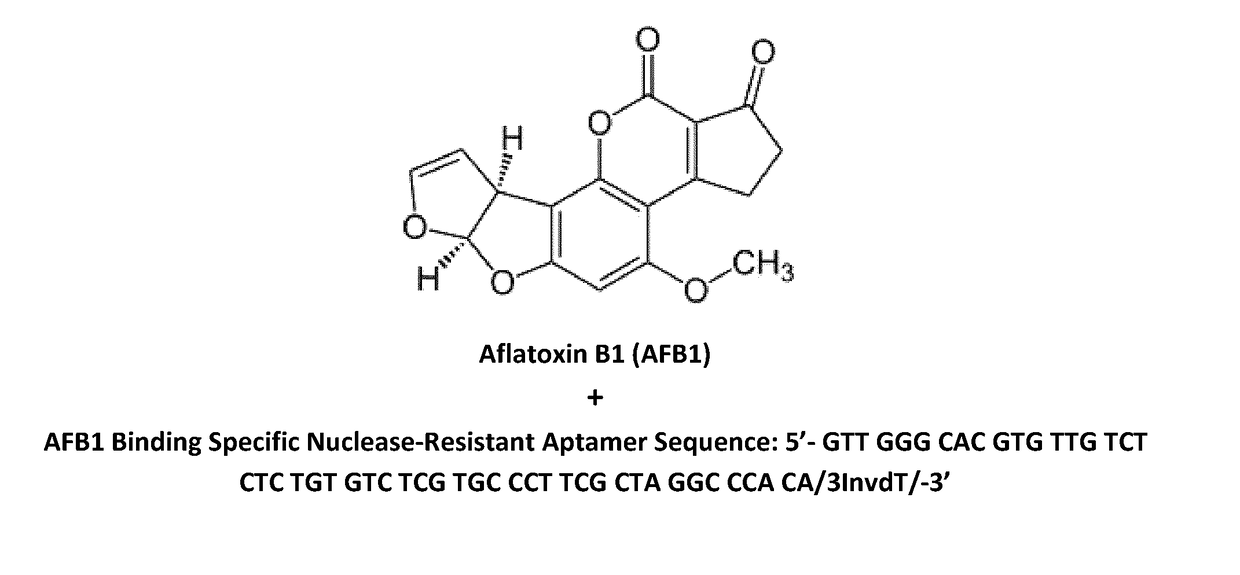
Figure 1 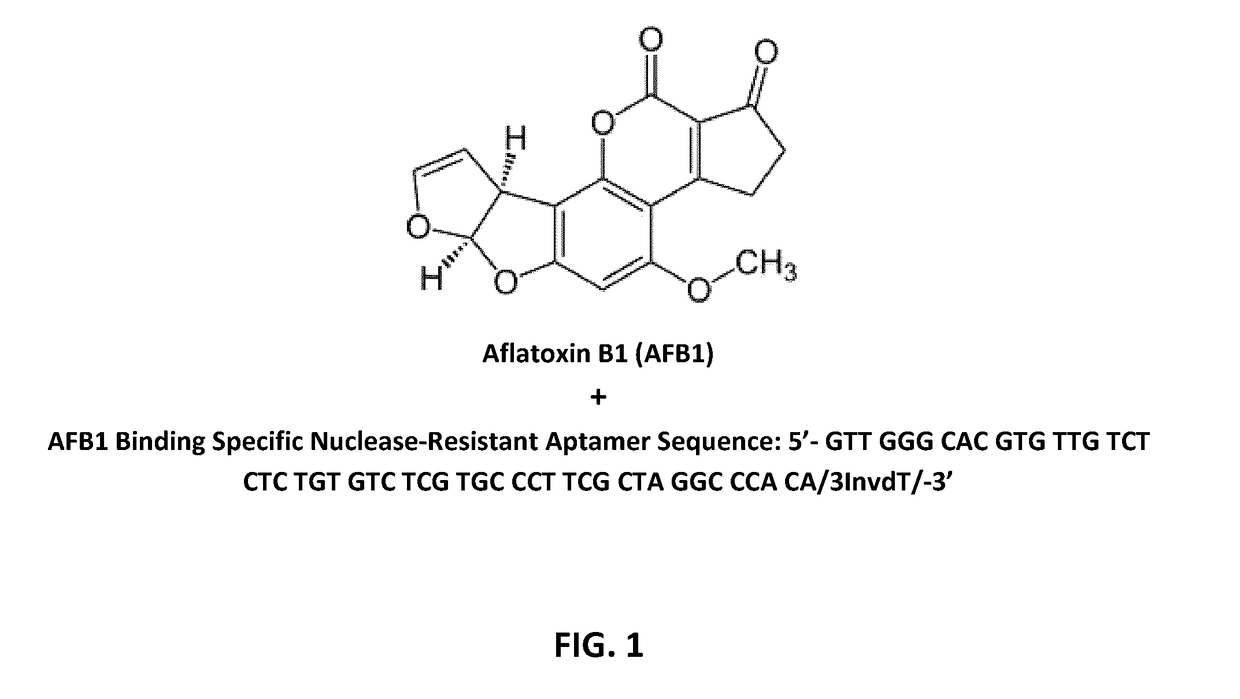
Figure 2 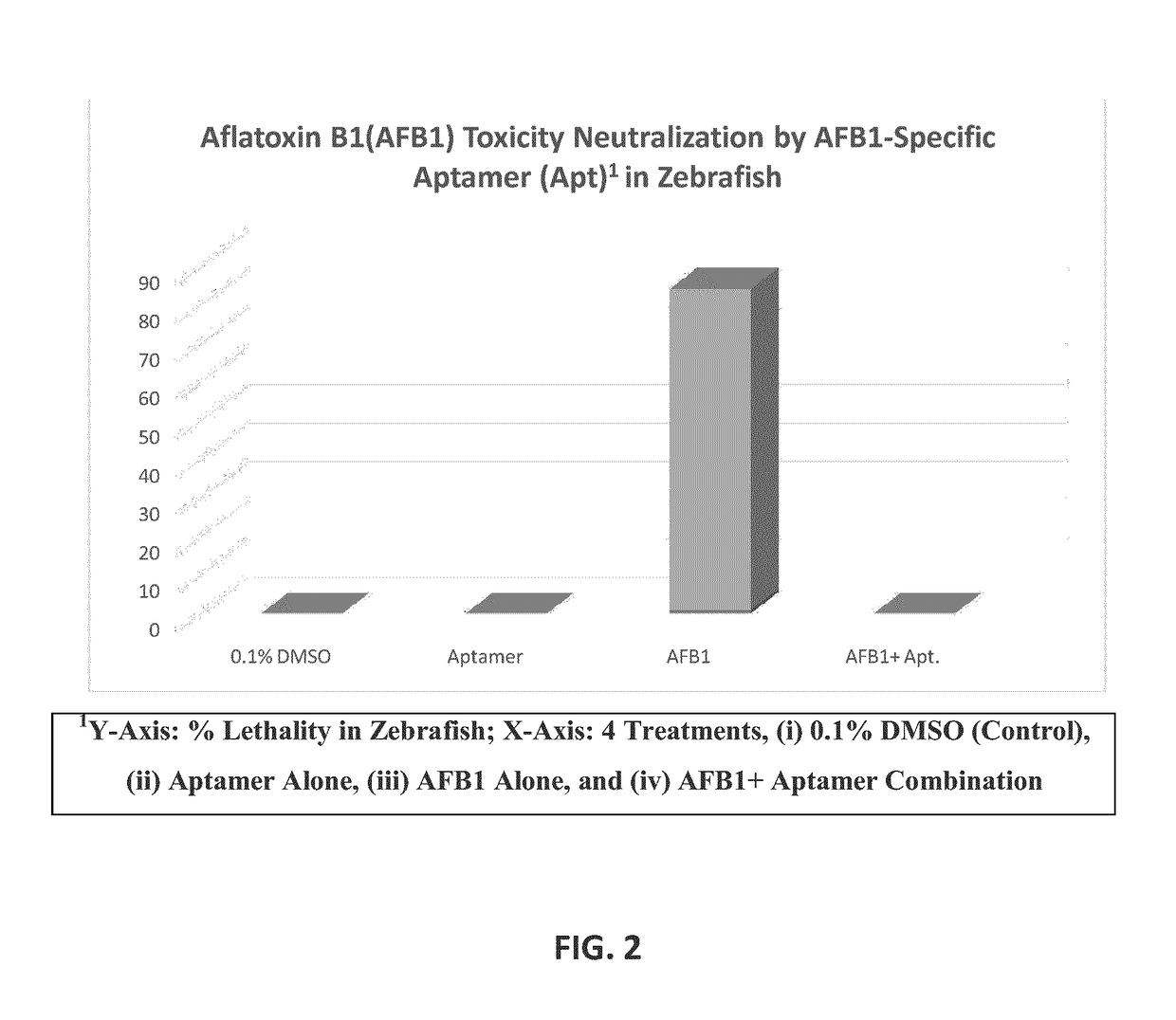
Figure 3
Abstract
Description
FIELD OF THE INVENTION
[0001] The present invention relates to aptamer-based compositions for mycotoxin detoxification, more specifically DNA or RNA aptamer-based compositions, and to the methods of preparing said aptamer-based compositions. The invention also relates to the use of said aptamer-based compositions as feed additives for detoxifying mycotoxins, such as aflatoxins, deoxynivalenol, zearalenone, fumonisins and ochratoxin A.BACKGROUND OF THE INVENTION
[0002] Mycotoxins are toxic secondary metabolites produced by fungi. Only some fungi produce mycotoxins, and they are referred to as toxigenic. Mycotoxin formation may occur when the causative fungi grow on crops in the field, at harvest, in storage, or during feed processing; essentially whenever favourable conditions for their formation prevail. There are hundreds of mycotoxins known, but few have been extensively researched and even fewer have good commercially available methods for analyzing them. The primary classes of mycot...
Examples
example 1
Enzyme-Linked Immunosorbent Assays for Mycotoxins
[0054]Indirect competitive ELISAs were developed for quantitation of the mycotoxins following the procedure outlined by Xiao et al. (J. Agric. Food Chem. 1995; 43: 2092-2097) and Li et al. (J. Food Prot. 11:952-1037, 1994). An example of an assay for mycotoxin is given below. The procedure for coating and blocking the microtiter plate with the aminodex AFB1 conjugate is similar to that used for the antibody titer assay. The following are then added to the appropriate microtiter plate wells: 75 μl of pH 7.2 PBS-T, 10 μl of AFB1 or AFB1 standard diluted with methanol, and 65 μl of chicken anti-AFB1 antibodies diluted in pH 7.0 PBS-T. The plates are incubated at 37° C. for 1 h. The remaining procedure is the same as for antibody titer assay. The antibody titer assays for the other anti-mycotoxin antibodies are similar to those for the AFB1 antibody.
example 2
n of Aflatoxin B1 Specific Aptamers
[0055]The production of aptamers was mostly based on SELEX (Systematic Evolution of Ligands by Exponential Enrichment) technology. Briefly, from a library of random sequences the one / ones with the best affinity for the target molecule were selected through a series of cycles with increasing stringency conditions. This SELEX approach was based on the Morse protocol (Morse, D. P. Biochem. Biophys. Res. Commun. 2007; 359: 94-101), modified to be applied to DNA sequences, and one of the target molecules is AFB1. The procedure involved the following steps: (i) An initial library of random sequences was digested to obtain single strand DNA pool for the selection; (ii) The single strand DNA sequences were put on magnetic beads through hybridization with a short oligonucleotide immobilized on the surface; (iii) Upon incubation with the target, i.e. AFB1, aptamers that undergo a conformational change due to the interaction with the target were displaced fro...
example 3
B1 (AFB1) Lethality Test in Zebrafish
[0056]The goal of this study was to determine the dose-dependent aflatoxin B1 (AFB1) toxicity induced lethality in Zebrafish.
[0057]Materials & Methods:
[0058]Zebrafish embryos were generated by using a Mass Embryo Production System. Approximately 50 embryos were generated per female zebrafish. Embryos were cleaned by removing dead embryos and sorted by developmental stage. As embryos receive nourishment from an attached yolk sac, no feeding was required for 6-days post fertilization (dpf). Aflatoxin B1 was supplied by Cayman Chemical Company (Ann Arbor, Mich., USA). In this pilot study, the Maximum Tolerable Concentration (MTC) of AFB1 was determined. 2 dpf zebrafish were distributed into 6-well plates containing 4 ml fish water / well; 4 μl sub-MS solution of AFB1 was then added directly to fish water. Zebrafish were exposed to AFB1 continuously for 72 hr. Untreated and 0.1% DMSO-treated zebrafish were used as controls for the lethality test. Dimet...