
Tunable, controlled-release, urethane-containing elastomers and processes of forming the same
Patent Information
- Authority / Receiving Office
- US · United States
- Current Assignee / Owner
- Publication Date
- 2020-02-27
Smart Images
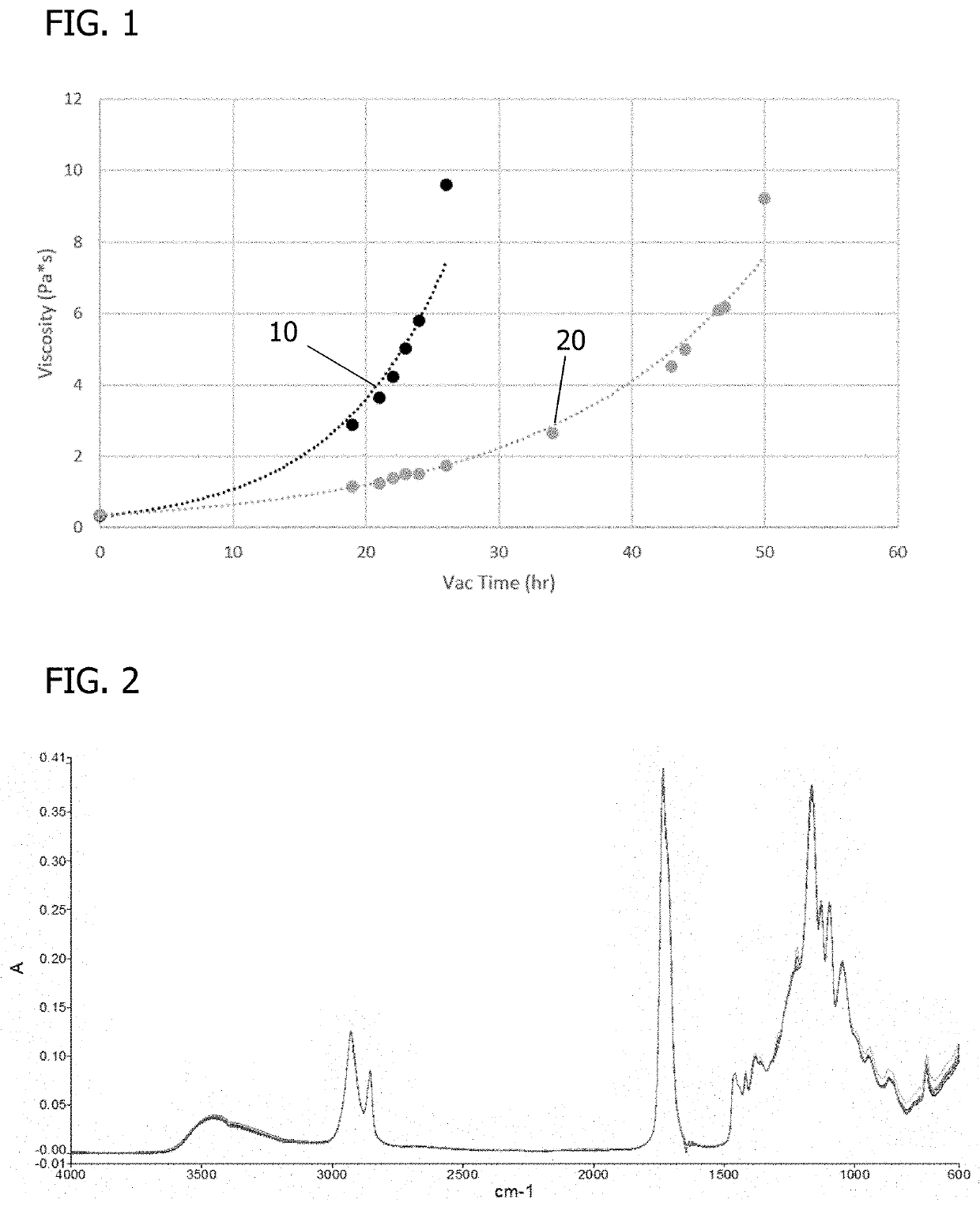
Figure 1 
Figure 2 
Figure 3
Abstract
Description
CROSS-REFERENCE TO RELATED APPLICATIONS
[0001] This application claims priority to and the benefit of U.S. Provisional Application No. 62 / 720,412 filed Aug. 21, 2018 and U.S. Provisional Application No. 62 / 872,793 filed Jul. 11, 2019, which are hereby incorporated by reference in their entirety.FIELD OF THE INVENTION
[0002] This application is directed to processes of forming urethane-containing polymers and polymers formed by such processes. More specifically, this application is directed to processes of forming poly(glycerol sebacate) urethane polymers with tunable controlled release rates and polymers formed by such processes.BACKGROUND OF THE INVENTION
[0003] The majority of biodegradable biomaterial polymers used for drug delivery are bulk eroders that exhibit a dose-dependent active pharmaceutical ingredient (API) release rate, where increasing the drug loading concentration increases the relative release rate. With such polymers, achieving high drug loadings that also sustain relea...
Examples
example 1
[0173]PGS resins synthesized by a water-mediated process were compared to PGS resins synthesized by a non-water-mediated process. FIG. 1 shows the viscosity as a function of reaction time for the water-mediated process (10) compared to the non-water-mediated process (20).
[0174]PGS resins synthesized by a water-mediated process and PGS resins synthesized by a non-water-mediated process were characterized and analyzed. Four different batches of water-mediated PGS resins and four different batches of non-water-mediated PGS resins, having a weight-average molecular weight (Mw) over the range of about 10 kDa to about 50 kDa, were characterized. Table 1 shows the resulting data from the characterizations. Resins 1-4 were formed by a water-mediated process, and Resins 5-8 were formed by a non-water-mediated process.
TABLE 1Water-mediated vs. Non-water-mediated PGS Sample DataMw by GPCZero-Shear ViscosityPolydispersityAcidSample(Da)(Pa · s)IndexNumberResin 1132753.069.98947Resin 2228175.2311...
example 2
[0178]Sixteen samples of PGSU films were formed by reacting each of Resin 1 through Resin 8 by combining and mixing each PGS resin with HDI at two different PGS:HDI mass ratios, 2.5:1 and 3.5:1, during film fabrication.
[0179]The crosslinking of each PGSU film was estimated by FTIR spectroscopy and a multiple linear regression (MLR) model that used the integrated area of peaks highly correlated with crosslinking density. The resulting estimated crosslinking is shown in FIG. 4 as a PGS:HDI mass ratio. The PGS:HDI mass ratio is related to the crosslinking density, as shown in Example 5. PGS:HDI mass ratio can be converted to NCO:OH stoichiometric ratio using the hydroxyl value of the PGS resin and the equivalent weight of OH and equivalent weight of NCO. For reference, 3.5:1 PGS:HDI mass ratio films are less crosslinked than 2.5:1 PGS:HDI mass ratio films. FIG. 4 shows that different resins demonstrate different crosslinking behaviors, in some cases having lower crosslinking than would...
example 3
[0181]The sixteen samples of PGSU films were tested to determine elastic modulus, with the results being shown in FIG. 6, and strain at break, with the results being shown in FIG. 7, as determined by tensile testing. As shown in FIG. 7, PGSU films did not break in some cases such that no strain at break data could be collected. In these cases, increased PGSU crosslinking led to a tougher polymer that did not break, as opposed to a more brittle polymer behavior that might have been expected.