
Method for confirming prdm14 expression
a technology of prdm14 and expression confirmation, which is applied in the field of confirming the expression of prdm14 gene, can solve problems such as difficulty in handling
Patent Information
- Authority / Receiving Office
- US · United States
- Patent Type
- Applications(United States)
- Current Assignee / Owner
- Publication Date
- 2021-07-08
Smart Images
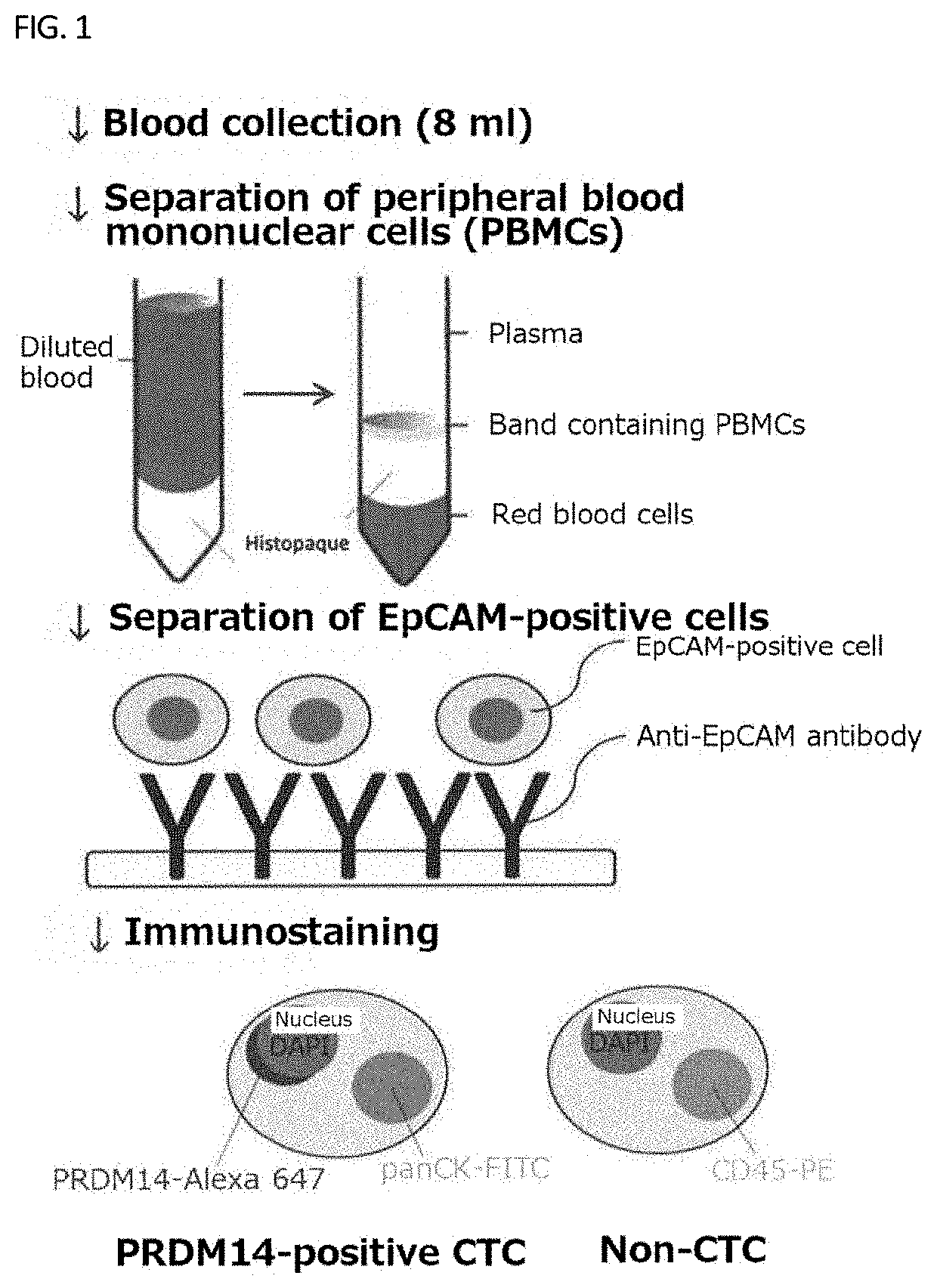
Figure 1 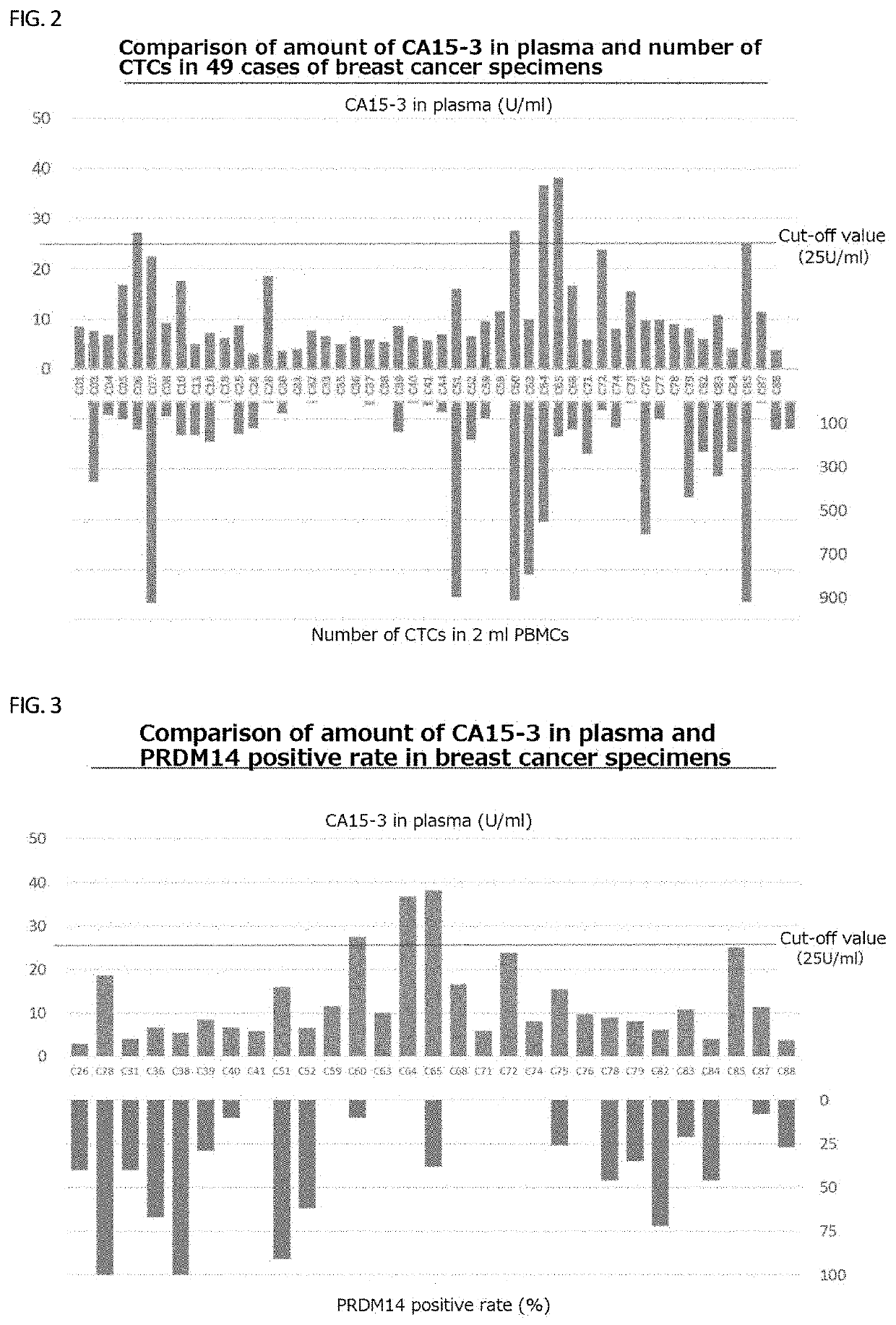
Figure 2 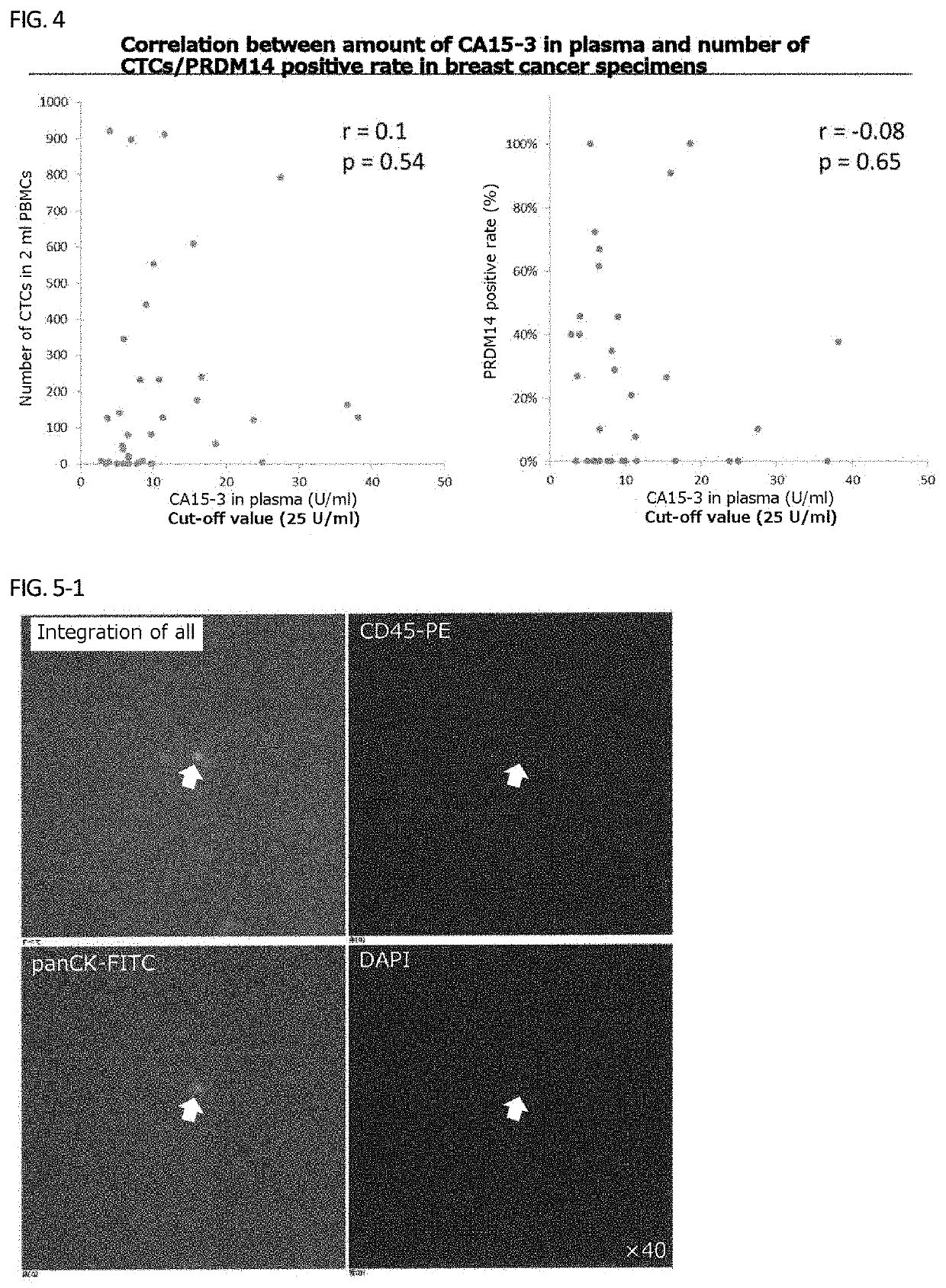
Figure 3
Abstract
Description
TECHNICAL FIELD
[0001] The present invention relates to a method for confirming expression of PRDM14 gene from the blood or lymphatic fluid collected from a subject, and more specifically, relates to (1) a peripheral blood circulating tumor cell biomarker for use in the confirmation method, a diagnostic method of cancer, a method for judging efficacy and prognosis of a therapeutic agent for cancer, a kit comprising a detection reagent for the biomarker, a method for identifying peripheral blood circulating tumor cells, as well as a method for diagnosing a disease involving PRDM14 gene expression, a method for evaluating efficacy of a therapeutic agent for the disease, a method for determining a therapeutic policy for the disease, and / or a method for judging prognosis after therapy of the disease, and a cancer metastasis marker and a kit that can be used in those methods.BACKGROUND ART
[0002] PRDM (PR domain-containing protein) 14 has been identified as a nuclear transcription factor tha...
Examples
example 1
[0148]In the method for detecting PRDM14-positive CTCs according to the present invention, CTCs were detected from 36 specimens of 2-mL blood collected from breast cancer patients and the number thereof was measured, in accordance with the instruction attached to CytoQuest® CR of Abnova, and in addition, the PRDM14 positive rate was calculated by immunostaining using an anti-PRDM14 antibody (product codes: ab187881 and ab192411; Abcam). Table 1 shows the results.
TABLE 1Number of CTCs and PRDM14 positiverate in breast cancer specimensPatientNumber ofPRDM14 positiveNo.CTCsrate (%)C26740C2855100C300—C31540C32——C330—C350—C361666.7C370—C38140100C39728.6C402010C41490C5117590.9C527961.5C580—C599120C6079210C635520C641620C6512837.5C682400C71400C721200C7440C7560826.3C76800C770—C7844045.5C7923234.5C8234472.1C8323220.7C8492045.7C8540C871287.7C8812526.7
[0149]Of all 36 specimens listed in Table 1, one or more CTCs were present in 29 specimens (80.6%), of which 19 were PRDM14 positive (65.5%) and ...
example 2
[0150]Using PRDM14 and the tumor marker CA15-3 which is considered useful for tracking recurrence and metastasis of breast cancer, the amount of CA15-3 in plasma was measured while measuring the number of CTCs as in Example 1, and the PRDM14 positive rate was calculated. Results are shown in FIGS. 2 to 4, respectively.
[0151]There was no correlation between the amount of CA15-3 in plasma, and the number of CTCs and the PRDM14 positive rate, respectively (FIG. 4), but the number of specimens that were PRDM14 positive and CTC detectable were greater than that of CA15-3-positive specimens.
[0152]The following shows the stage of breast cancer, number of CTCs and PRDM14 positive rate.
TABLE 2Stage of disease, number of CTCs and PRDM14 positive rate.Pre-Pre-PRDM14Patho-surgicalsurgicalNumberpositivePatientClinicallogicalhormonalchemo-ofrateNo.stagestagetherapytherapyCTCs(%)C26IIIA540C28IIAIIBNoneNone55100C30I00C31I540C32IIA00C33I00C36I1667C37I00C38I140100C39I729C40IIIB2010C41IIA490C51IIA1759...
example 3
[0155]>
[0156]FIG. 6 schematically outlines a series of screening methods for identifying a biomarker that correlates with the expression level of PRDM14 gene. First, in the primary screening, comprehensive gene expression information by microarray in 29 cases of breast cancer clinical tissues was analyzed, and candidate molecules were narrowed down based on the following conditions: a correlation with the expression level of PRDM14 gene found to be frequently amplified (about 60%) in breast cancer (1) with a correlation coefficient of 0.7 or more, (2) the regression line has a slope of 0.5 to 2.0, and (3) it is known to be a secretory protein on the database, (4) ELISA kit is available. Then, in the secondary screening, reproducibility verification using comprehensive gene expression information by microarray for another 50 cases of breast cancer clinical tissues was performed, and it was found that LEPR correlated with the expression level of PRDM14 gene.
[0157]In addition, after th...