
Reference selection for video interpolation or extrapolation
A video unit, selective technology, applied in the field of digital video decoding, which can solve the problems of undesirable spatial artifacts, damage to visual quality, etc.
- Summary
- Abstract
- Description
- Claims
- Application Information
AI Technical Summary
Problems solved by technology
Method used
Image

Examples
Embodiment Construction
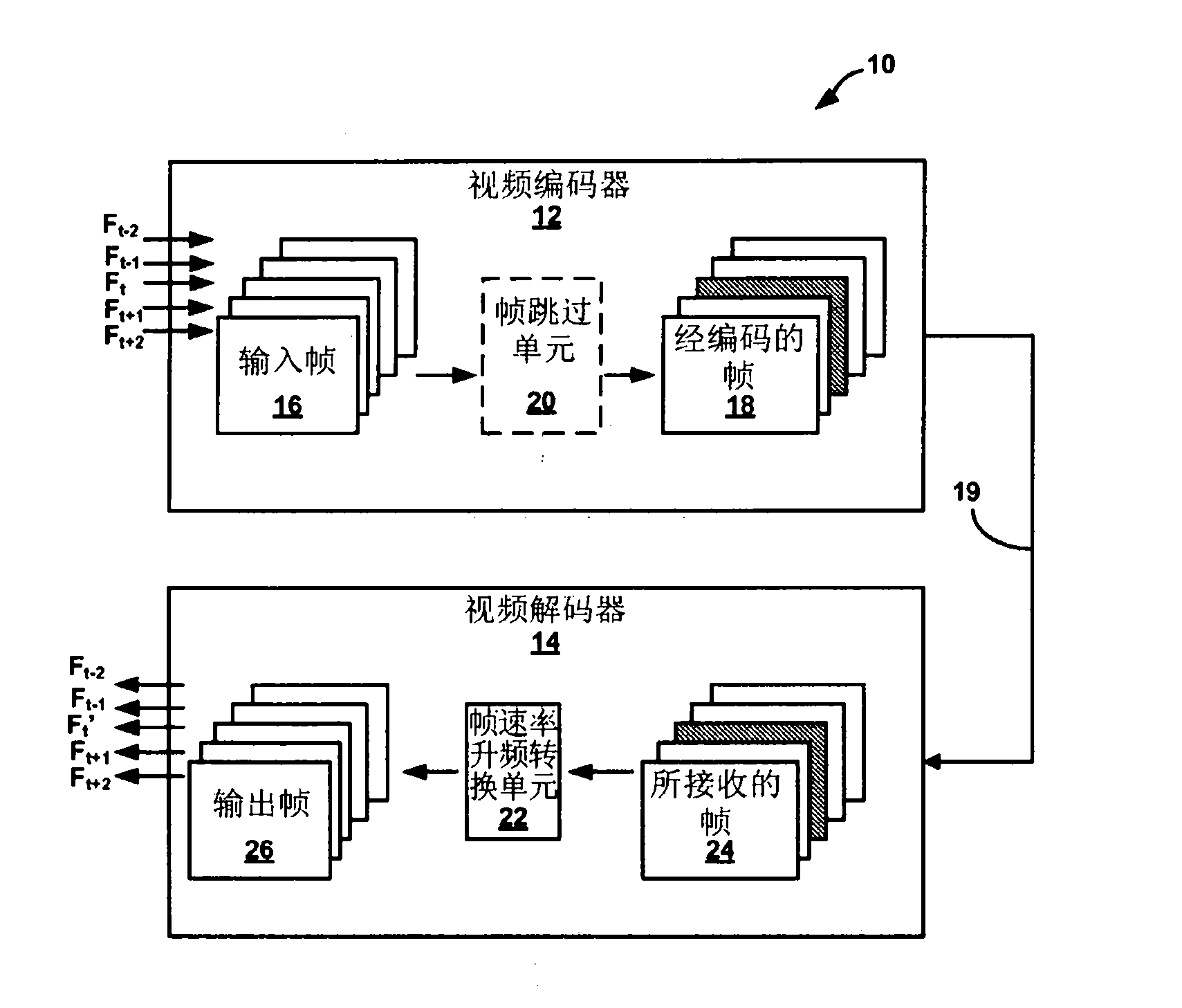
[0040] figure 1 To illustrate a block diagram of a video encoding and decoding system 10 configured to select reference video units for use in video unit replacement. In various aspects, the replaced video unit and selected reference video unit may be, for example, a video frame, video slice, or video block. Such as figure 1 As shown in , system 10 may include video encoder 12 and video decoder 14, each of which may be generally referred to as a video coder. exist figure 1 In the example shown, video encoder 12 encodes input video frame 16 to produce encoded video frame 18 . Video encoder 12 may transmit encoded video frames 18 to video decoder 14 via communication channel 19 .
[0041] Although the techniques described in this disclosure may be applicable to a variety of units of video (e.g., frames, slices, blocks, or sub-blocks), for purposes of illustration, this disclosure will generally describe applying the techniques to video frames , but without limitation in ter...
PUM
 Login to View More
 Abstract
Description
Claims
Application Information
 Login to View More