
A kind of devolatilization method and equipment of thermoplastic elastomer
A thermoplastic elastomer, a first-class technology, applied in the field of post-treatment devolatilization of thermoplastic elastomers, can solve the problems of large equipment occupation, small bulk density, unstable volatile index control, etc., to prevent loss and smooth feeding Effect
- Summary
- Abstract
- Description
- Claims
- Application Information
AI Technical Summary
Problems solved by technology
Method used
Image

Examples
Embodiment 1
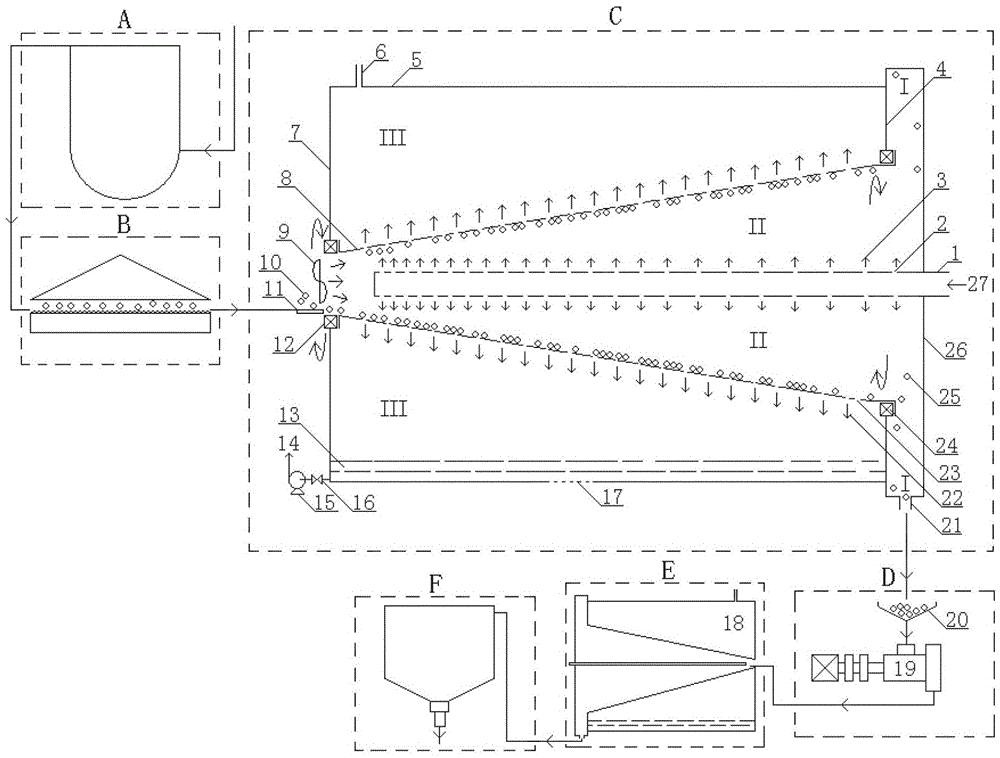
[0058] Take the horizontal conical centrifugal sieve as an example to describe it in detail.
[0059] A star-shaped SBS glue with a weight average molecular weight of 300,000, a block ratio of 30 / 70, and a vinyl content of 16% (m / m) was obtained by polymerization. The glue contained 82% (m / m) of cyclopentane and 18% (m / m) polymer molecule. The glue passes through the water precipitation coagulation section A, and after the cyclopentane is cooked and removed, very fluffy colloidal particles are obtained, and these colloidal particles contain 85% (m / m) of water and a small amount of solvent. The colloidal particles are first sent to the vibration dewatering section B for preliminary water removal, so that the volatile content is reduced to about 51% (m / m).
[0060] The hydrocolloid particles 10 sent from the vibration dewatering section B are sent to the primary drying section C at a delivery rate of 55kg / min, the pressure balancer 9 is activated, and the air is blown to the le...
Embodiment 2
[0064] Take the vertical conical centrifugal sieve as an example to describe in detail.
[0065] The polymerization reaction obtained a syndiotactic 1,2-polybutadiene glue solution with a weight average molecular weight of 410,000, a syndiotactic degree of 72%, and a 1,2-structure content of 83%. The glue solution contained 84% (m / m) Cyclohexane and 16% (m / m) polymer molecules. The glue passes through the water precipitation coagulation section A, and after the cyclohexane is cooked and removed, very fluffy colloidal particles are obtained, which contain 75% (m / m) of water and a small amount of solvent. The colloidal particles are first sent to the vibration dewatering section B for preliminary water removal, so that the volatile matter content is reduced to about 45% (m / m), and the water colloidal particles sent by the vibration dewatering section B are sent to the primary drying section Dry in a vertical conical centrifugal dryer in C.
[0066]Vertical conical centrifugal...
PUM
 Login to View More
 Abstract
Description
Claims
Application Information
 Login to View More