
Image defogging method and system
An image and input image technology, applied in the field of image processing and computer vision, can solve the problem of easy to produce halo effect, the color of the image is too saturated, etc., and achieve the effect of fast and effective dehazing.
- Summary
- Abstract
- Description
- Claims
- Application Information
AI Technical Summary
Problems solved by technology
Method used
Image


Examples
Embodiment Construction
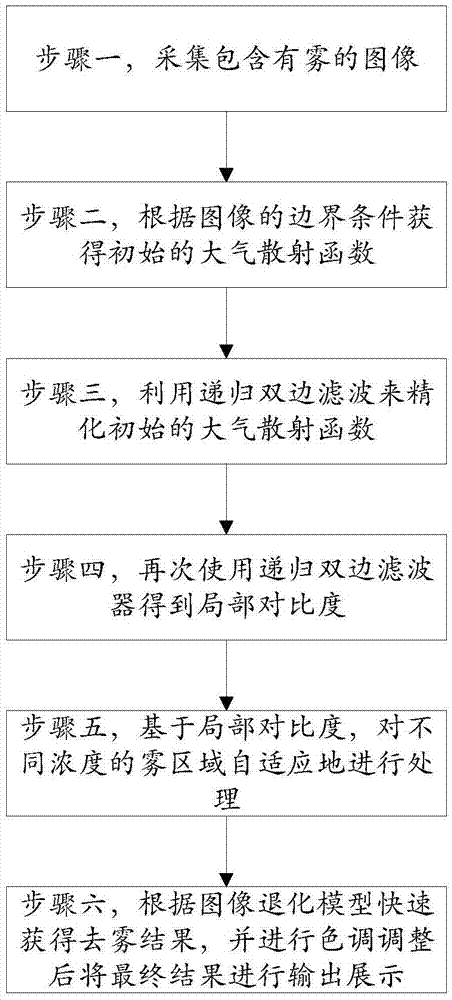
[0022] Such as figure 1 As shown, the present invention provides a kind of image defogging method, and it comprises the following steps:
[0023] Step 1, collecting images containing fog;
[0024] Step 2, obtain the initial atmospheric scattering function according to the boundary conditions of the image;
[0025] Step 3, using recursive bilateral filtering to refine the initial atmospheric scattering function;
[0026] Step 4, use the recursive bilateral filter again to obtain the local contrast;
[0027] Step five, based on local contrast, adaptively process fog regions with different concentrations;
[0028] Step 6. According to the image degradation model, the dehazing result is quickly obtained, and the final result is output and displayed after adjusting the tone.
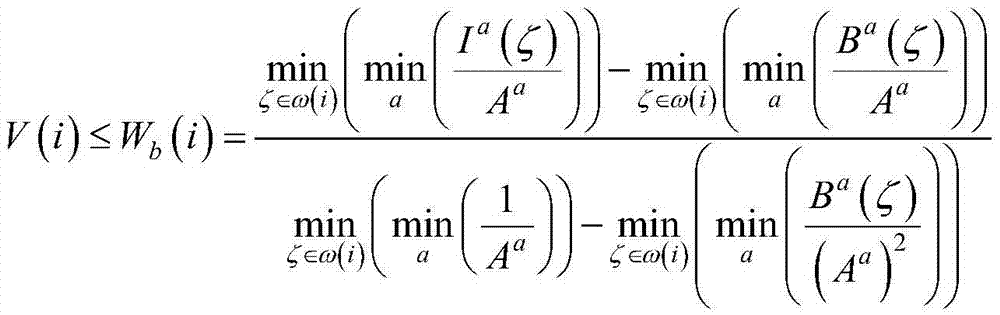
[0029] Preferably, in step 2, the global atmospheric light A is obtained according to the image degradation model, and a window ω(i) centered on the pixel i is used to perform minimum value filtering on t...
PUM
 Login to View More
 Abstract
Description
Claims
Application Information
 Login to View More