
Nearest-neighbor collaborative filtering method based on item feature augmentation (IFA) of product
A collaborative filtering and nearest neighbor technology, applied in special data processing applications, instruments, electrical digital data processing, etc., can solve the problems of reducing the accuracy of recommendation systems, calculating similarity measurement errors, and inaccurate similarity calculations, etc.
- Summary
- Abstract
- Description
- Claims
- Application Information
AI Technical Summary
Problems solved by technology
Method used
Image

Examples
Embodiment Construction
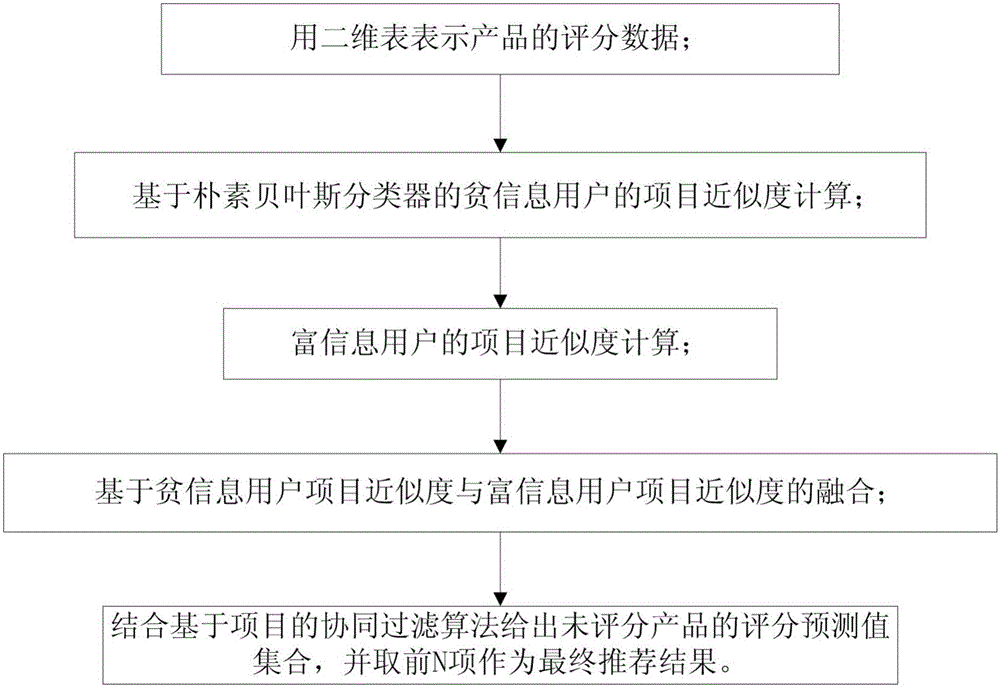
[0064] like figure 1 As shown, a nearest neighbor collaborative filtering method (Item FeatureAugmentation, IFA) based on product item feature expansion is carried out as follows:
[0065] Step 1, using a two-dimensional table T={U, I, S} to represent the rating data of the product;
[0066] In the two-dimensional table T, U={U 1 ..., U u ,...,U u} represents the set of users, I={I 1 ..., I i ,...,I |i|} means product set, S={S (1) ..., S (s) ,...,S (s)} represents the collection of user ratings on the product;
[0067] In the user set U, |u| is the total number of users, U u Indicates the uth user; 1≤u≤|u|; in the product set I, |i| is the total number of products, I i Indicates the i-th product; 1≤i≤|i|; in the scoring set S, S (s) Indicates the sth rating in the rating set, and S (1) (s) (s) ;
[0068] Let the u-th user U u For the i-th product I i rated as S u,i , and S u,i ∈ S;
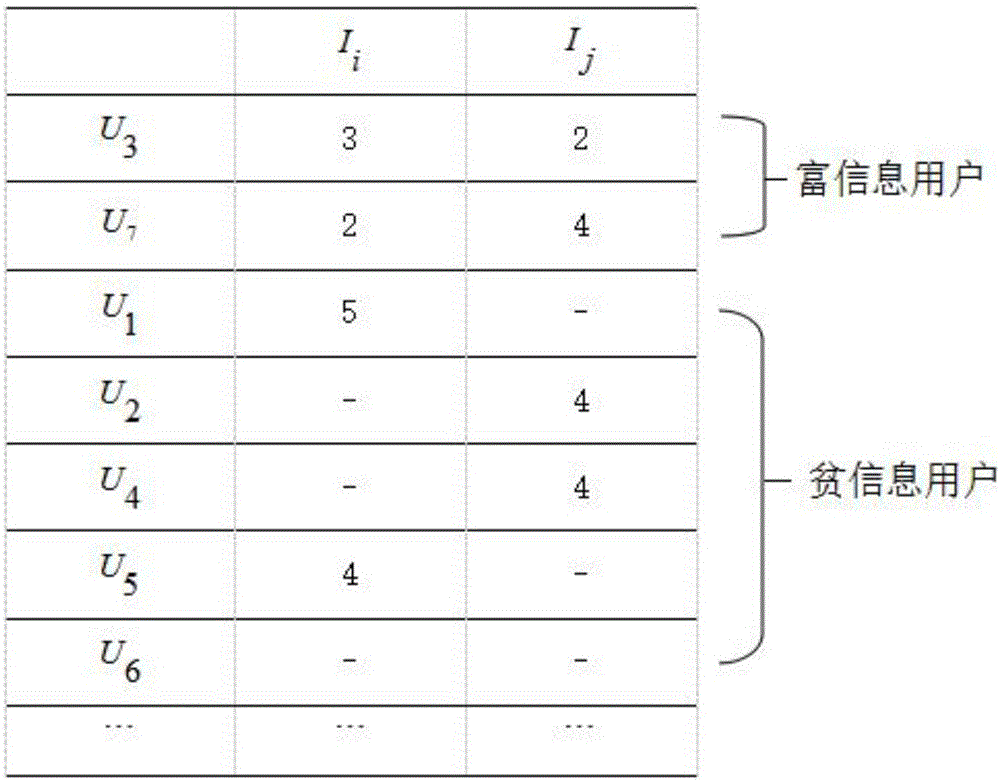
[0069] like figure 2 As shown, for any ith product I i and the jth prod...
PUM
 Login to View More
 Abstract
Description
Claims
Application Information
 Login to View More