
Speed Magnetic Resonance Imaging Method Based on K-Space Center Ghost Location
A magnetic resonance imaging and k-space technology, applied in magnetic resonance measurement, material analysis through resonance, magnetic property measurement, etc., can solve the problem of failure to find authorized invention patents or applications, shorten reconstruction time, and be easy to integrate , Improve the effect of data collection time
- Summary
- Abstract
- Description
- Claims
- Application Information
AI Technical Summary
Problems solved by technology
Method used
Image

Examples
Embodiment Construction
[0042] The present invention will be further described below in conjunction with accompanying drawing.
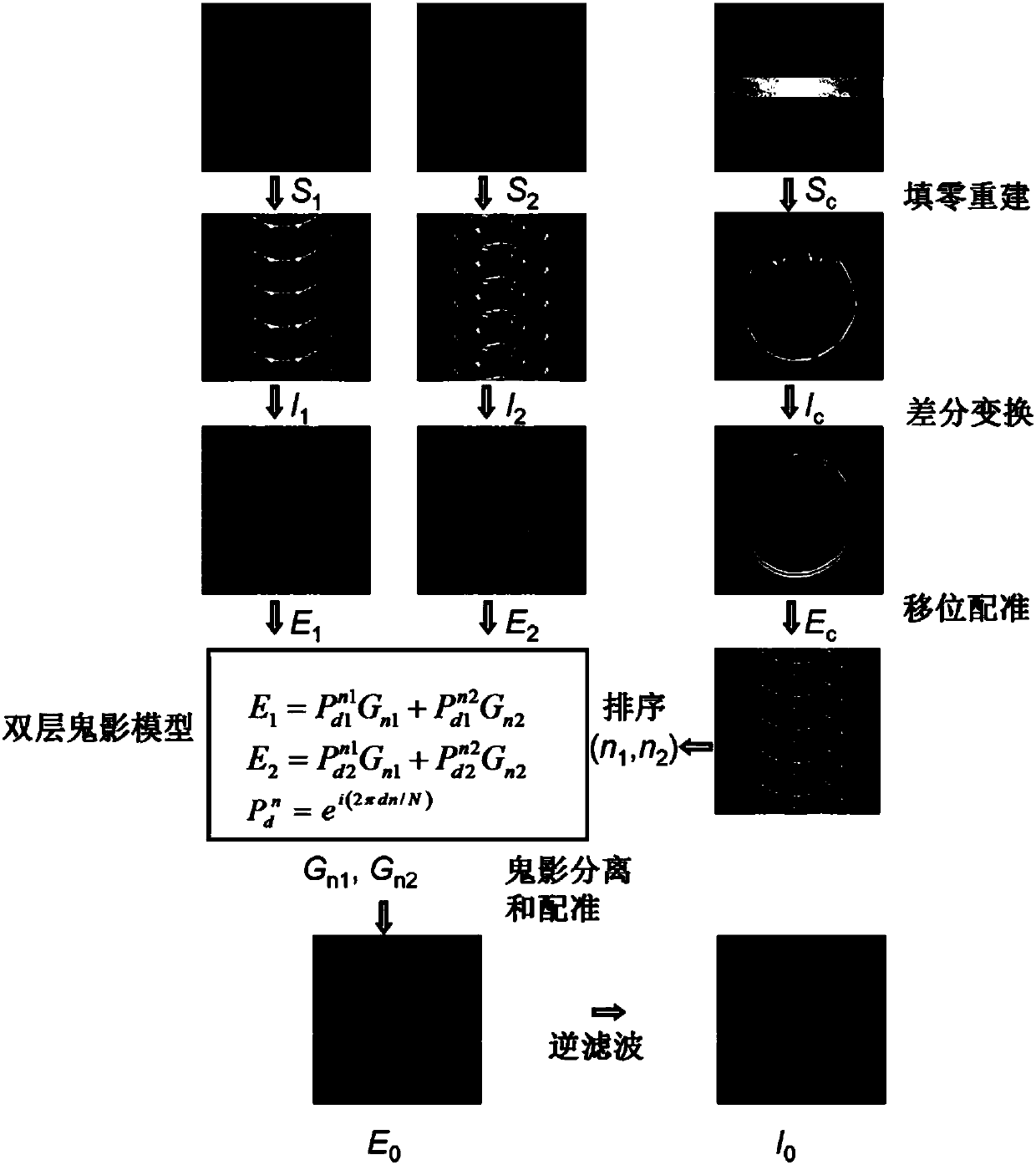
[0043] The present invention mainly includes nine steps: k-space data acquisition, zero-filled Fourier reconstruction, differential transformation, establishment of low-resolution overlapping ghost image, establishment of ghost order, double-layer ghost model solution, ghost separation, multiple Registrar summation, inverse filter reconstruction of ghost maps.
[0044] Step 1: k-space data acquisition
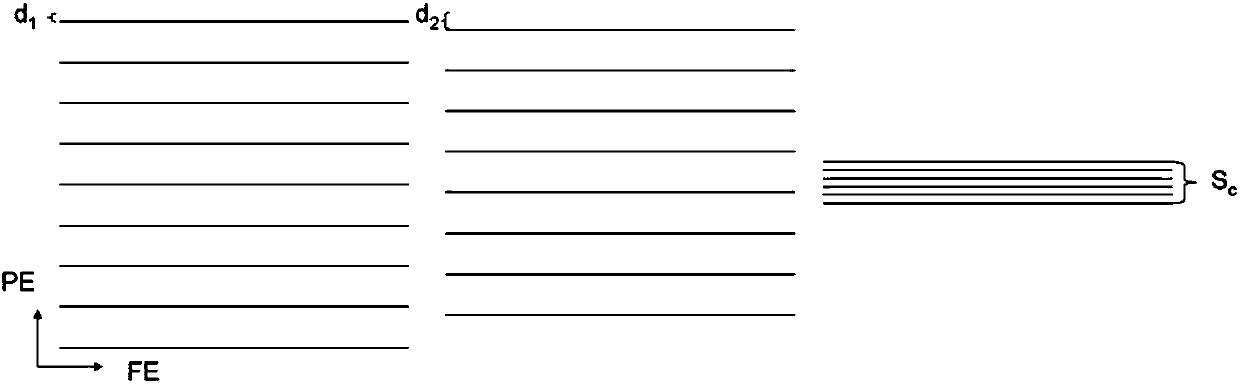
[0045] In the phase encoding direction of k-space (i.e., PE direction), one row of data is collected every N rows, and two groups are collected in total, respectively with S 1 and S 2 express. use d 1 , d 2 Indicates the offset of each group of undersampled data in the PE direction, and the sampling method is N(d 1 , d 2 ) means, if figure 1 shown.
[0046] According to the size of the image, 16 to 64 rows of data are collected in the central area of k-space in th...
PUM
 Login to View More
 Abstract
Description
Claims
Application Information
 Login to View More