AI technical title is built by Patsnap AI team. It summarizes the technical point description of the patent document.
A technology for products and teeth, applied in the field of dental product manufacturing, can solve problems such as limited efforts
Pending Publication Date: 2022-01-07
AGENCY FOR SCI TECH & RES
View PDF0 Cites 0 Cited by
Summary
Abstract
Description
Claims
Application Information
AI Technical Summary
This helps you quickly interpret patents by identifying the three key elements:
Problems solved by technology
Method used
Benefits of technology
Problems solved by technology
Unfortunately, so far, efforts to provide color schemes in 3D printing of teeth have been limited
Method used
the structure of the environmentally friendly knitted fabric provided by the present invention; figure 2 Flow chart of the yarn wrapping machine for environmentally friendly knitted fabrics and storage devices; image 3 Is the parameter map of the yarn covering machine
View more
Image
Smart Image Click on the blue labels to locate them in the text.
Viewing Examples
Smart Image
Click on the blue label to locate the original text in one second.
Reading with bidirectional positioning of images and text.
Smart Image
Examples
Experimental program
Comparison scheme
Effect test
Embodiment 1
[0095] Example 1 - Masterbatch Resin Preparation
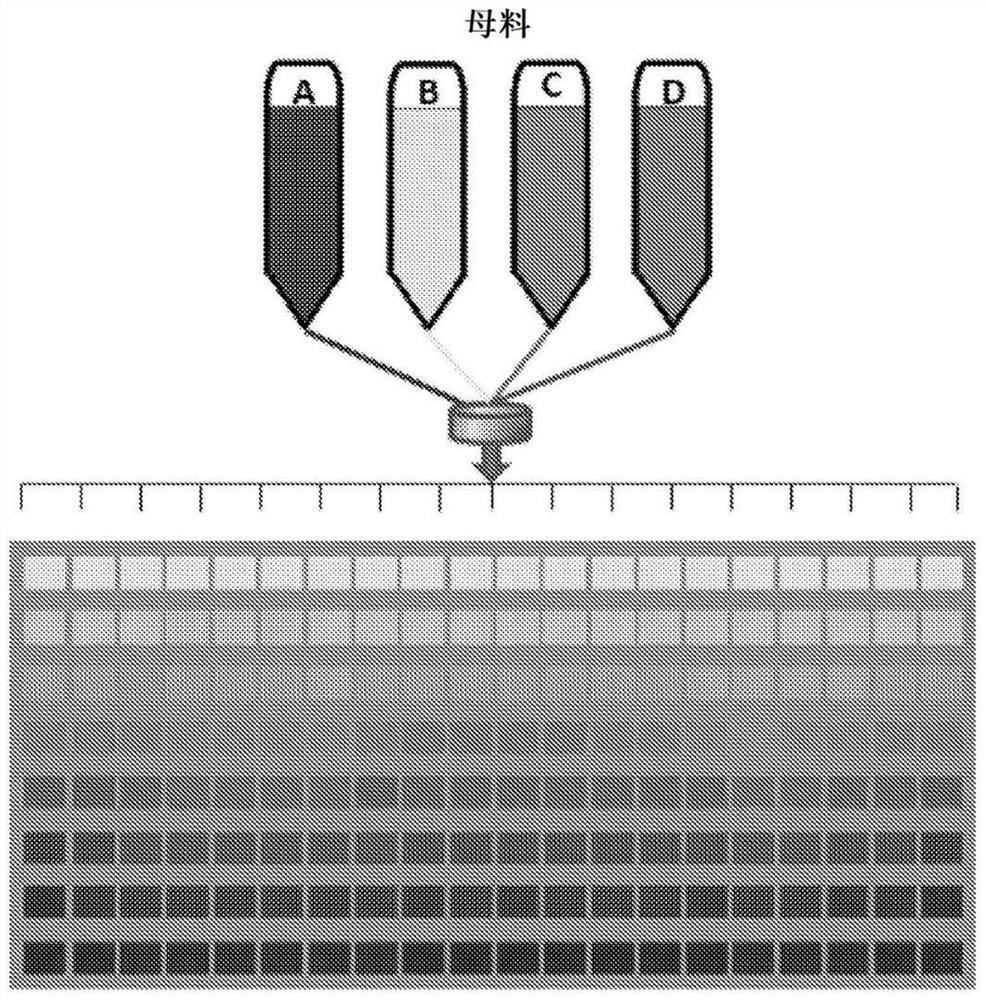
[0096] The formulations of Masterbatch Resins A, B, C and D are shown in Tables 1-4. To prepare Masterbatch Resin A, measure all components listed in Table 1 into a flask and stir in the dark for 8-24 hours until all solid contents dissolve and reach a homogeneous state. Masterbatch resins B, C and D were similarly prepared according to the compositions shown in Tables 2-4, respectively.
[0097] Table 1. Integration of Masterbatch Resin A
[0099] Table 2. Integration of Masterbatch Resin B
[0100] Element Percentage (weight%) bisphenol A dimethacrylate 50 polyethylene glycol diacryla...
Embodiment 2
[0106] Example 2-36 Color array preparation
[0107] Mix masterbatch resins A, B and C from Example 1 in the proportions shown in Table 5 to construct Figure 5 The 36-color array shown. For example, test article 001 was prepared by mixing 20 grams of Resin A and 20 grams of Resin C in a bottle and stirring at room temperature for 2 hours until a homogeneous mixture was obtained. Other test products from 002 to 036 were similarly prepared according to the compositions shown in Table 5, respectively.
[0108] Table 5. Composition of color points on the 36-color array (mixing ratio)
[0109]
[0110]
[0111]
Embodiment 3
[0112] Example 3 - Color Calculation
[0113] Step 1: Measure the spectral reflectance S(λ) or transmittance of the target sample with a UV-Vis spectrometer, and calculate the X, Y and Z color coordinate values.
[0114] XYZ color coordinates are calculated according to the following formula:
[0115]
[0116]
[0117]
[0118]
[0119] where x - 、y - and z - is has such Figure 7 (a) CIE standard observation function for the function shown;
[0120] where I(λ) is the Figure 7 (b) Spectral power distribution of the CIE standard reference illuminant (D65 in this case) for the function shown. Integrals are calculated over the visible spectrum (390 nm to 830 nm).
[0121] Step 2: Convert the calculated X, Y and Z values into L* according to the following formula 1 、a* 1 and b* 1 value:
[0122]
[0123]
[0124]
[0125] in
[0126]
[0127]
[0128] Here, X n , Y n and Z n is the CIE XYZ tristimulus value referenced to the white point (th...
the structure of the environmentally friendly knitted fabric provided by the present invention; figure 2 Flow chart of the yarn wrapping machine for environmentally friendly knitted fabrics and storage devices; image 3 Is the parameter map of the yarn covering machine
Login to View More
PUM
Login to View More
Abstract
The present disclosure provides a method of making an article particularly a dental article having a desired color, the method comprising the steps of: (a) providing a color array, said array comprising a plurality of distinct color points, each color point being independently composed of a resin mixture comprising one or more master batch resins; (b) comparing the desired color with the color points on the color array and selecting a color point that substantially corresponds to the desired color of the article; (c) identifying the resin mixture corresponding to said selected color point; and (d) making the article using said identified resin mixture. The embodiments include the preparation of master batch resins comprising mainly bisphenol A dimethacrylate, polyethylene glycol) di acrylate, tetrahydrofurfuryl methacrylate, phenylbis(2,4,6 trimethyl benzoyl)phosphine oxide and 2,5-bis(5-tert-butyl-benzoxazol-2-yl)thiophene, as well as the preparation of 36-color array by mixing the master batch resins at different ratios.
Description
technical field [0001] The present invention generally relates to a method of making a dental article. Background technique [0002] It has been observed that the present generation is more conscious about appearance and beauty. One aspect of this is having beautiful teeth. Therefore, the demand for dental aesthetics has also grown rapidly over the past few years, which has led to an increase in the demand for 3D printing in the dental industry. This increase in demand is also driven by technological advances that allow dentists to perform dental procedures with high precision, efficiency, and minimal trauma to patients. Dental 3D printing is performed through an additive process programmed by computer-aided design (CAD) files. The global dental 3D printing market is expected to be valued at USD 3,427.1 million by the end of 2025. [0003] Dental 3D printing is generally available in three main materials, including metals, polymer resins, and ceramics. Polymer resins ac...
Claims
the structure of the environmentally friendly knitted fabric provided by the present invention; figure 2 Flow chart of the yarn wrapping machine for environmentally friendly knitted fabrics and storage devices; image 3 Is the parameter map of the yarn covering machine
Login to View More
Application Information
Patent Timeline
Application Date:The date an application was filed.
Publication Date:The date a patent or application was officially published.
First Publication Date:The earliest publication date of a patent with the same application number.
Issue Date:Publication date of the patent grant document.
PCT Entry Date:The Entry date of PCT National Phase.
Estimated Expiry Date:The statutory expiry date of a patent right according to the Patent Law, and it is the longest term of protection that the patent right can achieve without the termination of the patent right due to other reasons(Term extension factor has been taken into account ).
Invalid Date:Actual expiry date is based on effective date or publication date of legal transaction data of invalid patent.


 Login to View More
  Login to View More