
Method for transferring a message in a predetermined sending time and related communication system thereof
- Summary
- Abstract
- Description
- Claims
- Application Information
AI Technical Summary
Benefits of technology
Problems solved by technology
Method used
Image

Examples
first embodiment
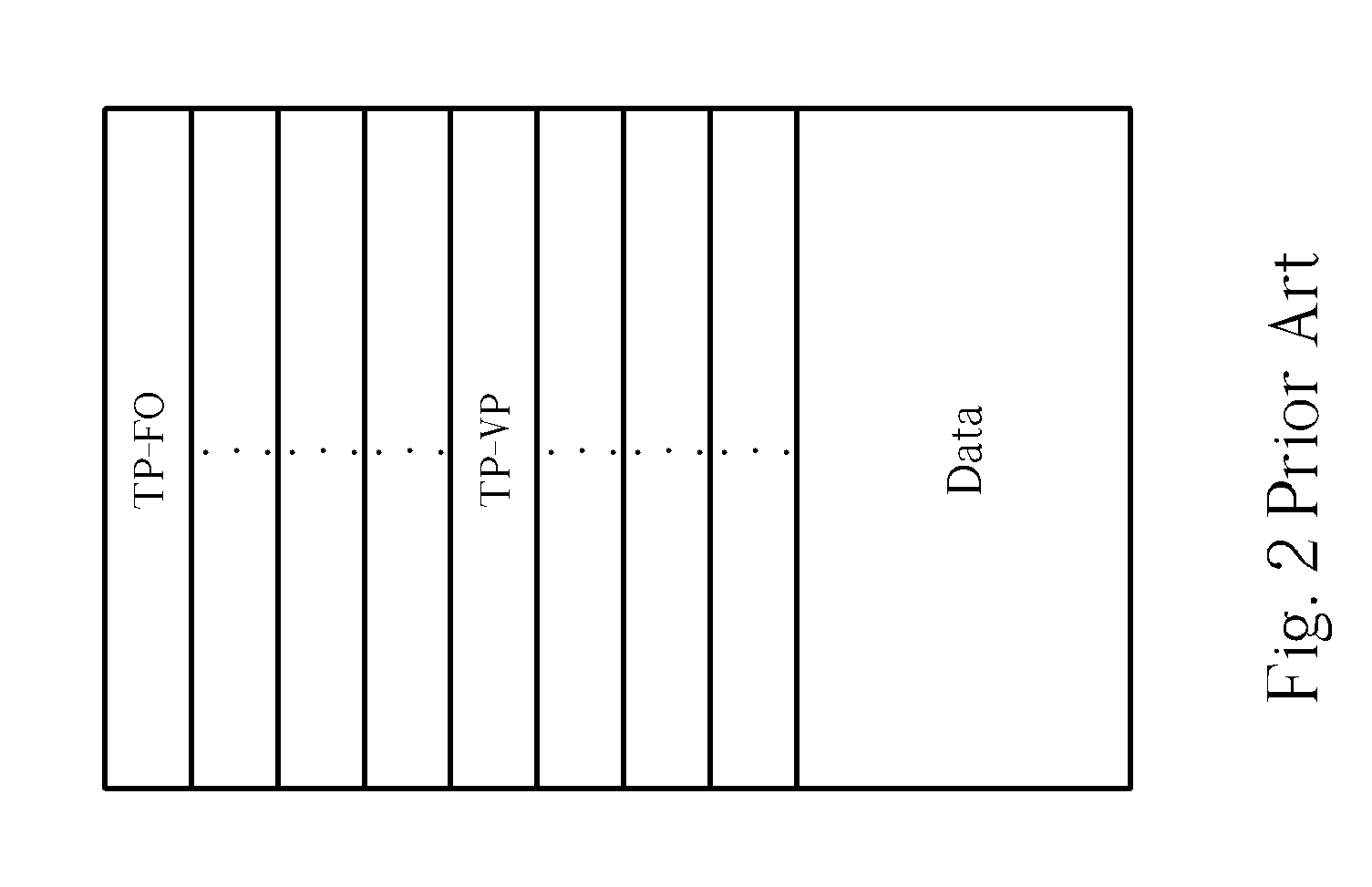
[0030] Please refer to FIG. 3, which is a diagram of a message of a first embodiment according to the present invention. As shown in FIG. 3, besides the parts mentioned above, the present invention adds an additional part TP-OT (transmission-protocol-order-time) to represent the predetermined sending time. Therefore, after the message has been transferred to the service center, the service center can obtain the information of the predetermined sending time, and send the message to the destination cell phone at the predetermined sending time according to the information.
second embodiment
[0031] Please refer to FIG. 4, which is a diagram of a message of a second embodiment according to the present invention. As shown in FIG. 4, in this embodiment, there is no additional part in this message. Instead, the original part TP-VP is replaced by a new information TP-MVOT, which is a combination of the original information TP-VP and the information TP-OT. In other words, the information of the predetermined sending time is put inside the information of the current time.
[0032] Combining the information is simple. Here, the present invention encodes the information of predetermined sending time and the information of the current time through using two orthogonal codes. In other words, the information of predetermined sending time is multiplied by one of the orthogonal codes, the information of the current time is multiplied by the other orthogonal code, and the two pieces of multiplied information are added to each other in order to generate the combined information TP-MVOT. S...
PUM
 Login to View More
 Abstract
Description
Claims
Application Information
 Login to View More