

Zeolite based catalytic process for preparation of acylated aromatic ethers
a technology of acylated aromatic ethers and zeolite, which is applied in the direction of physical/chemical process catalysts, organic chemistry, chemistry apparatus and processes, etc., can solve the problems of post reaction catalyst separation, process operation disadvantage of high temperature and very high pressure, and needing a solven
Patent Information
- Authority / Receiving Office
- US · United States
- Patent Type
- Applications(United States)
- Current Assignee / Owner
- Publication Date
- 2007-05-03
- Estimated Expiration
- Not applicable · inactive patent
Smart Images
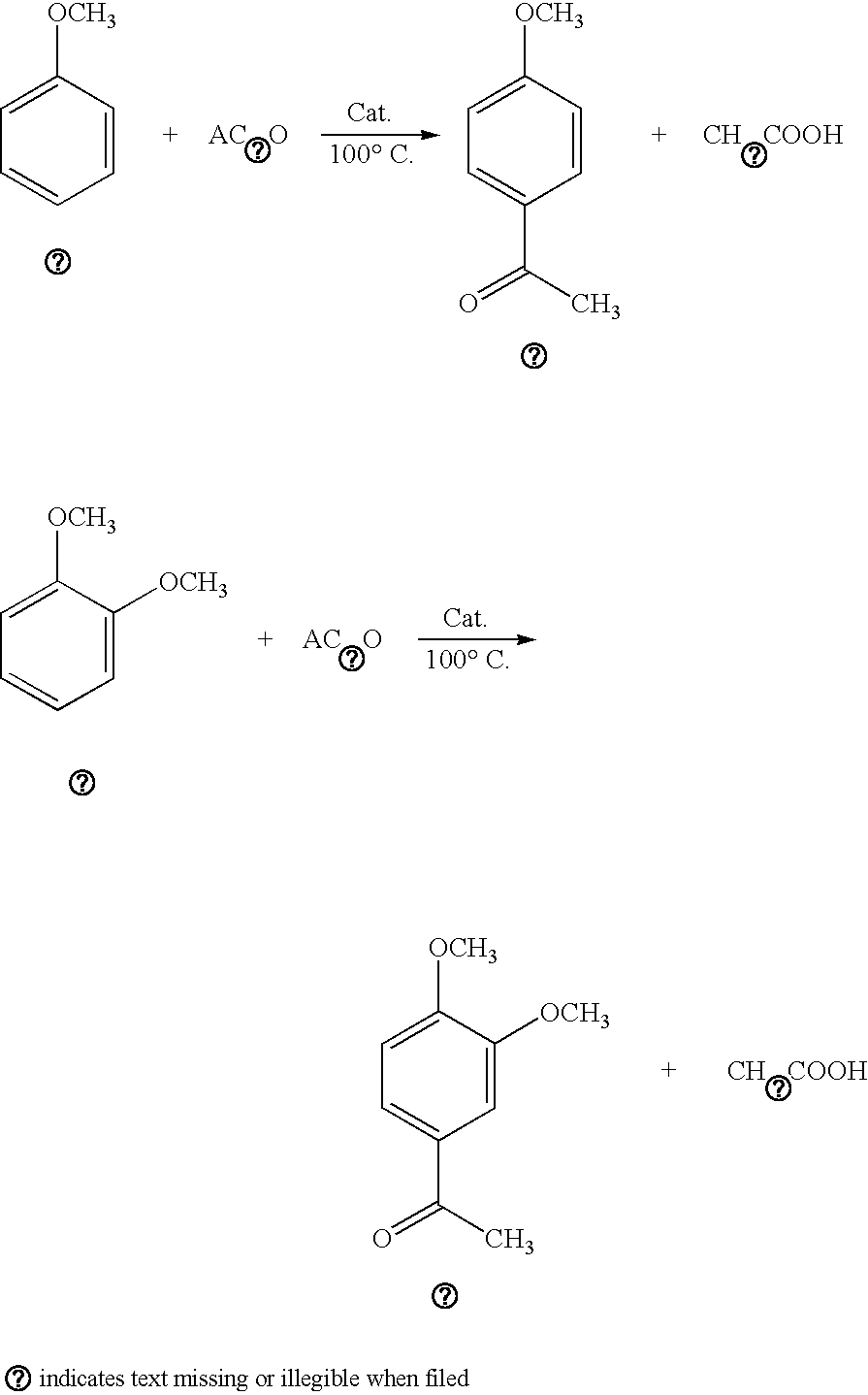
Figure 1
Abstract
Description
FIELD OF THE INVENTION
[0001] The present invention relates to an improved zeolite based catalytic process for the preparaton of acylated aromatic ethers and more panicularly, the invention relates to catalysed acylation of anisole (methoxybenzene) and veratrole (1,2-dimethoxybenene) for the preparation of acylated aromatic ether, namely, p-methoxyacetophenone and 3,4-dimethoxyaoetophenone respectively using microporous alumino-silicates solids like zeolites. BACKGROUND AND PRIOR ART DESCRIPTION
[0002] The acylated aromatic ethers are of commercial importance in the fine chemicals industries, as many synthetic fragrances and pharmaceutical contains an acyl group, and these ether are useful intermediates. Acylated anisole is used for synthesis of 2-4Methxybenzoyl) benzoic acid, the sodium salt of which is used as sweetening agent. Similarly, acylatd veratrole is a synthon for preparation of vesnarinone 1-(3,4-Dimethoxybenzoy)4(1,2,3,4-tetrahydro-2-oxo6quinoliyl) piperazine which is a...
Examples
example 1
[0043] 10 grams of sodium zeolite Beta was refluxed with 100 ml of 1M aqueous solution of ammonium chloride for 6 hours at 80° C. This was followed by filtration, washing with hot distilled water till the filtrate became chloride free as checked by silver nitrate solution. Solid thus obtained was dried over night at 110° C. The dried sample was calcined at 550° C. in air for removing ammonia and the calcined solid was termed as zeolite H-Beta. 5.5 g of veratrole (or 4.3 g of anisole) and 3.5 g of acetic anhydride were taken in a 50 ml capacity round bottom flask to which 2 g of zeolite H-Beta as obtained above after activation at 400° C. for 4 hours in a muffle furnace was added. The round bottom flask was fitted with a condenser through which constant temperature water was circulated. Moisture trap was attached at the end of the condenser. The contents of the flask were constantly stirred using a magnetic stirrer. The flask was kept in an oil bath whose temperature was slowly raise...
example 2
[0044] 10 g of zeolite H-Beta prepared by the process described in Example-1 was refluxed with 100 ml of 1M aqueous solution of Lanthanum nitrate for 6 hours at 80° C. This was followed by filtration, washing with hot distilled water till the filtrate became chloride free as checked by silver nitrate solution. Solid thus obtained was dried over night at 110° C. The dried sample was calcined at 550° C. in air and the calcined solid thus obtained was termed as zeolite La-Beta. Acylation of veratrole (or anisole) was carried out following the procedure as described in Example-1 using La-Beta as a catalyst instead of H-Beta. Same amounts of veratrole, acetic anhydride and catalyst were used. The percent yield of p-acyl veratrole and p-acyl anisole obtained as shown in Table 1 varies from 56 to 86% and 51-68% respectively.
example 3
[0045] 10 g of zeolite H-Beta prepared by the process described in Example-1 was refluxed with 100 ml of 1M aqueous solution of Cerium nitrate for 6 hours at 80° C. The Cerium nitrate solution used was prepared by treating cerium oxide with nitric acid). This was followed by filtration, washing with hot distilled water till the filtrate became chloride free as checked by silver nitrate solution. Solid thus obtained was dried over night at 100° C. The dried sample was calcined at 550° C. in air and the calcined solid was termed as zeolite Ce-Beta. Acylation of veratrole (or anisole) was carried out following the procedure as described in Example-1 using Ce-Beta as a catalyst instead of H-Beta. Same amounts of veratrole, acetic anhydride and catalyst were used. The percent yield of p-acyl veratrole and p-acyl anisole as shown in Table 1 from 60 to 93% and 39 to 65% respectively were obtained.