
Enhancement of visual perception through dynamic cues
a dynamic cue and visual perception technology, applied in image enhancement, image analysis, instruments, etc., can solve the problems of difficult detection of certain patterns or objects, and difficult detection of them by examining radiologis
- Summary
- Abstract
- Description
- Claims
- Application Information
AI Technical Summary
Benefits of technology
Problems solved by technology
Method used
Image

Examples
Embodiment Construction
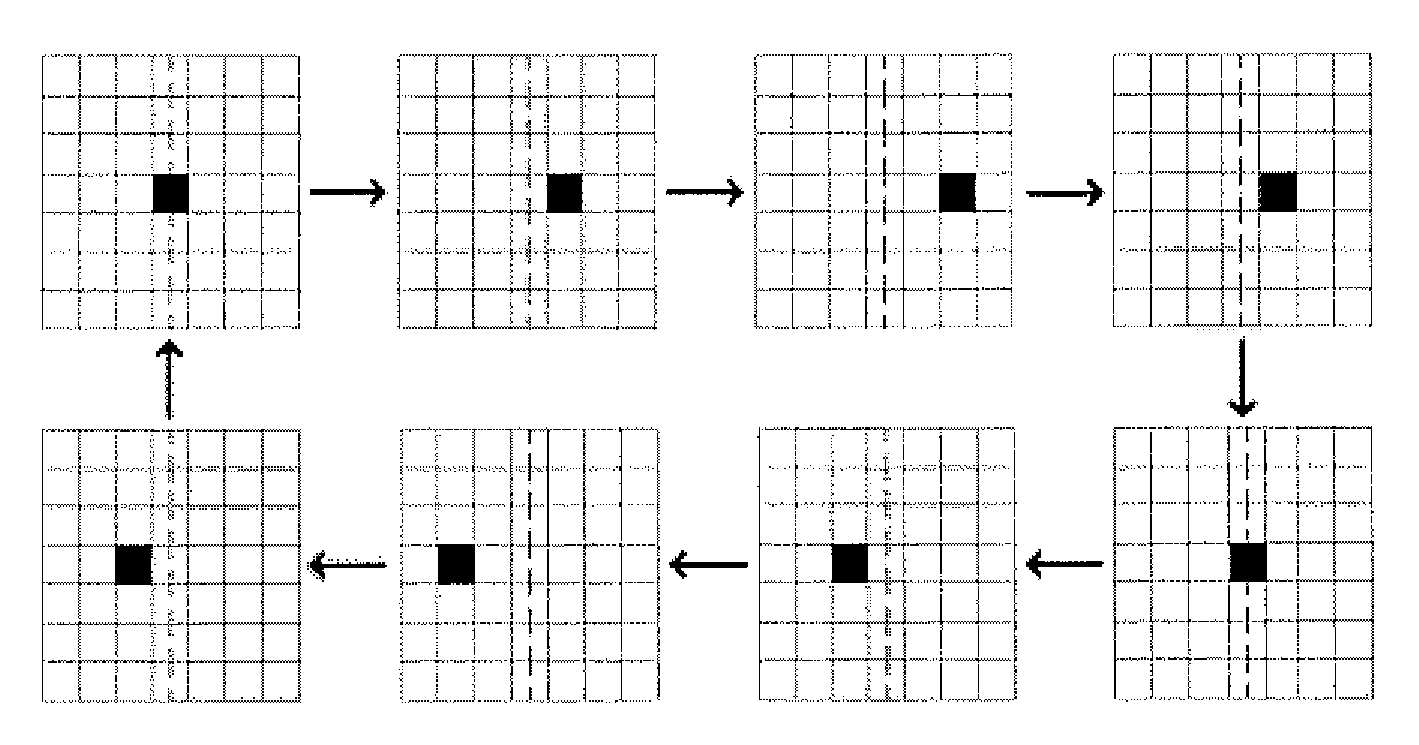
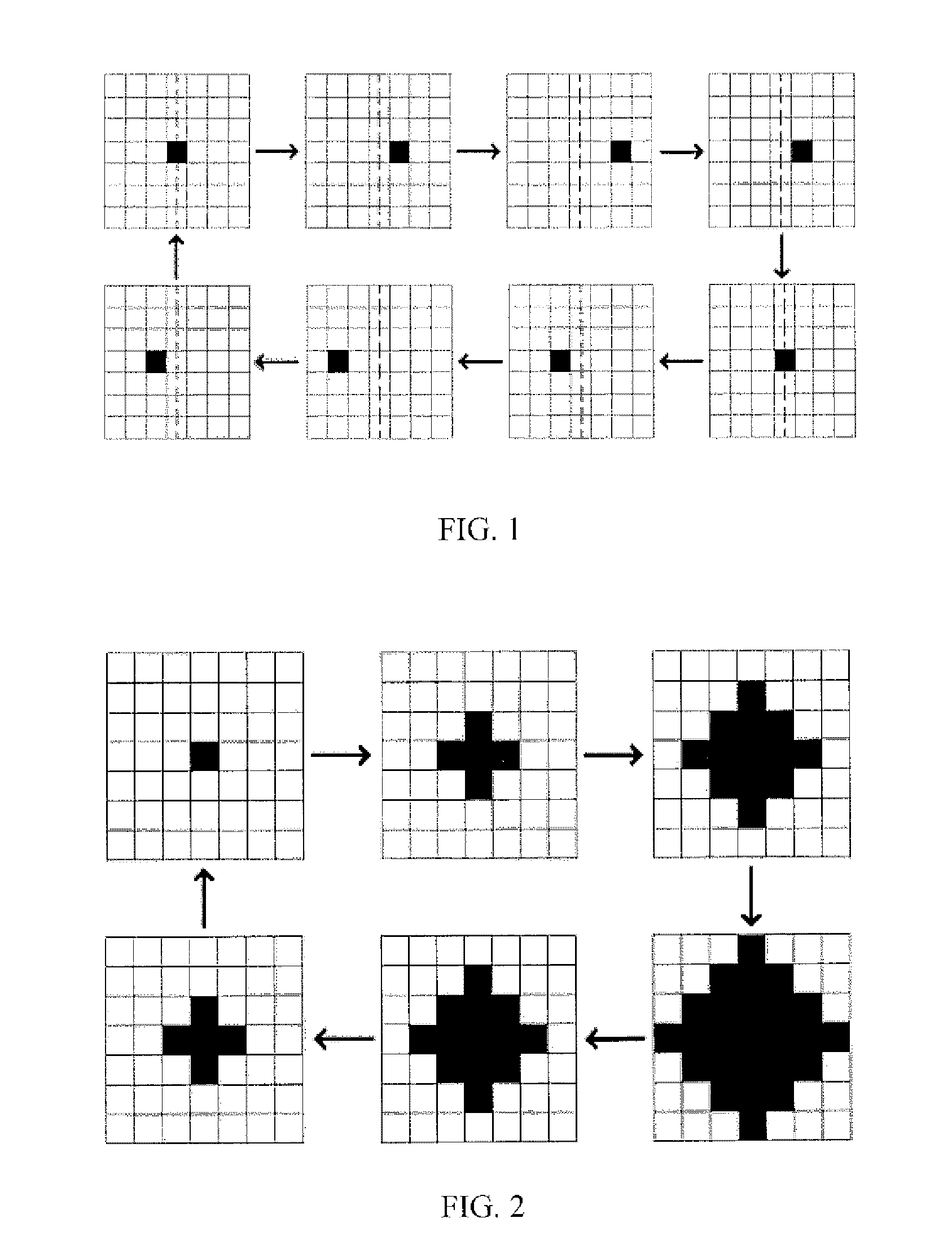
[0025]The present invention provides a method for transforming a static image into a movie to aid in the detection and to identify objects and features in images. In this movie the observer sees motion or flicker which depends on the features of the static image. The system receives as input static images and generates as output a movie containing the dynamic cues.
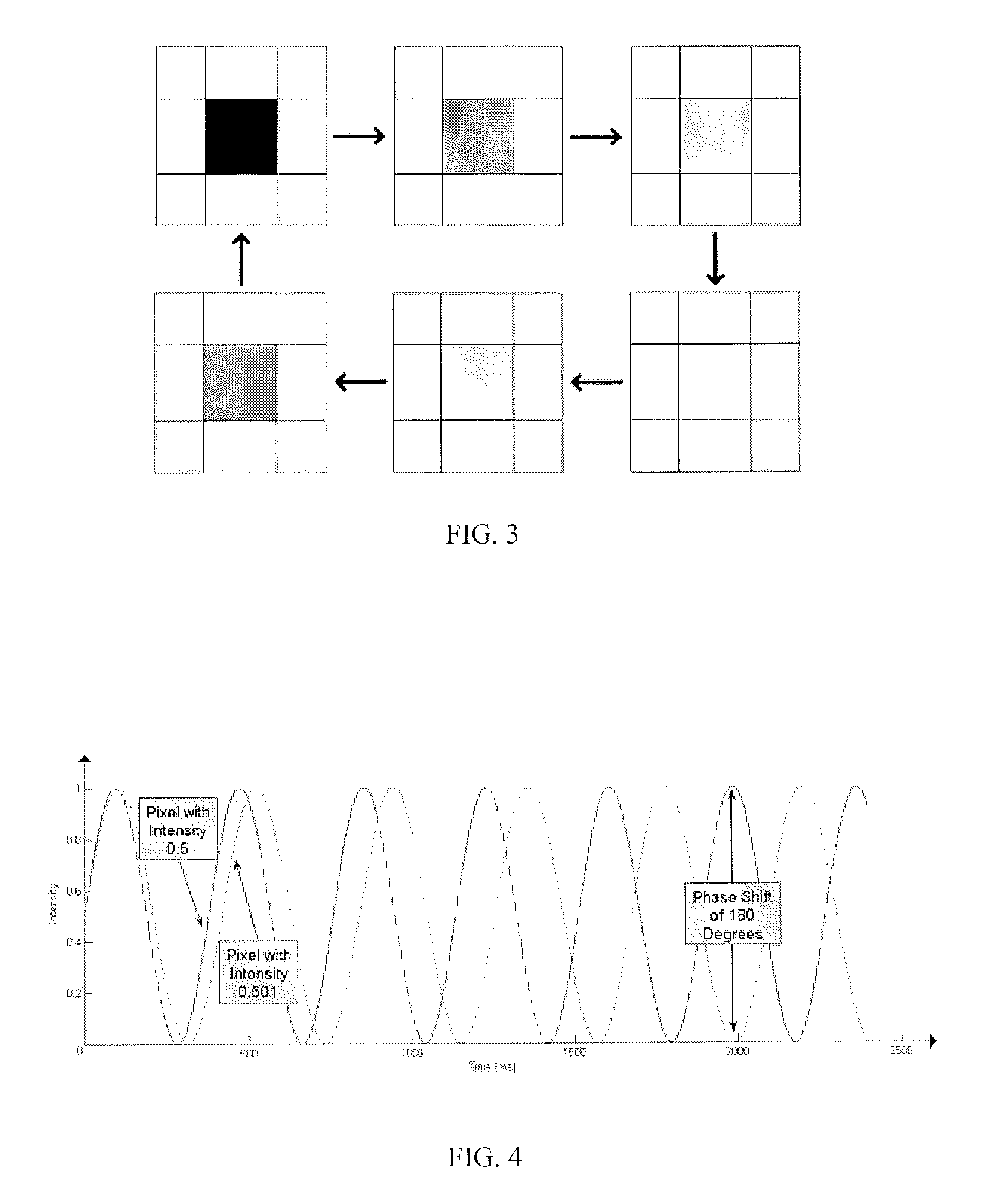
[0026]Two kinds of dynamic cues are utilized: spatial movement (the pixel is moved around in some fashion) and temporal variation of the intensity at a fixed location (there is no change in position, only in its intensity). Spatial motion can be understood as the name implies, as objects moving in space throughout the frames. In the present invention, the objects to be moved will be the pixels (picture elements). The concept of temporal motion refers to a pixel not moving in space but changing its intensity in time.
[0027]The definition of the motion is described by a “motion function,” which expresses mathematically the ki...
PUM
 Login to View More
 Abstract
Description
Claims
Application Information
 Login to View More