
Children's riding device
a technology for children and riding devices, applied in the field of children's riding devices, can solve the problems of not having a vast amount of such devices for younger children or babies, unable to be trusted to operate small vehicles without direct supervision, and devices, although almost staples among younger children, are in fact rudimentary in operation and design, so as to facilitate the up and down bouncing motion, and facilitate the rocking motion
- Summary
- Abstract
- Description
- Claims
- Application Information
AI Technical Summary
Benefits of technology
Problems solved by technology
Method used
Image

Examples
Embodiment Construction
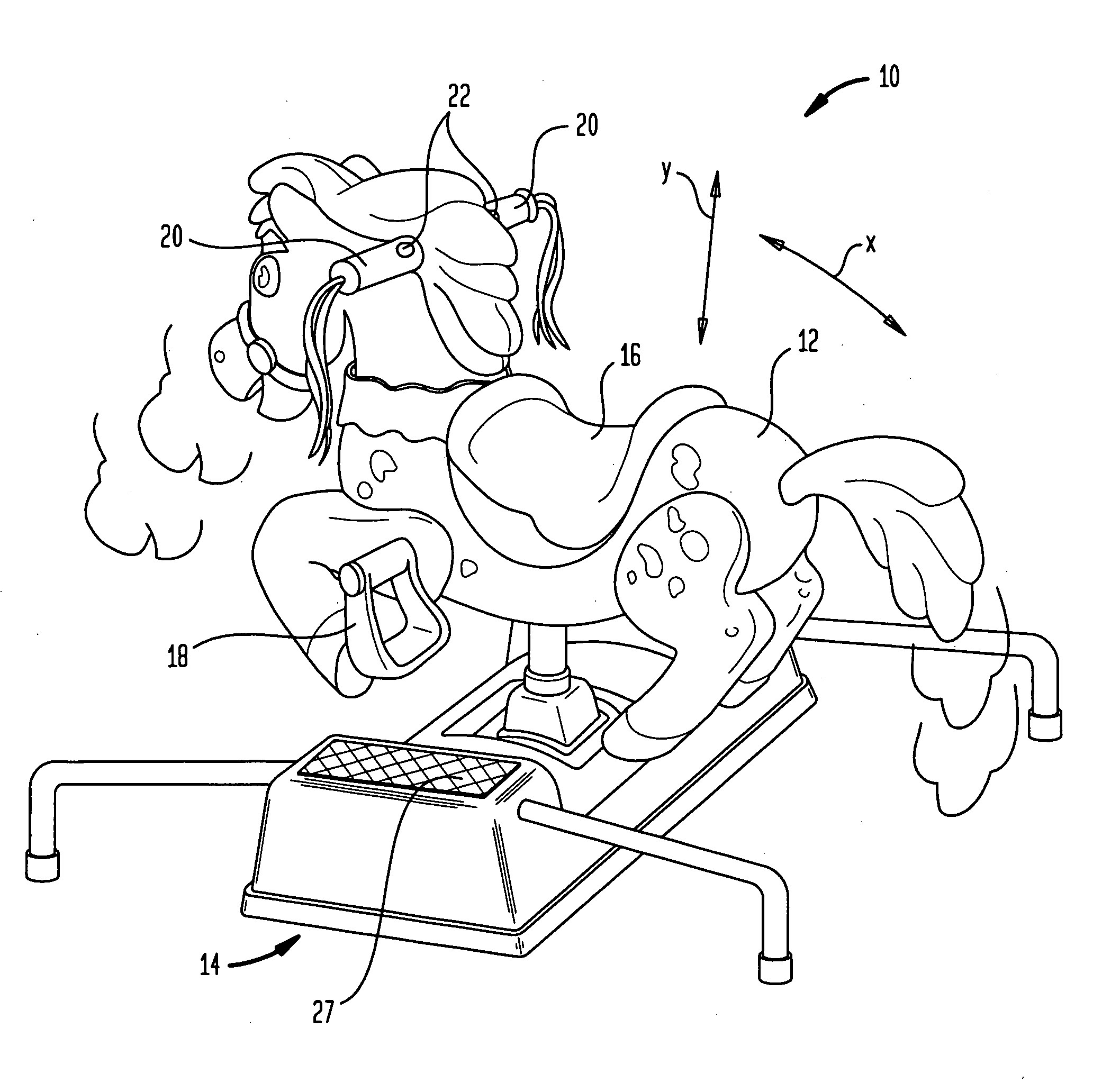
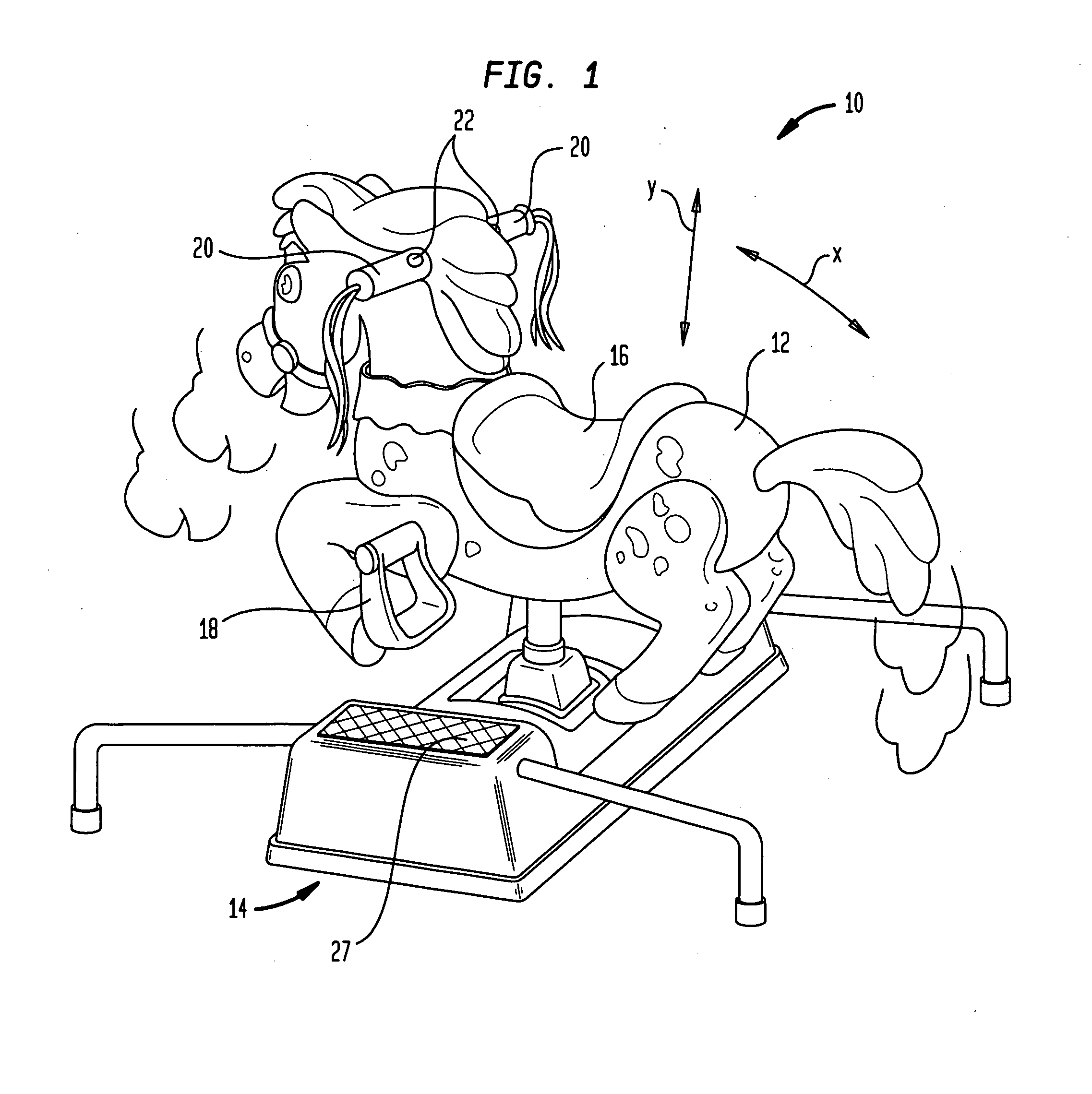
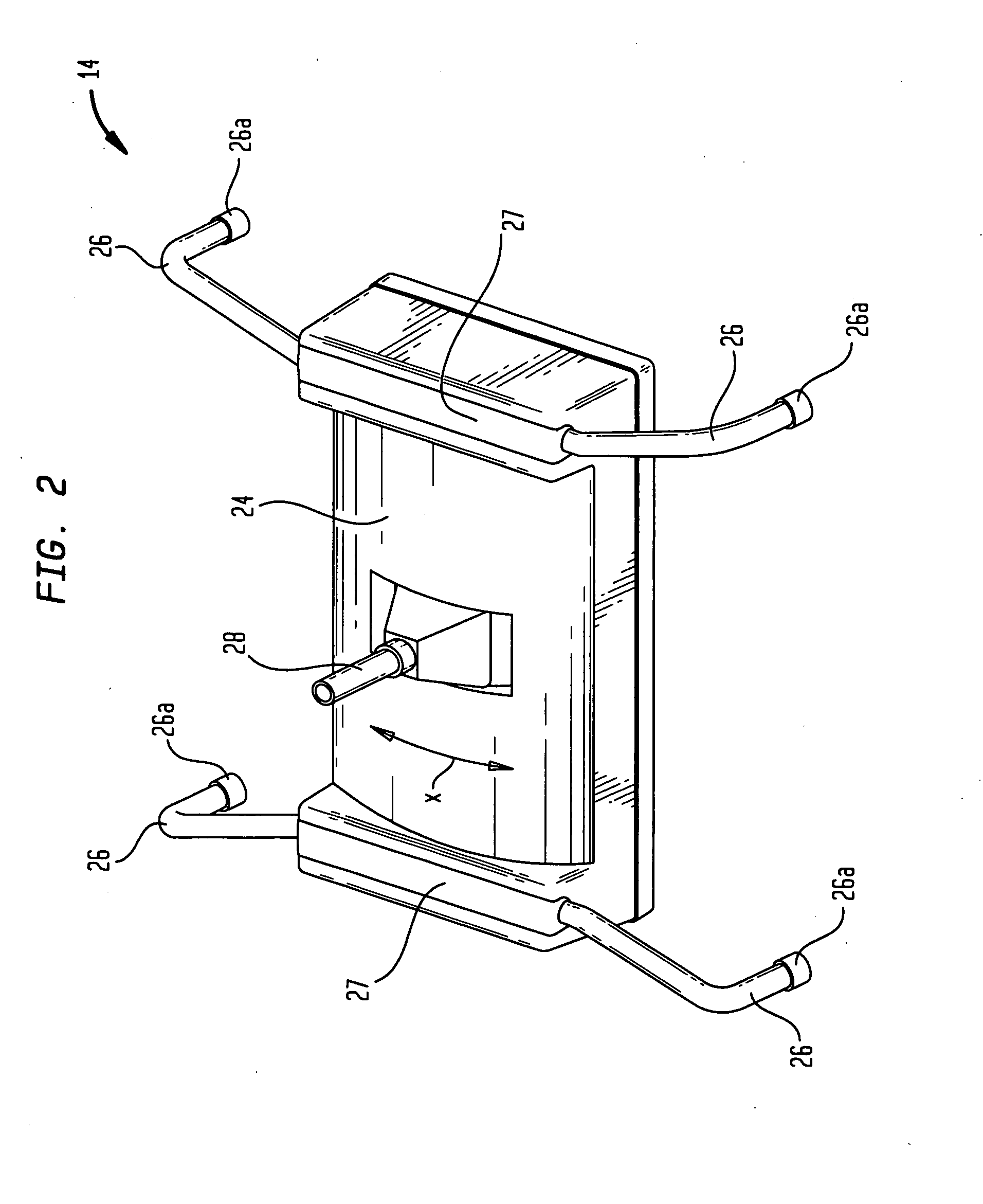
[0028]Referring to the drawings wherein like reference numerals refer to like elements, there is shown in FIG. 1, in accordance with one embodiment of the present invention, a children's riding device or apparatus designated generally by reference numeral 10. In the embodiment shown in FIG. 1, riding device 10 preferably includes a seat portion 12 and a base portion 14, as well as the individual components which make up each of those portions. Such will be elaborated on further below. Although riding device 10 is shown and described below as being designed for use by a child, it is to be understood that other embodiment devices may be adapted for use by larger persons. In such cases, larger scale devices may simply be provided in order to accommodate larger individuals. Of course, larger scale devices will necessarily be more difficult to transport and therefore position. In addition, as will be further expounded upon below, device 10 can be provided so as to emulate many different ...
PUM
 Login to View More
 Abstract
Description
Claims
Application Information
 Login to View More