Method for image reconstruction using sparsity-Constrained correction

a sparsity-constrained correction and image technology, applied in the direction of instruments, nuclear engineering, material analysis using wave/particle radiation, etc., to achieve the effect of accurate representation

Active Publication Date: 2010-01-07
THE BOARD OF TRUSTEES OF THE UNIV OF ILLINOIS
View PDF6 Cites 7 Cited by
  • Summary
  • Abstract
  • Description
  • Claims
  • Application Information

AI Technical Summary

Benefits of technology

This approach significantly reduces computational requirements, enabling faster image formation and reconstruction while maintaining accuracy, thus improving the economic feasibility of iterative methods and enhancing image quality.

Problems solved by technology

One problem of tomographic reconstruction is to reconstruct a 2D or 3D image from a set of its line-integral projections.
Another problem of tomographic reconstruction is to reconstruct a 3D image from a set of its surface-integral projections, that is, its integrals on a family of surfaces.

Method used

the structure of the environmentally friendly knitted fabric provided by the present invention; figure 2 Flow chart of the yarn wrapping machine for environmentally friendly knitted fabrics and storage devices; image 3 Is the parameter map of the yarn covering machine
View more

Image

Smart Image Click on the blue labels to locate them in the text.
Viewing Examples
Smart Image
  • Method for image reconstruction using sparsity-Constrained correction
  • Method for image reconstruction using sparsity-Constrained correction
  • Method for image reconstruction using sparsity-Constrained correction

Examples

Experimental program
Comparison scheme
Effect test

Embodiment Construction

Symbols and Fonts

[0052]The following system of mathematical symbols and fonts will be used to improve clarity.

[0053]Functions in the space domain are denoted by small letters (e.g. f(x)), while their Fourier transforms are denoted by capital letters (F(ω)).

[0054]The indices of two-variable functions are denoted variously, depending on convenience. The following three notations of function f are equivalent: f((x1, x2), f({right arrow over (x)}), and

f([x1x2]).

[0055]Continuous-domain and discrete-domain functions respectively are distinguished by the style of parentheses used with their indices: f(x1, x2) is a function of two continuous variables (i.e., x∈), and f[m1, m2] is the sampled version of f({right arrow over (x)}) and is therefore a 2-D array.

[0056]A linear operator and its corresponding matrix are distinguished by the font style. Suppose (A∈) is a matrix, then is its associated linear operator. For example, if A is a coordinate transformation, g({right arrow over (x)})=() ({...

the structure of the environmentally friendly knitted fabric provided by the present invention; figure 2 Flow chart of the yarn wrapping machine for environmentally friendly knitted fabrics and storage devices; image 3 Is the parameter map of the yarn covering machine
Login to View More

PUM

No PUM Login to View More

Abstract

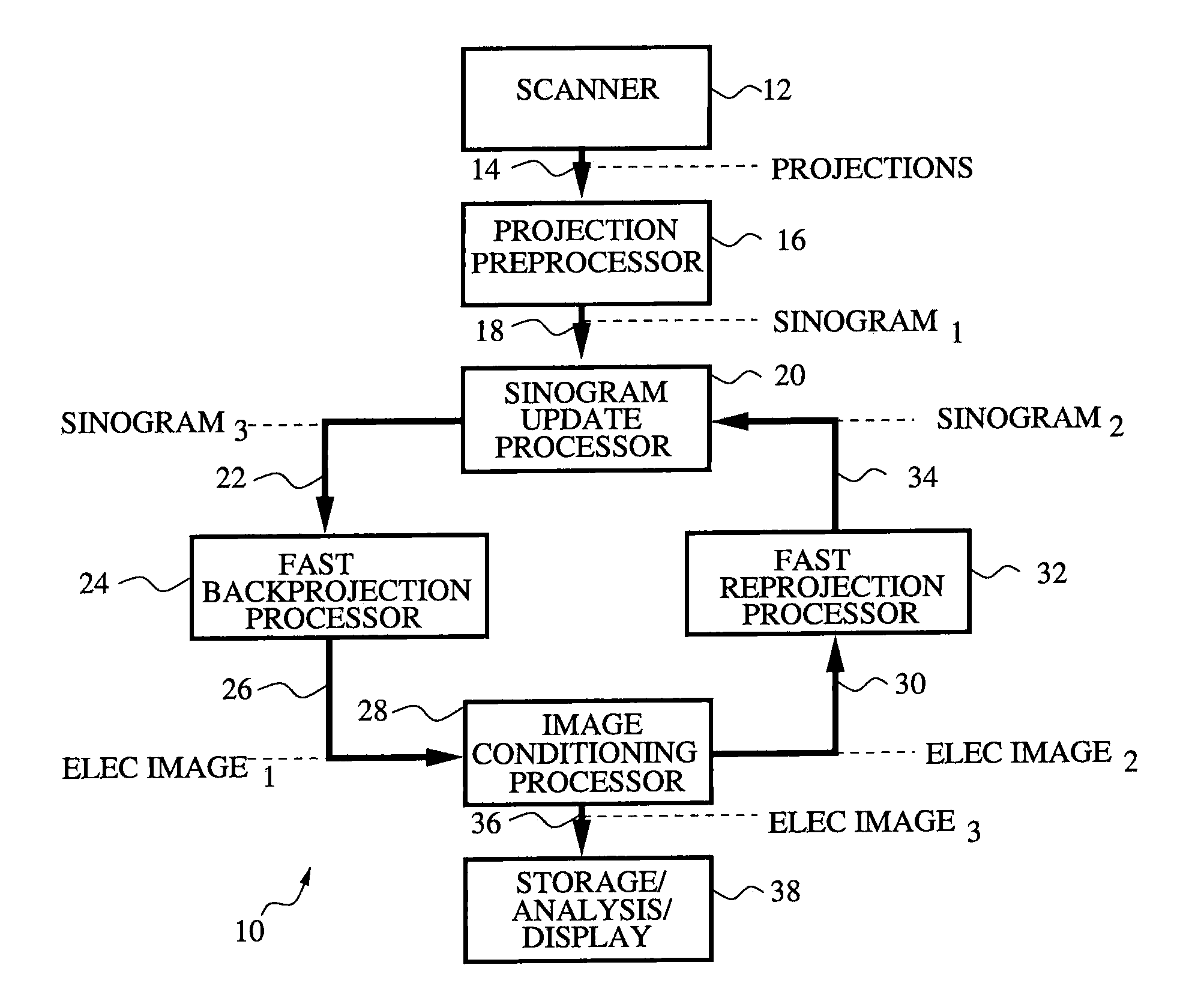
Pixel images {circumflex over (f)} are created from projections (q1 . . . qp) by backprojecting selected projections to produce intermediate images (Il,m), and performing digital image coordinate transformations and / or resampling on selected intermediate images. The digital image coordinate transformations are chosen to account for view angles of the constituent projections of the intermediate images and for their Fourier characteristics, so that the intermediate images may be accurately represented by sparse samples. The resulting intermediate images are aggregated into subsets, and this process is repeated in a recursive manner until sufficient projections and intermediate images have been processed and aggregated to form the pixel image {circumflex over (f)}. Digital image coordinate transformation can include rotation, shearing, stretching, contractions. Resampling can include up-sampling, down-sampling, and the like. Projections can be created from a pixel image ({circumflex over (f)}), by performing digital image coordinate transformation and / or resampling and / or decimation re-projecting the final intermediate image.

Description

[0001]This application is a continuation of U.S. patent application Ser. No. 10 / 570,020, filed Feb. 28, 2006, which is incorporated herein by reference in its entirety, and which claims the benefit of U.S. Provisional Patent Application Ser. No. 60 / 501,350, filed Sep. 9, 2003, which is also incorporated herein by reference in its entirety.[0002]This invention relates to tomography, and more particularly, to methods and apparatus for creating pixel images from projections.BACKGROUND OF THE INVENTION[0003]Tomographic reconstruction is a well-known technique underlying nearly all of the diagnostic imaging modalities including x-ray computed tomography (CT), positron emission tomography (PET), singly photon emission tomography (SPECT), and certain acquisition methods for magnetic resonance imaging (MRI). It also finds application in manufacturing for nondestructive evaluation (NDE), for security scanning, in synthetic aperture radar (SAR), radio astronomy, geophysics and other areas.[00...

Claims

the structure of the environmentally friendly knitted fabric provided by the present invention; figure 2 Flow chart of the yarn wrapping machine for environmentally friendly knitted fabrics and storage devices; image 3 Is the parameter map of the yarn covering machine
Login to View More

Application Information

Patent Timeline
no application Login to View More
Patent Type & AuthorityApplications(United States)
IPC IPC(8): G06K9/36G06K9/32G06K9/00G06TG06T11/00G06T15/08
CPCG06T11/006G06T2211/428G06T2211/421G06T15/08
InventorGEORGE, ASHVIN K.BRESLER, YORAM
OwnerTHE BOARD OF TRUSTEES OF THE UNIV OF ILLINOIS