

Memory device and control method thereof
a memory device and control method technology, applied in the field of memory devices having nonvolatile semiconductor memory, can solve the problems of reducing file rewrite speed and increasing overhead
- Summary
- Abstract
- Description
- Claims
- Application Information
AI Technical Summary
Benefits of technology
Problems solved by technology
Method used
Image



Examples
first embodiment
[1] Arrangement of Memory Device and Host Device
In this embodiment, a memory card will be exemplified as a memory device. A memory card is designed to be, e.g., attachable to a host device. However, the present invention is not limited to this. A memory device and a host device may be formed as one large-scale integrated circuit (LSI) or LSI package. More specifically, a controller and a nonvolatile semiconductor memory included in a memory device may be mounted on a printed circuit board with a host device.
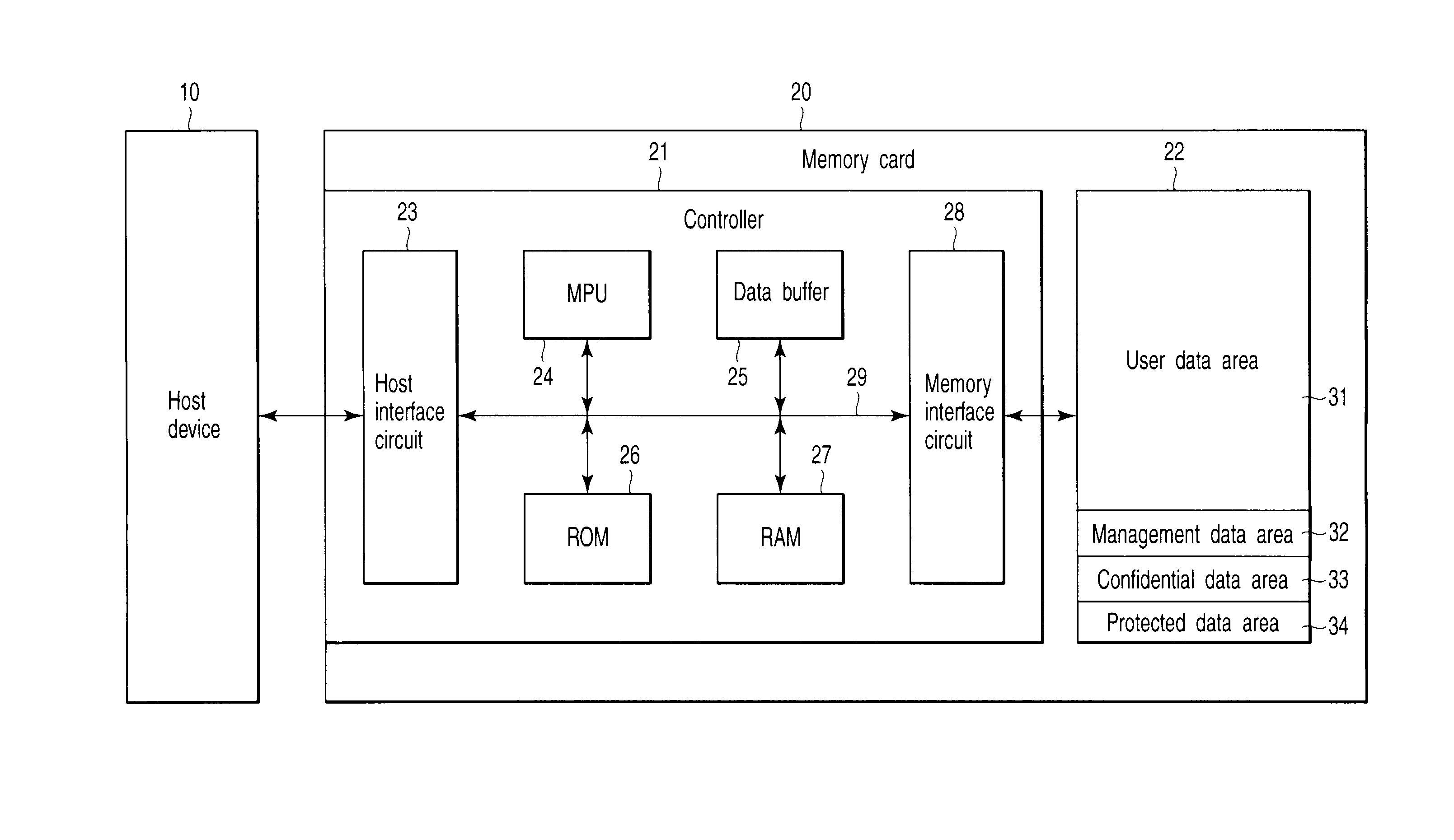
FIG. 1 is a block diagram illustrating the arrangement of a host device 10 and a memory card 20 according to the first embodiment of the present invention. The memory card 20 is attachable to the host device 10. The memory card 20 is normally attached to the host device 10 and used as a kind of external storage medium of the host device 10.
The memory card 20 includes a nonvolatile semiconductor memory 22. In this embodiment, a NAND flash memory 22 that is a kind of electrically e...
second embodiment
FIG. 16 is a view illustrating the structure of a user data area 31 recognized by a host device 10 when a file system complying with the UDF is applied to a memory card 20 (i.e., when a flash memory 22 is formatted by the UDF). As shown in FIG. 16, the host device 10 appends data to the above-described user data area 31 of the storage areas of the memory card 20.
When the host device 10 writes data in the memory card 20 by the UDF, data are sequentially written as packets from the lower address to the higher address of the user data area 31 on the side of the memory card 20. Every time a file is updated, the VAT is updated, and the updated VAT ICB is written at the final write position. To access a written file, the host device 10 must confirm the position where the VAT ICB is written and read the VAT ICB.
When a file is repeatedly updated, a plurality of VAT ICBs are created in the user data area 31. In the example shown in FIG. 16, a file is updated twice, and accordingly, three VAT...
third embodiment
In the third embodiment, a flag is written in the redundant area of a user data area 31. VAT ICB position information is acquired by using the flag. That is, it is possible to acquire VAT ICB position information by using not a management data area 32 but only the user data area 31.
FIG. 19 is a view illustrating the structure of the physical blocks of a NAND flash memory 22. For easy understanding of the invention, the number of physical pages included in a physical block in FIG. 19 is smaller than actual. In this embodiment, the user data area 31 in the NAND flash memory 22 stores the flag to be used for searching for a VAT ICB that is normally written in the past.
Each physical page included in a plurality of physical blocks corresponding to the user data area 31 has a redundant area 35. Part (e.g., 2 bits in this embodiment) of the redundant area 35 stores a flag representing “written” or “unwritten”. There are prepared three kinds of flags: a flag (“11”) representing “unwritten” ...
PUM
 Login to View More
 Abstract
Description
Claims
Application Information
 Login to View More